Apr 29, 2008

Super Star of Cyrene has a name!

Just heard from Sijie that the Star of Cyrene has been tentatively identified as Pentaceraster mammillatus by Dr. David Lane. Sijie adds in his updated nature scouter blog entry:

Its distribution is that of Indian Ocean, but apparently with its appearance in Singapore, it has expanded its range. It is usually found in lower eulittoral and deeper region, on sand and seagrasses. However, the taxonomy of this group has some uncertainties, with gradations between species, possible hybrids and a closely related form living in the Philippines region.
Some of the volunteers have been calling it the Black Evil Star, because it is so different from our more commonly seen lovable cuddly Knobbly sea stars (Protoreaster nodosus).The Special Star has a much more regular pattern and is dark so I guess it does appear rather sinister compared to the bright red and rather cartoon-like Knobbly.It's the first record of Pentaceraster on Singapore's shores so this suggests Cyrene Reef is a special place. We're all very excited by this! Bravo!

Nature Photography at Sungei Buloh by Jeremy Ang

I spent a delightful afternoon at Jeremy Ang's talk on nature photography.Jeremy is a fabulous photographer and so far I've only seen glimpses of his wonderful work.

He covered lots of issues including what's there to shoot at Sungei Buloh (LOTS, and not just birds). As well as how to be a good nature photographer. Not just to take good photos, but also to take good care of our nature places.
We then gawked at wondrous images of long-legged beauties. (These grabbed shots by a dinky camera like a bad video pirate operator don't do justice to Jeremy's wonderful work. So please ignore poor quality of these blogged photos.)

Jeremy emphasised the role of bird photography in better understanding our birds. For example, he encouraged photographers to share with Sungei Buloh Wetland Reserve any photographs of birds with flags or rings.Such photographic records will allow a better understanding of the birds at the Reserve. So don't just take a pretty photo but understand the subject and share the photos!

Besides beautiful photos of shorebirds in action, and raptors in flight and all kinds of other birds, Jeremy also shared photos of SEX! Monitor lizards as well as this menage d'trois of Atlas moths.There were also photos of snakes eating all kinds of things including Jeremy's subject, a frog!

Not forgetting our favourite marine creatures such as the Amazing Mud Lobster!There's a story behind this (and the other photos) that you'll just have to ask Jeremy to tell you himself.

My second favourite photo is this bashful little colourful fiddler crab!Of course my all time favourite were his photos of Smooth Otters at the Reserve!He enthralled with stories of otter sightings as recent as last Friday! And antics of the otters including the odd habit of rolling about in sand after a swim, including rubbing their faces in the sand. (Some of us ladies in the audience think it might be some kind of otter exfoliation treatment.)Also stories of how they hunt and interact in a family and more.

Wow! Aren't our shores and mangroves simply amazing!

Thank you Jeremy for a wonderful afternoon of photos, stories and thoughts about nature.

And we all hope we see MORE of your photos online SOON! (hint hint)

More otter photos by Jeremy on the Sungei Buloh Wetland Reserve website.

Here's Jeremy checking out Shufen's photos after the talk.

Works on new Sentosa Bridge: MPA notices

PORT MARINE NOTICE NO. 89 OF 2008 28 Apr 08

Resorts World at Sentosa – Construction of a New Bridge from Singapore Island to Sentosa

With effect from 01 May 08 to 31 Oct 08, at Selat Sengkir.

New bridge construction works will entail steel pipe piling, drilling and socketing of piles and removal of rocks from pile locations. Crane and work barges will be used for the piling works and transportation of equipment. Barges will travel through the Selat Sengkir water to the working area. Barges are expected to travel in/out of the Selat Sengkir water up to 4-6 times a week for material delivery and equipment transportation. A safety boat will be deployed to advise all craft to keep clear of the working area. Further enquires relating to the project can be directed to Mr Chris Kelly, the project manager, at Tel: 9118 2802, email: chris_kelly@macdow.com.au .
from PORT MARINE NOTICE NO. 90 OF 2008 28 Apr 08

Proposed Resorts World at Sentosa: The New Bridge; Widening of the Existing Causeway and
Causeway Extension Works

With effect from 01 May 08 to 31 Oct 08, at Cruise Bay, off Sentosa.

Widening works will entail steel pipe piling and removal of existing revetment. Crane barges and work barges will be used for the piling works and transportation of equipment. A safety boat will be deployed to advise all craft to keep clear of the working area. Further enquires relating to the project can be directed to Mr Chris Kelly, the project manager, at Tel: 9118 2802, email: chris_kelly@macdow.com.au .

Reclamation at Pulau Tekong: MPA notice

MARITIME AND PORT AUTHORITY OF SINGAPORE
from PORT MARINE NOTICE NO. 92 of 2008 29 Apr 08

This is a revision of Port Marine Notice No. 176 of 2007 (extract in this wildfilms post). The working period has been extended. With effect from 29 May 08 to 28 Nov 08, Off Pulau Tekong.

24 hours daily including Sundays and Public Holidays.

Reclamation works at Pulau Tekong will involve dredging, construction of revetment, soil investigation and soil improvement works. Soil improvement works will entail sand piling and deep cement mixing. Trailer-suction-hopper dredgers (TSHD) will be used for transporting and pumping sand into the working area. Safety boats will be deployed in the vicinity to warn other craft of the operations in the area. Further general enquiries relating to the project can be directed to Mr R Kamata, the construction manager, at Tel: 9624 8603, email: ryuji_kamata@tjput.com.sg.


Pulau Tekong is just off Chek Jawa, Pulau Ubin.

Apr 27, 2008

Talk on Cyrene Reef by Ria Tan on 3 May (Sat): 2pm at the Botanic Gardens

Get a sneak peek at mysterious Cyrene at Ria's public talk this Saturday!

She will feature the amazing marinelife on this submerged reef in the middle of our port.

Highlights include the stunning Star find at last week's trip as well as the volunteers working for this shore.

She will also be sharing about our many marvellous but little known shores from Changi to Tuas, Sentosa to the Sisters Islands and beyond. Nemos, sea snakes, living corals and more.

"Secret Shores of Singapore" by Ria Tan
Date: 3 May (Sat)
Time: 2-3pm
Venue: Botany Centre, Singapore Botanic Gardens
Website: http://www.nbrcnparks.org/
Contact: Wei Ling LIM lim_wei_ling@nparks.gov.sg

More details on the wild happening blog http://wildsingaporehappenings.blogspot.com/.

See also the "I want to go Cyrene!" facebook group

Chek Jawa and hornbill babies with Outward Bound

Bright and early, was off to Pulau Ubin again.Unfortunately, the dredger is still at Changi Creek...sigh.First things first, the Sunday-only and Ubin-only Lontong at Pak Ali's stall next to Ubin Jetty overlooking the Ubin Info Kiosk.And how nice today, to see Pak Ali and Macik at the stall. Both looked very fine! Macik hadn't been well for a while.

Soon, the OBS team and July arrived, we ate some more and then headed off to Chek Jawa. It was great to have July with us to share about the mangroves.And the nipah palms and mudlobster.And seagrasses and lots lots more.We came across Cynthia and her team, studying Littorinids (i.e., periwinkle snails) on Chek Jawa.As well as a family having a picnic on the shore...Here's a closer look at them...Alas, I noticed quite a bit of fresh litter along the boardwalk at the mangroves.This didn't wash up with the sea tide, but probably brought in by the tide of visitors.It was a scorching day, but most enjoyable sharing with yet another enthusiastic and fun bunch of OBS folks.They certainly set the standards for lively group photos!

They also shared some wonderful entries to the Naked Hermit Crab guestbook! More on the adventures with the naked hermit crabs blog.

On the way home, we stopped by at the Volunteer Hub where Uncle Mark shared what was seen on the camera at the hornbill nest box put up for a study of these wonderful birds.Wow, this is way cool. There were clips of the very dedicated dad feeding the mum who was sealed into the box with her babies. He fed her bananas and papaya as well as protein like insects and lizards and even other birds and their eggs.

Then we headed out to have a look at the nest box.And he shared more about how the study is being conducted.The artificial nest box is working very well and there are now 12 chicks some of which have already successfully left the nest. Bravo!

More about the Ubin Hornbill project on Ubin Tides

As the OBS team stopped by at Ubin Green House run by the Green Volunteers Network, we bid them farewell.
We headed for a quick lunch and to meet up with the rest of the Naked Hermit Crabs who valiantly went on to the 3pm public walk at the boardwalk. I was lame and headed home. It's been a long and exciting week of low tides. Tired but looking forward to the next series.

Apr 25, 2008

Stars of Cyrene

We were out again this morning with Dr Lane to search for echinoderms, in particular, a Special Star that was seen two weeks ago.

We saw lots of wonderful stars and stuff (see links to more blog entries of the trip below).

But to me, these are the true stars of our shores!
The valiant volunteers who turned up in force to help in the search. And our hero is Vyna (here, the rose among the thorns) who in the last minutes of the dying low tide, found The Star!

Like paparazzi, everyone crowded around to have a shot at The Star.It was a real squeeze and poor Jerald couldn't get past the huddle.And what's the fuss about?

This!A beautiful jewelled star (Pentaceraster sp.) that resembles our more commonly seen Knobbly sea star (Protoreaster nodosus), represented by the small star in the photo. The small Knobbly was unceremoniously tossed aside as everyone focused on The Star.

Why is The Star so special?

Because Dr Lane says it's the first record of it in Singapore!

Unfortunately for The Star, fame means eternal glory in the collection of the Raffles Museum of Biodiversity Research. Other interesting observations today: Dr Lane pointed out that the huge bobbly snaptid sea cucumbers that we commonly see among the seagrasses...Have itty bitty crustaceans on them!!They were really tiny and hard to photograph. Amazing!

Dr Lane also explained that not all the big black long-spined sea urchins that we see are necessarily Diadema setosum just because they have an orange ring on the anal cone.He says this one could be Diadema savignyi as it has shorter spines and has blue lines on the body!Jerald also found a Knobbly eating something, and we show it to Dr Lane.Everyone finds all kinds of echinoderms.

Robin found the Cake sea star (Anthenea aspera), Sam found a baby Cushion star (Culcita sp.), Heok found a red feather star which later was found to have a black bristleworm-like thing on it. And probably lots more that I missed out on (check out the links to blog entries below).

And everyone saw lots of Knobbly sea stars of all colours, sizes and knob patterns.
There were also sand dollars, sea urchins, sea cucumbers, and lots and LOTS of Common sea stars (Archaster typicus).

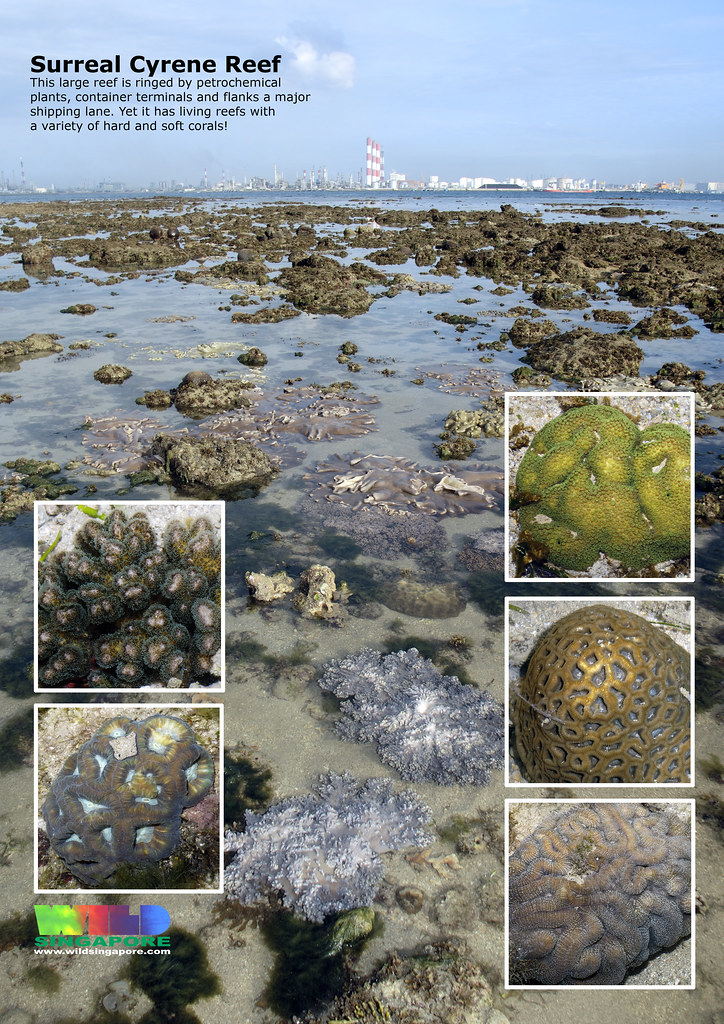
This is quite amazing given the proximity of this submerged reef to the major industrial installations on Jurong Island and Pulau Bukom.Right smack next to major shipping lanes with humungous ships like this car-carrying ship passing close by.And just overlooking the container terminals and the city on the mainland.Well back to the stars.

They are unstoppable. All ready for action even before sunrise.Unfazed when told they need to work on a reef that only briefly shows above water during a short window of low tide.And requires an amphibious landing that involves leaping off a tiny boat.The volunteers have strange rituals, such as worship of the GPS Gods.But most importantly, our star volunteers need to eat.

Before the trip.And definitely after that...don't disturb them while they're feeding.Thanks to everyone who came today: Vyna, Andy, November, Marcus, Liana, Sijie, Kok Sheng, Jerald, Sam, Siti, Wei Ling, Robin and Dr Tan Heok Hui. And of course, Dr Lane for sharing so much with us.

More behind-the-scenes efforts: Intrepid volunteers during a TeamSeagrass visit first saw The Star. It was found by none other than our best hunter seeker: Chay Hoon. Marcus brought The Star's discovery to the attention of Dr Lane, and thus sparked off this trip. Kok Sheng also organised the hunt today to ensure there was as complete a search as possible despite the short low tide. And Sijie mobilised support in collection and follow up with the media. Look out for a story about this soon! And all this would not have been possible without the friendly and able support from the Dolphin crew.

Many hands and hearts come together to make discoveries possible.

Links to more blog entries about this trip

ACT for Cyrene!

Apr 24, 2008

Searching for Spawning on Sentosa

Back on the shore early this morning with TeamSeagrass to do a quick check-up on one of Sentosa's last remaining natural shores.
We were a little late starting off, so we rushed out to get the job done as the tide was already starting to come in. After the work is done, we have a quick look around at the shore.

MASS spawning of corals is expected among our corals RIGHT now. So I had a very close look at the hard corals on the shores.Hmm....do you see anything engorged or lumpy or like about to burst in a sexual frenzy?Sigh. Doesn't look very different from the usual state. To me anyway.

How about this one?...Hmmm...The water was getting high, and well, I don't really know what I'm looking for.
This one certainly doesn't look exciting or excited.

I guess we'll just have to wait and see what Debby and the hantu bloggers find out when they do their spawning dive tonight. All the best guys!

And in case you DON'T believe that our corals do have frenzied orgies of sex, here's a post about last year's mass spawning on the hantu blog which quotes Wai's fabulous spawning log 1 and spawning log 2.

By this time, the tide has started to come in with a vengeance so we check out the high shore. Under rocks is a good place for small animals to hide.There are little snails and oysters and a small cowrie!
Unfortunately, we saw a lot of stones obviously turned over and not turned back. Unlikely to be due to waves. Possibly people have come by to harvest marine life. We've seen people collect snails on this and Labrador shore as well.

On the coastal forest that hugs the beautiful natural cliffs were curtains of enormous pitcher plants!The pitcher is actually a modified leaf that has become a container to trap unwary insects!

If you'd like to see these and MORE marine life on this Sentosa shore, join the Naked Hermit Crabs on their upcoming Sentosa family walk tentatively scheduled for the June holidays.

Our little expedition is cut short as a storm front develops right before our eyes!
But just as I was scurrying back, I noticed something bright and colourful in our favourite 'Tongkat Ali' plant, a well known aphrodisiac.Could it be the fruits of the 'Tongkat Ali'? Or do the fruits belong to the vine entwined around the plant?

So much more still to learn about our shores!

But right then, it was time to HURRY back before the heavens opened up.I hope we get better weather tomorrow :-(

Afternote: Alas, no spawning was sighted at Pulau Hantu. But lots of other sightings including sea turtle! more on the colourful clouds blog and hbing's blog

Apr 23, 2008

Ferry-tale solution to Singapore's land transport issues?

Another proposal that seems to ignore physical and current realities ...

Tired of jammed roads? Go to work by sea instead
Letter from Clinton Lim Eng Hiong, Straits Times Forum 23 Apr 08;

ON SATURDAY, it was reported that there were 4.779 million train and rides a day in the first quarter, up 7 per cent over last year ('Buses, MRT see jump in ridership'). While the growth in public transport ridership is significant, it is not known if the rise has been at any real expense to car trips.

With more than 800,000 cars on the roads currently, the intention to increase the population to 6.5 million could well put another 250,000 or more vehicles on already congested roads.

The Land Transport Authority has taken action to manage traffic congestion in the city during peak hours by ensuring vehicular growth is met by a corresponding increase in the number of expressways, tunnels, MRT lines, electronic road pricing (ERP) gantries and charges.

After many years in service, I wonder if ERP is effective in alleviating traffic congestion or is it just 'rearranging furniture'.

In land-scarce Singapore, do we fully harness all resources available to meet public transport challenges? I think not. So far, we have looked only landwards. We need to take a more holistic, innovative approach - by looking to the sea.

Singapore is, after all, an island. Why not explore the idea of ferrying thousands to and from work daily via a Park 'n' Cruise scheme, to supplement the existing rail and road transport system?

This refreshing mode of transport will be guaranteed not to encounter traffic jams, be squeezed out of bus lanes or cause the motorist to be fined for not having a valid CashCard as he passes the ERP gantry.

With the Government providing the infrastructure - carparks and ferry terminals - the bus shuttle service and plying the route can be left to private enterprise.

I can already envisage Clifford Pier and the soon-to-be- made-over Singapore Cruise Centre at HarbourFront as two hubs of this ferry service, with terminals stretching from Woodlands to Punggol, Pasir Ris, Tampines, Bedok, Siglap, Marine Parade and West Coast, for a start.

I hope any feasibility study of this suggestion will be favourable, enabling at least part of our transport system to be left perpetually in 'cruise control'. This will also contribute to the Government's expectation that, by 2020, 70 per cent of trips in the morning peak period is by public transport.
Is it shorter to go by sea?

Singapore is a lozenge-shaped island. And the land causeway between Johor and Woodlands prevents sea transport between the east and west via the Johor Straits.

As a result, for most points of urban concentration near our coast, it is shorter to go by land than by sea. A quick look at a map of Singapore will clearly demonstrate this.
In most cases it is LONGER to go by sea. For example from Punggol to Jurong, a sea route requires travelling almost the entire circumference of our island, including all the bits jutting out due to recent reclamation.

Elsewhere in the world, ferry transport makes sense when the distance across water is shorter than by land. For example, across a large bay or across a wide river. In such instances, ferry transport makes sense also because it avoids the investment in infrastructure such as bridges.

Is it quicker to go by sea?

While you might imagine there is no congestion at sea, there are safety protocols and sea lanes laid out in our very busy port and shipping lanes that will affect speed and routes (you can't simply travel the shortest route across the water) .

Weather also more seriously affects speed in sea transport than land transport. Even a windy day can result in very choppy water that most land lubbers may not stomach.

Sea-going vessels are generally not as fast as cars on a road. Small boats are slow and less stable, resulting in a ride that may not suit most land lubbers. Some urbanites find difficulties even taking the short 10-minute boat ride from Changi to Pulau Ubin.

High speed ferries are of course available but these produce wake (big waves).

High wake disrupt other vessels and result in shore erosion. Many of our coasts, notably the long East Coast, are already suffering from extensive erosion.

For these reasons, it can be expected that such vessels will not be allowed to attain top speed until they are some distance from other vessels and shores that might be impacted. This adds further to the distance to be travelled, and time taken. Because they will literally have to crawl at low-wake speeds for portions of the route where they are close to other vessels or sensitive shores.

High speed ferries are also large and require deep water and proper jetties for safe transfer of passengers. Creation and maintenance of such areas will involve regular dredging which will affect water quality and thus the coastal environment.

Other problems with the letter

Clifford Pier has been closed since Apr 06 with the construction of the Marina Barrage. The Pier has been replaced by the Marina South Pier.

The West Coast coastline is highly congested and it seems unlikely that deepwater access with good land links can be freed up easily. In fact, many existing old piers along that coast had been shut down in the past.

The author clearly doesn't really have a sound grasp of the current situation along our coast and the realities of our island geography.

Apr 22, 2008

Remembering Darwin

Dear all, I came to learn from the Newpaper about the sudden loss of our fellow crew member, Darwin.

Darwin has passed away on last Sunday, 20th April after falling into the sea while wakeboarding.

Darwin joined the team in 2005. Although he had not been with us for most of the trips, he always bring laughter to us whenever he was there. We used to tease him about being an "arms dealer" because he was so secretive about his day job.


Here's Darwin(center in the pic) with us on a trip to the Lim Chu Kang mangroves.

He was forever cheerful is what I remembered of him. And the crews will definitely remember the trips that he had been with us.

Outside Wildfilms, he had touched many lives too. Here's two posts by his friends about him:

a) Life is fragile by Consider Contentment
b) Goodbye my friend by nuei_nuei

and Darwin's final goodbye by Consider Contentment....

Our deepest condolences to his family.

Darwin, you will be remembered and be with us always whenever we are out at the shores.

RIP

Earth Day with Echinoderms at Pulau Semakau

Dr Lane, the expert in echinoderms is in town and asked to visit our shores to check up on our echinoderms. A bunch of intrepid volunteers happily obliged, even though it meant starting out at 4am this morning.

For some reason, it turned out to be more of a Mollusc Night.We saw not one but two cuttlefishes that adopted the same kind of posture when alarmed.Sticking out their tentacles in a branching manner. We're not sure why they do this, but it certainly makes them resemble boring seaweed rather than yummy sotong.

No night trip is complete without octopus sightings, and they were among the first to be spotted.Among the myriad colourful corals, hard and soft, amazing feathery fan worms, flat worms and fishes and other wonderful sightings (which hopefully the others will blog about), we did see a few echinoderms.

Of course the big red Knobbly sea stars (Protoreaster nodosus) were sighted.A nice red one spotted by Sam.
And a really big one by Marcus.

Sam later spotted a 'Garlic bread sea cucumber' our name for the Sandfish sea cucumber (Holothuria scabra). But I suspect he first saw the tiny nudibranchs that were on it.He also spotted another pair of these Chromodoris lineolata mating!

Ivan spotted a big fat bobbly synaptid sea cucumber, one of the many sightings on the trip.At daybreak, Dr Lane decides to check out the seagrass meadows to look for baby Knobblies which we often see in such habitats on Cyrene Reef.Sadly we didn't see any. But we did see lots of the Common sea star (Archaster typicus) almost all of them in mating position.It seems to be mating season on the reef! Debby and the Hantu Bloggers are planning a special trip to check out the mass spawning by our very sexy corals on 24 Apr. Can't wait to find out what they'll see.

In the seagrass area, Marcus and I encounter this humungous nudibranch with flowery bumps on it.It's very pretty indeed! I have no idea what it is.

Alas, we also encountered a driftnet.The guys release several crabs and other marine life before removing half of the net. It was too long to remove all of it.

Earlier on, we also came across a very dead 'Garlic bread' sea cucumber (Holothuria scabra). It was slit and its innards removed. This suggested that people were collecting and processing them on the shore. This one probably fell out of the bucket.

At daybreak, we also noticed that the ominous weather, which had put up a good light and sound show earlier (and which we ignored with determination), had moved off over the mainland. Phew.Daylight also revealed the impact of the petrochemical plants nearby.With the effects going high up into the sky.The boatman took the 'scenic' route home via Pulau Hantu. And we could see more of this special island, which is right next to major industrial installations.Despite this, the remaining natural shores of our Southern Islands are still rich in amazing marine life.

More about Singapore's echinoderms

Do have a look at Dr Lane's wonderful book on our echinoderms ...

Lane, David J.W. and Didier Vandenspiegel. 2003. A Guide to Sea Stars and Other Echinoderms of Singapore. Singapore Science Centre. 187pp.
The IYOR Singapore blog has feature articles on Singapore's echinoderms tooOther blog entries about this trip

Earth Day thoughts about our shores

Today is Earth Day. Although called Earth, our planet is mostly ocean.

And today seems a good time to review what we think about our shores, the place where earth meets ocean for ordinary people.

Singapore's shores are very much alive! As the many entries in this and other blogs attest.

It is thus with dismay that we read recent proposals to utilise our shores for large scale development including: building a strip of hotels at the East Coast (21 Apr), a huge artificial dam across Pulau Ubin and Pulau Tekong and the mainland (18 Apr), a Disneyland Sea in Singapore (9 Apr).

These proposals don't appear to embody an understanding of the impact of these developments to the quality of life for those who live nearby and to our natural heritage. And a true appreciation of the price and value of our shores.

What can be done about this?

Explore!

Visit your shores while you can. Join many of the activities and efforts to raise awareness of our reefs (see the exciting list below).

Express!

Speak up when proposals are made that don't seem to take full account of the situation. This is an opportunity to highlight all the critical issues. For example, Ivan's and other responses to the Tekong-Ubin proposal.

Act!

There are many groups working hard to raise awareness of our rich and living shores.

Last weekend, there was a turnout of many volunteers at ADEX to share our shores. Last Sunday, the Naked Hermit Crabs went on the Rouge talk show to highlight our shores. To highlight the imperiled Cyrene Reefs, a special reef in Singapore's port, last week November started the Cyrene Blogging Carnival to highlight blog entries about Cyrene Reef.

And upcoming this week, to celebrate Earth Day, the Hantu Bloggers will do a dive at Pulau Hantu to check out our coral spawning (yes, our reefs are not only very much alive, but also having great sex!).

While the NParks Conservation Division is launching a series of talks on our biodiversity, answering questions such as "Are there coral reefs in Singapore?" and sharing about Pulau Hantu.

The Naked Hermit Crabs meanwhile are doing a free public walk at the Chek Jawa Boardwalk.

Here's more Earth Day activities for our shores.

As part of International Year of the Reef, a great many groups and individuals are putting effort into highlighting our reefs and shores this year. Up ahead, Joseph Lai has put together the Dugong Ambassadors at Chek Jawa a fabulous events for kids to paint a mural at Chek Jawa and share about our shores.

Don't want to get your feet wet?

Support our shores from your armchair!
You CAN make a difference with a click!

Leave a comment about our shores on the International Year of the Reef guestbook. Every voice counts!

Join the facebook group called "I want to go Cyrene Reef!" started by November, which at last count has 129 members. To show that there are people who care enough to want to learn more about our reefs.

Our shores are wonderful, there is much to do for them!
More links
More on explore, express and act on the wildsingapore website.

Apr 21, 2008

Making money from our coasts and waterlines

There was another 'let's make money from our coasts' letter today ...

Create a 'Gold Coast' at East Coast Park
Letter from Michael Tan Jiak Ngee, Straits Times Forum 21 Apr 08;

I READ with interest that the Urban Redevelopment Authority (URA) is opening up land outside the central area (for example in Balestier) for hotel development.

I commend the move. It will help meet the high demand for rooms now and in the years ahead. It will also help to ameliorate the growing congestion in the Central Business District.

The choice and location of new tourism projects are significant for Singapore. I feel we can and should do more to exploit our valuable waterfront assets.

It is noteworthy that Sentosa has made successful inroads in the tourism sector and, lately, the luxury residential market. It is not by coincidence our two integrated resorts are situated near the waterfront.

I wonder if the URA and the Singapore Tourism Board have studied the feasibility of creating our own 'Gold Coast' at the East Coast Park.

It is an exquisite diamond waiting to be cut and polished.

The land area is massive, stretching from the Big Splash to the Lagoon, with lush vegetation and trees nestling the waterfront. It has all the qualities to be transformed into a major tourism/leisure hub with an array of iconic waterfront hotels and related amenities.

Such a hub at the East Coast Park will not encroach on the present activities of Singaporeans in the area. Good planning can ensure that the interests of both tourists and Singaporeans are met.

Another idea which may seem to be a long shot is for an 'experimental eco-theme hotel' to be built at one of our major reservoirs.

Obviously, the design must blend in with the rich vegetation and tranquillity. It will offer a select group of discerning tourists, and Singaporeans, a new kind of 'natural habitat experience'.

While the two major integrated resorts, together with other exciting facilities, will undoubtedly take Singapore tourism to new heights, it will be unwise to believe that their magic will last forever.

We need to continue to innovate and reinvent to broaden our international appeal - thus staying ahead in the expanding global tourism market.
Some points to consider...

From "Coastal Impact of Tourism" Prepared by the United Nations Commission on
Sustainable Development NGO Steering Committee


The two most popular locations for holiday makers are the mountains and the coast.

Most problems are related to conflicts between different uses and access restrictions. Tourism leads to increased traffic flow and overcrowding in already densely populated areas. Up to 130 tourists have been calculated per inhabitant in the most popular coastal regions. Therefore tourism adds substantially to the following pressures:
  • Pollution by waste water, garbage, heating, noise and traffic emissions;
  • Encroachment of buildings, facilities and roads close to the coastline;
  • Beach erosion due to building, dune removal and dredging;
  • Excessive use of natural areas;
  • Destruction of natural areas to accommodate tourism or other needs;
  • Inter-sectoral competition and conflict over (marine and terrestrial) space;
  • Exclusion of local communities from any role of significance in decision-making;
  • The loss of natural and architectural heritage in the face of rapid expansion;
  • Strain on public utilities and facilities;
  • Displacement of local population;
  • Creation of restricted exclusive zones that are off-limits to the local people;
  • Loss of business to the local enterprises as all-inclusive resorts supply all the needs of their guests.
Additional typical tourism impacts are socio-economic conflicts as property and general costs of living are increasing and small communities can be overrun by summer guests, changing the social structure significantly. Foreign customs and expectations can create conflicts and a deterioration of cultural and regional values.

Proposed solutions include ...

Criteria for planning and EIA should be:
  • Strict environmental standards for solid, liquid and gaseous waste emissions;
  • Taking the integrity of coastal values and resources into account;
  • Enhancement of public transport infrastructure (train, boat, bike, bus);
  • Locally adapted styles and maximum height/size limit for facilities;
  • Setting of local/regional carrying capacities on a case-by-case basis;
  • Limits to sale of property to foreigners;
  • Maintenance of public access to the coastal strip;
  • Safeguarding cultural values and customary uses.
Modern instruments, which should be and partly are already applied in the tourism industry are:
  • Introducing environmental management, (according to ISO 14.000 or the European EMAS Initiative);
  • Increasing cultural and nature awareness of guests through interactions with local initiatives, guided nature walks, museums, etc.;
  • Integrating the local economy by giving priority to local produce (eg fish, fruit, vegetables, furniture, building materials).

However, all these efforts will be in vain, unless carrying capacity limits can be agreed upon in a dialogue and on a case-by-case basis. These limits have to follow sustainability criteria and have to come out of discussions on the development objectives and the natural and cultural values to be protected.

These limits have to be probably most strict for "nature use". Here the introduction and implementation of ranger and guide systems together with limits regarding the number of visitors can lead to increased awareness and control at the same time.

As a simple example may serve the different approaches to beach litter. Instead of excessive beach cleaning of all organic matter, a plastic litter clean-up by volunteers plus hands-on teaching on the biota originally inhabiting the beach and its natural detritus like algae and wood could reinstate an appreciation of nature.

Here's more about the situation on the East Coast today ...

Apr 20, 2008

"I want to go Cyrene Reef!" a new facebook group


Cyrene Reef is an elusive nymph in our seas. A mysterious submerged reef in Singapore that only at the lowest tides of the year. It doesn't have a jetty and accessibility is rare. But it is also one of the biggest patch reef with magnificent and rare sea creatures found only at Cyrene!

Do you want to go Cyrene but never had a chance? Are you just dying to go Cyrene but don't know how? Have you been there already but wants to go again and again and again like some insatiable hunger? Can never get enough of Cyrene's beauty? Or do you just feel for Cyrene's plight and want to show your support for it? Join this group! We want to show the world how many people are just waiting to visit this wonderful reef before it's gone!
Join this facebook group and the growing number of people who are curious and care about this reef in Singapore's port.

Latest update from the facebook group...

Invite your friends to join the group! Let's get 4 million people in here! The whole of Singapore should get a chance to see a patch reef that belongs to us and our children right?

-------
Updates:
-------
19 Apr 2008 - the group was started
20 Apr 2008 - 96 members, 425 more invited
21 Apr 2008 - 112 members and counting
22 Apr 2008 - Earth Day!

How many more Singaporeans and citizens of the world wants to go to Cyrene Reef before it's gone?


Be a part of the Cyrene blogging carnival!

Apr 19, 2008

Shore volunteers reach out at Asian Dive Expo (ADEX)

I paid a brief visit to Asian Dive Expo (ADEX) today and wow, there were so many volunteers at the outreach area, called the Eco Village, that ADEX kindly provided.There were volunteers from the Blue Water Volunteers, Hantu Bloggers, Green Volunteers Network, Eco Singapore, NParks Conservation Division, Keppel, Nature Society (Singapore) and international outreach groups like WWF and PADI.The organisers had arranged for school groups to visit the expo.
The students were enthralled by the many photos and messages about our reefs and shores.The volunteers had a great time sharing about our shores.These ranged to issues such as plastic bags, emphasised by PADIThe Coral Triangle at the WWF booth manned by Eco Singapore volunteers.Sharks' fins at weddings, dolphin hunting and other marine issues at the Green Volunteers Network boothAnd our wonderful shores manned by the Hantu Bloggers, Blue Water Volunteers, Nature Society (Singapore) under the International Year of the Reef banner.PADI also had a children's drawing competition.The use of coffee table books helped to bring our shores to life.As well as slide shows.There were also lots of splendid displays, like Debby's fabulous article about our very own Pulau Hantu.NParks Conservation Division and Keppel also had a display about our coral nursery at Pulau Semakau. With photos and stories of a typical day at the nursery.Some visitors to the nursery...And a closer look at our coral babies.ADEX also featured International Year of the Reef!And the IYOR roving reef exhibits made their debut at the expo! They were created by Underwater World Singapore and are available for display at your school, community and workplace. More about these exhibits on the singapore celebrates our reefs blog.YES, Singapore HAS reefs! Not convinced? Come for Jeffrey Low's "Are there coral reefs in Singapore?" talk on 22 Apr (Tue).

The organisers had also arranged for auctions of dive equipment, and little shop.All proceeds would go towards the efforts under the International Year of the Reef.

Wow, it's touching to have such support for conservation efforts for our shores. More in Asia Dive Expo sets standards in conservation awareness.

Alas, just adjacent to the outreach area, there was a booth that was giving out helium-filled balloons to visitors!But after I spoke to the people there, and Grant Pereira raised his concerns to the organiser, we noticed that they stopped giving out the balloons. But only for a while.

It is rather distressing to learn that dive operators are not aware of the terrible impact of balloons and other plastic impact on marine life.

This is why outreach efforts such as this remain important.

Bravo to all the volunteers!

Links to other posts about this event

10-year plan to make Singapore a coral paradise

Tania Tan, Straits Times 19 Apr 08;

TURNING local waters into a coral paradise in 10 years - that is the plan of marine conservationists here.

The 2018 target is part of an ambitious drive to save Singapore's aquatic environment, said Mr Francis Lee, chairman of the consultative group Marine Roundtable.

Over 60 per cent of the country's coral reefs have been lost to development, with the remaining 40 per cent under constant threat from pollution and climate change.

'If we act now, it will be possible to turn Singapore into a coral paradise,' said Mr Lee, who is also overseeing Singapore's participation in the International Year of the Reef (IYOR) campaign.

full article on the wildsingapore news blog.

Joseph Lai has made a comment on this article: Removing Snaring Nets and Mind Traps on the flying fish friends blog

Apr 18, 2008

Dam idea for Tekong-Ubin reservoir

There was a letter to the Straits Times Forum today proposing that "Singapore should consider building three barrages to enclose one of the potentially largest reservoirs in Singapore - connecting Singapore to Pulau Ubin, Pulau Ubin to Pulau Tekong and Pulau Tekong to Singapore."

"With these barrages in place, the growth and importance of both Pulau Ubin and Pulau Tekong will take a leap forward. Many important functions can be moved from the main island to these smaller ones, relieving much precious land resource."

November explains very thoroughly just what's wrong with an Ubin-Tekong reservoir? on the Pulau Ubin stories blog.

Such a construction will kill off the last of our natural shores in the North.

Our Northern shores are very different from those in the South and there are no other shores like them anywhere else in Singapore.

These shores are ...

Changi
full size poster for download on wildsingapore flickr

Pulau Sekudufull size poster for download on wildsingapore flickr

Chek Jawa on Pulau Ubin
full size poster for download on wildsingapore flickr

What can we do about such sentiments?

Explore and learn and find out about our Northern shores while we can.

Express Speak up about such ideas. Post a blog entry, post a comment to blog entries about the issue, post your response to the Straits Times Forum.

More importantly, speak up about how some of us treasure these last natural shores and would like them to preserved exactly the way they are. Went for a walk there? Enjoyed your visit? Write to the authorities about the fun and meaningful trip you had. We don't only need to write complaint letters.

Act! Volunteer and support efforts at Chek Jawa and Pulau Ubin. Volunteer guides help introduce Singaporeans to their natural heritage so that they can appreciate and protect them.

Join efforts to clean up our shores and learn more about them.

Join TeamSeagrass to monitor our seagrasses at Chek Jawa and other shores.

Here's more on how on to explore, express and ACT on the wildsingapore website.

More links

Apr 17, 2008

Rock filling near Cyrene with holding area off Labrador Nature Reserve

A) ROCK-FILLING OPERATIONS IN WEST KEPPEL FAIRWAY – SSD3 and SSD4
B) TEMPORARY HOLDING AREA IN WORKING AREA “A” (OFF LABRADOR PARK) (wildfilms comment: MPA should realise that Labrador is now a Nature Reserve)
from PORT MARINE NOTICE No. 84 of 2008 16 April 2008

With effect from 19 Apr 08 to 31 May 08 at West Keppel Fairway, Jong Fairway and approaches to Cruise Bay.
Rock-filling works will be carried out 24 hours daily, including Sundays and public holidays, within the shaded areas of SSD-3 (bounded by Point H,G,I,J) and SSD-4 (bounded by Point J, I, K, L). (wildfilms comment: this is just off Cyrene Reef)Working area “A”, within the shaded areas of “A” (bounded by Point 1 to Point 8) in the vicinity of Labrador Park, has been identified as the temporary holding area for the rock-filling works.Other current on-going works in the area

  • Sand mining and dumping at Labrador Nature Reservemore
  • Labrador Park designated temporary holding area for barge used in rock-filling operationmore
  • Reclamation off Cyrene Reef, Sand mining at Changi more

Apr 16, 2008

Status update on Singapore's coral nursery

Some extracts from the media today ...

Singapore's first coral nursery welcomed new inhabitants yesterday. Collected from reefs around the Southern Islands, some 10 species of coral were added.
The coral fragments - pieces that had naturally broken off from live coral - were collected by volunteer divers from the National University of Singapore (NUS) and transplanted to specially designed 'tables' in the nursery at Pulau Semakau, near Sentosa.
Once deemed healthy, the corals will then be transplanted to other reefs around Singapore, where the hope is that they will continue growing and spawning more colonies.

The $500,000 project is expected to produce up to 600 coral fragments by next year, when it ends. If successful, it could be expanded into a long-term mission to save coral reefs here.

There are over 250 different species of coral in the reefs around Singapore, said Professor Chou Loke Ming of NUS' department of biological sciences.

'If we do nothing, Singapore's reefs could be gone in the next 30 years.'

Experts said they aim to move the cultivated corals to their new home in six months’ time. This will revive sea beds that once thrived with corals.

full articles on wildsingapore news

Related articles

full articles on wildsingapore

Coral nursery off Semakau
Broken fragments to be re-grown close to dumping grounds
Nazry Bahrawi Today Online 31 Jul 07

Coral nursery for garbage island
By Shobana Kesava Straits Times 31 Jul 07

Job vacancies at the coral nursery
NParks website 27 Jul 07

Singapore unveils first coral nursery to conserve underwater habitat
Channel NewsAsia 30 Jul 07

Apr 15, 2008

Dolphins at Sentosa: Universal Studios distances itself

Dolphin export
Solomon Star 14 Apr 08;

DEAR EDITOR – Your article published March 7, 2008 “Dolphin Threat Continues to Singapore” (wildfilms is unable to trace this article), alleging that NBC Universal, Inc. intends to import live dolphins from the Solomon Islands for the Universal Studios theme park in Singapore, has come to our attention.

Contrary to the statements in such article, the Universal Studios Singapore theme park, currently under construction on Sentosa Island, is not expected to have any Solomon Islands bottlenose dolphins or any other type of dolphin or other marine animal.

None of the Universal Studios theme parks anywhere in the world contain dolphins or other marine animals, and Universal Studios Singapore will not be any different in this respect.

Universal Studios Singapore will be part of a master-planned integrated resort to be known as Resorts World at Sentosa, commonly known as Resorts World.

The owner and operator of Resorts World, including the Universal Studios Singapore theme park, is and will be Resorts World at Sentosa Pte. Ltd., a Singapore company.

Neither NBC Universal, Inc. nor its parent entities, General Electric Company and Vivendi S.A., nor any of their respective other subsidiaries, will own any equity in Resorts World.

NBC Universal, Inc., through a subsidiary, is solely a licensor to Resorts World at Sentosa Pte., Ltd., solely for purposes of the Universal Studios Singapore theme park.

We understand that other portions of Resorts World will feature dolphins, but we do not know if they will be Solomon Islands bottlenose dolphins nor do we know any details as to how Resorts World’s dolphins will be treated and cared for. As stated above, NBC Universal, Inc., its parent entities, and their respective subsidiaries, have no involvement in any portions of Resorts World other than the Universal Studios Singapore theme park.

We have provided this information to the Animal Welfare Institute and to the other organizations listed in the above-referenced article.

Had your reporter contacted Universal Studios before the article was published, your reporter would have been provided with this information as well.

We request and trust that you will print an appropriate retraction. Thank you for your cooperation.

Michael Silver
Senior Vice President, Business and Legal Affairs
Universal Parks & Resorts

From the Resorts World website

"Universal Studios" elements doesn't appear to have "
any type of dolphin or other marine animal""Marine Life Park" elements however, features dolphins and whale shark in tanks.
Meanwhile, the "Equarius Water Park" elements is "
is nestled under the natural canopy of Sentosa's rainforest, with water rides integrated into the island's natural tropical environment."Wonder where this "rainforest" and "natural tropical environment" referred to is currently on Sentosa?

This is what the worksite looks like recently.
Photo from November's chat with Resorts World's Corporate Social Responsibility officers on her leafmonkey blog.

From the Resorts World Corporate Social Responsiblity page, here's some examples of Resort World's corporate social responsibility ...More about the effect of Resort World development on the forests of Sentosa on Joseph Lai's eart-h.com

More about the effects of Resorts World development on the natural reefs of Sentosa on wildsingapore's doomed shore of Sentosa.


Related articles

Dolphin Exporter Wants To Export Live Dolphins to Singapore

Pacific Magazine 18 Feb 08;

Sentosa IR: Captive dolphins to be used for spa therapy
Dolphins at your doorstep?
Cara van Miriah, Electric New Paper 22 Dec 07;

Apr 13, 2008

Chek Jawa boardwalk with Outward Bound Singapore: Part 3

Bright and early, a bunch of Naked Hermit Crabs were off to Pulau Ubin, as this man contemplates his catch on Changi Beach with his cast net.It was a very hazy morning as we dealt with the first business of the day: Lontong at Pak Ali's, served only on Ubin and only on Sundays!We were soon joined by another enthusiastic bunch of Outward Bound folks and we were off to Chek Jawa to check out the Boardwalk.

The mangosteen was blooming and fruiting!And we almost walked past the fallen flowers of the amazing Barringtonia racemosa!If it wasn't for the sharp eyes of our Outward Bound friends! This is a rare kind of Sea poison that was planted here, among the many other rare shore and coastal plants featured in the area near Chek Jawa.

The day got really hot, but everyone was very attentive.Including our favourite participant Hannah, who got a real good view from dad's shoulders.It was really low today, so we could really see what's on the shore.We had a huge team of Naked ones to introduce the boardwalk today, so everyone got a turn at their favourite subjects.

Liana did a fabulous introduction of the mangroves.Marcus did all the icky stuff like spiders and barnacles.Leykun shared about the amazing mudlobster.November introduces the rocks and geology of Ubin.And Ivan introduces the story of civet cat poo-and-expensive coffee, which never fails to astound.At the end of the little introduction, everyone shared wonderful insights into our favourite shore.More about what they shared in the Naked Guestbook on the Adventures with the Naked Hermit Crabs blog.

On the way back, we dropped by at Ubin Green House and met with Grant Pereira too! Despite him being very busy with a bunch of volunteers.While Grace gave everyone a tour of the Green House and it's many green features.Hannah had a listen to the very BIG sound of the ocean.And the Naked Ones tried out some kampung games.Kampung Boy Marcus shows how it's done.City Girl November tries hard.What a fabulous day out with a great bunch of people on an amazing shore!Thanks everyone!

And here's a much nicer photo of everyone, taken by Li San and shared by November on her flickr.This is the last of a grueling series of morning low tides. But I'm sure, as soon as we've caught up with sleep, we'll be ready for the next set in two week's time!

More blogs about this trip
On Ubin with Crabs and OBS on the leafmonkey blog
Shared thoughts and more on the Adventures with the Naked Hermit Crabs blog

Apr 12, 2008

Chek Jawa with TeamSeagrass

Another dawn trip, this time with a large group of TeamSeagrass volunteers to monitor our fabulous seagrasses at Chek Jawa.As soon as we arrive, we quickly get sorted out, and say hello to the regulars at the Chek Jawa Info Kiosk such as Max the Dog.We quickly head out, some of us having discovered a new way to carry the transect square.While most of the rest headed for the usual transect sites, I went with Siti and Shufen and a few of the others to show them an enormous patch of Beccari's seagrass (Halophilia beccarii) that the Naked Hermit Crabs recently discovered as they were doing a net cleanup at Chek Jawa a few months ago. It was a good thing so many volunteers turned up today.

Beccari's seagrass is the smallest seagrass found on our shores (0.5cm long). It has a banded pattern compared to the plain green of the more common Spoon seagrass (Halophila ovalis); see the lower left photo of a small green H. ovalis next to regular sized H. beccarii.Beccari's seagrass has long oval-shaped leaves that emerge in a rosette of 5-10 tiny leaves on long thin stems; see top left photo. It is considered a rare and uncommon seagrass with a distribution restricted to the Bay of Bengal and South China Sea.

We were glad to find a large patch of this rare seagrass. Large enough to do a 50mx50m transect! Wow!
Soon, the team were hard at work setting up the site and doing the readings.In Singapore, Beccari's seagrss is more commonly found near mangroves, usually on hard (rather than soft) ground and rather higher up on the shore. We found more patches among the mangrove trees as well (this is the same situation at Sungei Buloh, the only other place in Singapore where we know this seagrass grows). So it's really special to be able to find a site to monitor its growth!

The new Beccari site overlooks the scenic Pulau Sekudu or Frog Island, which lies just off Chek Jawa.Soon we were done, and were off to look to set up another site for the Fern seagrass (Halophila spinulosa).

There's always time for a quick group photo.And to look at the shorebirds feeding at Pulau Sekudu.Elsewhere, the more common seagrass on Chek Jawa is Spoon seagrass (Halophila ovalis).Which can grow REALLY huge on Chek Jawa (also on Changi).
As we looked for Fern seagrass (Halophila spinulosa) and headed past the Chek Jawa boardwalk, we realise Fern seagrass grows right up to the rocky shore!Elsewhere, apparently, Fern seagrass is only found sub-tidally. That is, it is not exposed at low tide. Hmm...so much more to learn about our seagrasses.

Along the way, we discovered a few new things.

I noticed a row of Bubble shell snails (Family Haminoeidae) on the very soft silty mud. Although I've seen these snails before, this is the first time I've seen this sort of behaviour. Bubble snails indeed have a bubble-like shell that is thin and oval. The body of the snail can expand to be much larger than the shell. Some release a sticky purple secretion when disturbed. It has a well developed headshield, used to plough beneath the sand. It grazes on tiny algae growing on the surface of the mud.

Further along at the jetty legs, we came across a rather sad looking Flowery soft coral (Family Nephtheidae). A closer look revealed a pair of possibly Ovulid snails (Family Ovulidae) on the soft coral.Ovulid snails eat the soft corals they are found on. One of them looks like she was laying eggs! There were round white blobs among the soft coral. The white jelly-like stuff behind the snail has a similar pattern as the soft coral. Indeed, Ovulid snails are perfectly camouflaged in their host. Like the real cowrie, Ovulid snails cover their shells with a part of their body called the mantle. The ovulids usually have mantles that match their host in pattern, colour and sometimes even texture.

Today, the water was swarming with pretty jellyfish! Trailing long tentacles.There were small ones and big ones all bobbing around with the incoming tide.

On the boardwalk, I met this friendly group of visitorsWho for some strange reason, insisted on taking a photo of me. So I took a photo of them!

Alas, all may not be well for Chek Jawa.

On the shores near the new Beccari site, there were still lots of large abandoned driftnets. And some new nets as well among the mangroves, although the Naked Hermit Crabs removed a huge pile just a few months ago.

As we were leaving the Beccari site, we saw in the distance a man enter the shore (by bicycle) and then head out with a bucket, a plastic bag and a stick.Also rather disturbing, I encountered TWO Biscuit sea stars (Goniodiscaster scabra) that looked like they were unwell.Here's the underside of the first one. The tip of the arm looks more like it's disintegrating rather than having been chomped on by a predator.

Here's the upperside of the same sea star.
Nearby, I found another sea star with similar injuries.Oh dear. The last time sea stars disintegrated when there was massive flooding in Johor in early 2007, resulting in a drop in salinity at Chek Jawa. This badly affected some of the marinelife there, especially the sea stars and carpet anemones. And it has been raining quite a bit recently...

However, the carpet anemones seemed fine, so far.We need to continually monitor our shores so as to better understand and thus protect them.

Kok Sheng has compiled and analysed the separate observations of stressed marinelife during this trip. See his excellent cj project blog for more details.

Other blog entries about this trip

  • MORE amazing marine encounters on the nature scouter blog
  • Bubble snails, horseshoe crabs, more sea stars on the ramblings of a peculiar nature
  • All about the people, visitors, seagrassers and more on the teamseagrass blog
  • More sightings Beyond the Boardwalk on the budak blog
  • Anecdotal observations of stress at Chek Jawa recently: making sense of the recent observations of stressed sea stars, sea cucumbers and other marinelife at Chek Jawa recently on the cj project blog

Low-hanging flowers of Chek Jawa

Today, heading back after the TeamSeagrass monitoring, we saw lots of mangrove and coastal flowers hanging really low! This is a rare opportunity to get good photos of them. Usually, these flowers are high up and hard to shoot. Also, it was early in the morning, so the flowers were reasonably fresh!

Our mangrove trees have quite amazing flowers if you take a closer look at them.

Bruguiera cylindrica has tiny white flowers with tassels on the tips of their petals!The much larger Bruguiera gymnorrhiza has bright red plasticy bracts, with brown petals that have tassels on their tips too!A familiar mangrove tree with stilt roots, Rhizophora apiculata has large stumpy looking flowers that are attached firmly to the stem. The petals are odd-looking.On the shores, were these pretty asymmetrical flowers of Scaveola taccada. A big bumble bee was visiting these flowers.On a low hanging branch of the Sea almond (Terminalia catappa) were pretty little star-shaped flowers. And bunch of ants, not sure what the ants were huddled around.
Chek Jawa has among the last of our natural coastal forests. Today, some of the plants there obligingly had low hanging flowers.

Among the more famous trees there is the Seashore nutmeg (Knema globularia) with a bright red fruit that is eaten by hornbills. The flowers are small and brownish.Another special plant is the Pong-pong tree (Cerbera odollam). The Pong-pong trees commonly seen on our roadsides are from Malaysia. Our native Pong-pong trees have flowers with a pink centre and are now only found in natural coastal forests such as Chek Jawa. And here are a few other plants flowering in Chek Jawa's coastal forest who's names I don't know.

One with elegant tube shaped flowers.
Another with tiny flowers in a bunch.Another with tiny white brush-like flowers.And one with delicate white flowers in large bunches.On the way back to House No. 1, the paths were strewn with the fallen flowers of the Durian tree!Durian trees have flowers pollinated by bats. These nectar-feeding bats rely on the more regularly flowering mangrove trees for a steady supply of food. Thus the durians we love to eat, depend on flourishing mangroves and happy bats!

Apr 11, 2008

Exploring more of a new shore

Just before sunrise today, Dr Chua Ee Kiam, Joseph Lai, Vivian and I were dropped off at a silty soft flat for our first look at this rarely visited shore.
The rest did a better job of getting to shore. I had to do it on my knees as I kept sinking. I blame the heavy equipment.

As the tide was still a little high, we checked out the giant boulders, which had equally enormous oysters with garlands of Green mussels.
All surfaces bristled with Green mussels (at their preferred tide height).
Among the mussels, the colourful egg cases of Drills. Each egg case contains several eggs and when the eggs hatch, the case turns from yellow to purple. And trundling among the mussels, an ENORMOUS Onch! Everytime I see this slug I remember and miss Wai.

At some parts of the shore, every hard surface was encrusted with all kinds of colourful animals.
Included pieces of trash like this one.

Among them were small clumps of colourful sponges, which are commonly seen on our Northern rocky shores.
Sponges are animals, although they are sometimes mistaken for plants. They can take on a wide variety of shapes from branching to encusting.
And have a bewildering variety of colours and textures.
I think these smooth colourful animals are sponges, but they could be something else entirely.

Other encrusting animals include ascidians, which are colonial. Each blob is actually a group of tiny animals living together.
They too are colourful.

And in deeper water, attached to a rock, was this beautiful pink Flowery soft coral.
The soft silty shallow bay was completely devoid of seagrasses of any kind. There were also almost no seaweeds, except for a few clumps here and there.

Nevertheless, there were quite a few Peacock anemones.
These animals are NOT sea anemones. They have a long body column topped with tentacles of two different lengths; an outer ring of long tentacles, and an inner ring of short tentacles. These animals also create a tube to live in, and are thus sometimes also called tube anemones.

There were also lots of little carpet anemones in various colours, none of them were bigger than 6cm.

The weather had been building up for awhile. As usual, we kept on working until the last possible moment. Then the heavens opened up and we were totally drenched. Lightning stuck all around us, including one very close by. Dr Chua stays low to avoid getting zapped.
But Joe had a reassuring point to make. If you see the flash, he explains, it is quite clear that you will survive since it didn't hit you. Still, it didn't stop Dr Chua and me from jumping every time there was a flash nearby.

Although the shore was quite poor, it had a surprising number of Crown sea stars (Asterina coronata). Within a small area of the rubble, we saw at least 6 of these tiny sea stars.
Some were near sponges, others near Drill egg capsules. Do they eat these animals?
And I saw a bright orange one too! Wow!
Joe and Vivian also saw one Common sea star.

The shore is more notable for what is missing than what is there. Some portions of the shore was covered with soft clay, and on one stretch of shore, there were lots of timber washed ashore. Perhaps this shore is not as rich as it might have been because of the industrial areas just across from it?
On the way back to the boat, Vivian spots a chunk of worm.
Worms have been known to regenerate lost body parts. Indeed, our shores can recover if we mitigate the causes of their decline.

In the meanwhile, this shore-that-might-have-been is a reminder for us to appreciate and treasure those shores that ARE still wonderful.

The gentlemen take a last look at the shore as we headed back for a good cleanup.
At base camp, while waiting for our transport back, Joe discovers a rare sea shore plant! Wow! Read more about this and another spectacular find on Joe's flying fish friends blog.
Soon, all washed up, filled with hot coffee and too many pastries, we headed back home!
Thank you to all the kind and friendly people who made the trip possible: Vivian, Tahir, Ibrahim, Jeffrey and Chee Kong. We look forward to more explorations!

Apr 10, 2008

Cyrene Reef with TeamSeagrass

Another early morning and TeamSeagrass were off to monitor one of the most special seagrass meadows in Singapore -- at Cyrene Reef.

Cyrene Reef is a huge submerged reef in the waters smack in middle of Jurong Island and Pulau Bukom (where major petrochemical plants and industries are located) and our container terminals. The Reef is also along the shipping lanes for huge container ships and other ocean-going vessels.We arrive at first light and after a small encounter with MPA officers who were very concerned that we might drown, we landed safely on the shore.And immediately set to monitoring. Joseph Lai was my partner today!In one of our monitoring locations, we found a baby Knobbly sea star! It was really tiny!Of course, we saw lots of different kinds of seagrasses. Cyrene has ALL of our seagrass species except for two which are generally found only in the Northern shores like Chek Jawa and Changi. All the different species was a big of a headache for two oldies like Joe and I with bad eyesight and having to juggle arithmetics of percentages.

We soon finished and had a little time to check out the rest of the shore.It got really hot by then. Cyrene doesn't just have fabulous seagrasses. There are also reefs with lots of hard and soft corals, and sandy shores with sea stars and sand dollars and little sand crabs. It's like a Chek Jawa in the middle of our industrial/port area!

Among the little treasures I saw were the little Blue Fishie again!And lots of other little fishies! Seagrasses are an important habitat for young fishes to shelter and grow up.Some fishies are really well camouflaged. Like this one which is possibly a dragonet but I really have no idea.While the others saw stupendous stuff, my only lame find was a rather lame Knobbly sea star with only four arms!Otherwise, though, it seemed quite healthy and happy.

Meanwhile in the distance at Transect 2 (which I siamed out of this time, using the tried and tested reason of being old and feeble), the rest of the team have found fantastic stuff!Weird sea stars, jellyfishes, seahorses were among the sightings.
Among the sightings: Siti cooling off in a pool of water. It was really hot. I stayed cool by doing the Carpark Auntie thing with my trusty umbrella.

Just as we were leaving Sijie finds the Holy Grail that wildfilms have been pursuing all these years. Yes, it was the Marvellous Melibe!! The animal is a giagantic nudibranch (about 15cm long)!Besides sheer length (which we are always impressed by), it has another special feature.An expandable hood-like thing at the front with which it traps and eats crustaceans!Here's a closer look at its awesome hood!Not only that, the nudibranch can also swim! Which it promptly demonstrated.It swims by undulating its body from side to side while upside down.Chay Hoon took a video of it in action and has uploaded it on her blog.

With all those distractions, we were a little late at the departure point and the tide was fast rising.As we all know, if you are late for any of our field trips....... we will simply leave you behind.

After all that hard work in the blistering sun and clambering and nearly falling off out of and definitely falling into boats, despite being wet and very slimy, we stopped for a well deserved lunch.And while waiting for the food the arrive, we share all the photos of our sightings. Amazing stuff!This is a rare photo of people with actual food infront of them. Usually the food vanishes almost the instant it is put down.

I'm going to slack off and leave it to the rest to blog about all the special finds of today...

Other blog entries about this trip

Apr 9, 2008

Tuas with TeamSeagrass

Another bright and early morning today, this time at Tuas with TeamSeagrass volunteers from Schering Plough.

Led by the ever energetic Sheryl, the team got a quick briefing.It was a tad early in the morning, but the team still valiantly gave a hearty hello for the group photo.Meanwhile, I headed off to check out the beacon area, the first time in more than a year. Last year, things were not so good there. But this year, things are very much back to normal!

The coral rubble was covered in all kinds of plants and animals.These included flowery soft corals, hydroids (the stinging kind were also back), and worm-like synaptid sea cucumbers festooned all the slippery ascidians (a kind of colonial animal).
The sea fans were really back in full 'bloom'. Tuas is the only intertidal area where we can see so many different kinds of sea fans.Sea fans are actually animals, although they look like colourful plants.In fact, each sea fan is a colony of many tiny animals called polyps.The polyps are the tiny white things on this orange sea fan. Each polyp looks like a miniature sea anemone, with a long tubular body, topped with tentacles.

The beacon area is also full of hard corals and other spectacular animals.
Yes, I saw a big Cake sea star (Anthenea aspera), the first sighting for Tuas. Although it's not uncommon to see these sea stars near reefs.There are many kinds of hard corals at Tuas.

Hard corals are also colonial animals made up of many tiny polyps. The Anemone coral (Goniopora sp.) has polyps with long bodies.
The most common hard coral at Tuas are the Disk corals (Turbinaria sp.)Sheryl reported an increase in sand on the shore. And indeed, sand seems to be covering many of the hard corals like the one above.

Another hard coral I only see commonly on our Northern shores is this boulder shaped Sandpaper coral (Psammocora sp.) which has tiny petal-like patterns.This is an unidentified hard coral that was also common on Tuas.
The shores near the beacon were covered in this thick, leathery soft coral.Leathery corals are also colonial, with tiny short polyps. Instead of a hard skeleton, they live in a shared leathery tissue.

My first sighting of the Snaky sea anemone (Macrodactyla doreensis) for the year! In fact, I haven't seen these anemones since the big flood in early 2007.Other special encounters included a tiny electric blue fishie (which we've seen before elsewhere including Sentosa and Sisters, but still haven't found out its name).And another pretty unidentified fish.But we all know that this is a seahorse (Hippocampus sp.)! We've seen them before at Tuas, so it's nice to see that they are still here. And yes, the seahorse is a fish!Alas, all too soon it was time to go home. On the way back, along the sandy shore, sand stars and sand dollars!Wow, the Tuas shore is indeed flourishing!

Other blog entries about the trip
Other encounters on the teamseagrass blog

Apr 8, 2008

Dredging and works at Punggol

DREDGING AND MARINE CONSTRUCTION WORKS AT SUNGEI PUNGGOL, PULAU PUNGGOL BARAT AND PULAU PUNGGOL TIMOR
from PORT MARINE NOTICE NO. 80 of 2008 8 April 2008

With effect from 15 Apr 08 to 14 Oct 08. Sungei Punggol, Pulau Punggol Barat and Pulau Punggol Timor, within the working areas bounded by the shoreline and the following coordinates (see plan attached):Dredging of the riverbed and seabed of Sungei Punggol will be carried out by the grab dredger.
Piling works, reinforced concrete structural works, ancillary works for construction of cofferdam for gate house construction, dam construction and riverbed protection will be carried out across the mouth of Sungei Punggol.

Piers 6 and 5 (partial) of Marina Country Club will be temporarily removed to facilitate the project works. They will be re-instated on completion of project works.

Further enquiries relating to the operation can be directed to Mr. T. Matsumoto, the project engineer at Tel. 9229 6195. (Email: t_matsumoto@shimzcivil.com.sg)

Singapore's shores another major area of conservation

extract from Attracting the birds and the bees: Singapore's Garden City concept may be extended further to encompass ecosystems that encourage biodiversity by Matthew Phan, Business Times 8 Apr 08

Another major area for conservation lies off Singapore's shores, in its rivers and canals. The country has lost much of its coastal mangroves, important breeding grounds for fish, and 60 per cent of its coral reefs, according to marine biologist Peter Ng of NUS.

What with one of the world's busiest ports, and other coastal developments like marinas and land reclamation, 'let's not fool ourselves and say they don't impact the system, because they do', said Dr Ng.

What has changed, though, is that Singapore is far more concerned now, compared to 40 years ago, with mitigating impact.

A primary task is to bring silt levels down. Stirred up by erosion and ship movement, silt cuts the amount of light entering the water, stifling corals and seagrass.

Rather than using granite breakwaters, like in the past, Singapore aims to achieve this by redesigning the coastal landscape and reintroducing plants and corals, said Dr Ng. 'We used to think of mangroves as mosquito swamplands', he said. 'But they are useful as breakwaters, and for water containment and filtration'.

And if corals, seagrass and spunges come back, the marine facade, 'now very sterile and boring', will liven up, he said.

Fortunately, Singapore sits at the edge of the Coral Triangle, one of the richest areas in terms of marine life on the planet. 'The current brings things from A to Z here from all over the place,' said Dr Ng. 'If we have the right structures and clean water, animals will come back'.

One ongoing initiative is Singapore's first coral nursery, located off Pulau Semakau, which seeks to grow coral fragments and transplant them to strengthen existing reefs.

Similar efforts are taking place with Singapore's reservoirs and canals under the ABC Waters programme, which seeks to turn them into lush locations for water sports.

Here, too, biodiversity plays a dual purpose. Underwater plants, for example, can not only beautify a canal but also regulate water flow, improving the drainage system, according to Dr Ng.

full article on the wildsingapore news blog.

More links
Coral reefs of Singapore status and threats to our reefs
History and biodiversity of Singapore's mangroves on the Mangroves of Singapore online guide
International Year of the Reef 2008 on the singapore celebrates our reefs blog

Pulau Hantu: “Ecological study of the impact of effluents on divers”

Both Debby of the hantu bloggers and I received an email from an environmental consultancy called ERM asking about data on diver visitorship at and use of Pulau Hantu.

Debby has posted the full details on the hantu blog.

She ends off by emphasising that "there is nothing more effective and powerful than the efforts of a collective people - you. If you are concerned about Hantu, make your concerns known. Email the hantu bloggers or contact one of the following organisations, expressing your concerns and asking for details of the study to be released.

I received exactly the same email from Anna of ERM.

I called Anna to ask her what the info was for.

She said it was for an “ecological study of the impact of effluents on divers” that ERM had been engaged to do.

When I asked, she would not say anything more about the project. I asked about ERM and she said it is an environmental consultancy (the biggest in Singapore she said).

I asked and she would not say what the effluents were or who engaged them to do the study or why there was a study at this time.

Anna said she only needed to confirm whether 200 divers go to Hantu every week.

I’m glad Debby has engaged ERM.

And it’s good to suggest that those who care about Pulau Hantu ask for more information about this study (and the cause of the study) from the authorities.

More links
This topic also discussed on the fins online forum

More about Pulau Hantu

Changi: first predawn tide in 2008

Chay Hoon and I decided to visit Changi for the first time in months for the first low spring tide of the year.

As usual, this spectacular shore didn't disappoint. Chay Hoon almost immediately finds the endearing Pebble crab (Family Leucosiidae).But just as we were settling down to take photos of it, we were called to shore by a pair of policemen. They were very polite and took down our particulars including handphone numbers (this is the reason why us shore explorers always bring our IC with us). I thought this was rather odd, as this never happened before. But I attributed it to the recent increased security on the borders. We were stopped twice again by two other different groups of policemen. Most odd.

Anyways, we got to see lots of Noble volutes (Cymbiola nobilis) today!Rather little ones, that's nice.

And lots of Gong gong (Strombus canarium) too.These snails are well camouflaged with only their eyes peeping out from under the shell.

These intensive police patrols is great if they keep down the number of people who take home these animals to eat. And since they are taking everyone's particulars down, we can even track down people who take things home. Excellent!

We saw lots of shells of dead Button snails (Umbonium vestiarum) but didn't see the large patches of living ones. Oh dear.

There were lots of bright pink Thorny sea cucumbers (Colochirus quadrangularis). I haven't seen this all year since the flooding in early 2007. There were also lots of Ball sea cucumbers (Phyllophorus sp.) and Smooth sea cucumbers. And we came across this odd-looking 'hairy' sea cucumber which we still haven't got an ID for.

And what a lovely surprise to see two of these sea stars, which we think might be Gymanthenea laevis although they do look like baby Cake sea stars (Anthenea aspera).

I found a mottled one.Chay Hoon found a bright orange one!
These sea stars are rather flat (instead of convex) and have a set of five largish bumps on the middle upper surface (at the points of the dark pentagon). On the underside are large clam-like pincers (see the slit like structures?) called bivalved pedicellaria. Anyway, we're not really sure what stars they are, but it's nice to see them as they are not commonly encountered.

The entire shore was covered by very LARGE white sea urchins (possibly Salmacis sp.). And there were lots of sand dollars too, of all sizes. Looks like the echinoderms are doing very well on the shore.

There were lots of small little sea anemones, and two tiny carpet anemones. We also came across this large sea anemone that we seldom see.We call him Bob because we don't know his scientific name (yet, Dr Daphne Fautin is figuring it out). He is rather boring on top, but has lots of big bumps on the sides. Cool!

And there was this tiny sea anemone trying to swallow a huge piece of crab shell...Or perhaps spitting it out? Sea anemones only have one opening that serves both as a mouth and an anus.

We didn't see too many fishes, except this rather odd Black eel-tail catfish (Plotosus canius).Only it wasn't black! We know it's the Black eeltail catfish because the 'whiskers' (called barbels) at the top of its mouth extends past its eyes.

And there were a pair of these beautiful Diamond wrasse (Halichoeres dussumieri) who looked like they were dead and washed up on the shore.But when Chay Hoon nudged one gently, it immediately burrowed into the sand. At the same time, giving her a good morning face wash with lots of splashing in the pool!

As the tide came in, we came across an octopus in the murky water who wasn't moving at all. We figured it was eating breakfast and left it alone.

All too soon, it was sunrise to the chorus of birds in the park on the shore.In the morning light, we realised that the entire shore had changed from three fingers of sand bars to a giant lagoon with a sandbar surrounding it in the low water mark. Amazing! But we didn't go out as the water was murky and we didn't want to crunch up any sea urchins.

The seagrasses were not as lush as before, with a lot less Halophila spinulosa. And quite a bit of sanding up of the Halophila ovalis. Perhaps this is due to the change in the profile of the shore.

And as we were leaving, we notice lots of policemen, and a pair of patrol cars next to and police tape around a shelter in the park. Driving out, we saw even more policemen and patrol cars. I'm sure we'll soon read in the papers what all this was about.

Me and Chay Hoon just wanted to go home quickly to wash up and sigh...go to work.

Tomorrow and the rest of the week, more morning low tides to look forward to!

(PS: Today was also the first time Mr D3 went out to the shore for his first morning shoot. He's doing very well and the high ISO shots are terrifyingly impressive. Poor Ms D2X hardly got used. But lugging two of them is killing me. Despite trying to figure different ways to carry them. I need (a) two necks (b) an extra pair of hands (c) retrofitted back (d) knee replacements).

Apr 6, 2008

Looking for Pollution at East Coast Park

This morning, I decided to have a quick look at the stretch of East Coast Park that was reported to have been affected by an oil spill.
The first thing I noticed (besides the fact that it was HIGH tide) was just how CLEAN the beach was. And the water was clean too. There wasn't any smeary traces of oil on seawalls either.
Then it became clear why the sand was so clean. There was veritable army of cleaners out in the early morning, sweeping up after beach users.

Each little pile of swept up debris was bagged. There was a VERY long line of bags and little sweepings piles all along the beach.And what is being swept up?Mostly natural stuff, plus the usual litter. I spoke to one of the earnest cleaners at the beach and asked about the oil pollution, but he didn't speak any English. He's probably from China.

I had to walk further ahead of the cleaners, to get to the beach in it's uncleaned state.All along the shore line, the horizon is crowded with large ships. It is probably not surprising that we have had a 'mystery' oil spill.

And it was here that I spotted the only sign of a spill in the entire trip.Further down the road, and later in the morning, there was a truck fully loaded with rubbish.Obviously from the beach, as it had used BBQ mesh stuck among the bags.Litter is left behind by thoughtless beach users.It's nice to read the papers in the morning by the beach, or have a snack at the jetty, or de-stress with a spot of fishing, but shouldn't we clean up after ourselves?

What's more disturbing is that no one seemed to bother about the litter. Probably waiting for the cleaners to do the job?

Near one of the canals, just next to the beach, was this perplexing sight.It looked like an office that had its walls and roof removed, but much of the contents still remained where they were.

These included a computer table, what looked like a large glass aquarium, several shelves, lots of plastic casings and all kinds of bits and pieces from a broom to used toiletries. There was even something that looked like a crab trap (the orange pyramid-shaped thing). This mess seems to have been there for some time. Surely people are required to completely clean up after themselves if they are moving an office out of a park? All these bits and pieces may end up in the canal and thus on the shore. Such a shame to spend so much (tax) money on cleaners and yet not enforce proper practices, at least on commercial users of the shore.

East Coast Park is a lovely place for huge numbers of Singaporeans to enjoy the outdoors.Swaying palms, clean grounds. Obviously a great hit for the many tents that sprouted by the shore.
Here, families can spend time together. The trails were full of cyclists, joggers, skaters and people walking their dogs.Kids can play at the shore, and fishermen enjoy a day out.In looking for oil pollution, I seemed to have glimpsed more of a different kind of pollution that happens everyday to this beautiful and much loved shore.

Links to more about the oil spill

Apr 5, 2008

Sand mining and dumping at Labrador Nature Reserve

Sand mining and dumping to take place just right next to Labrador Nature Reserve ...

SAND MINING AT AREA 1 AND DUMPING AT RECLAMATION OF (i) PASIR PANJANG TERMINAL PROJECT AND (ii) JURONG ISLAND LNG PROJECT
from PORT MARINE NOTICE NO. 78 OF 2008 4 Apr 08

With effect from 10 April 08 to 09 Oct 08. 24 hours daily including Sundays and Public Holidays.

The reclamation works will involve dredging by Trailer-Suction-Hopper-Dredger (TSHD) at Area 1. Area 1 extends from the Singapore Port Limit into the westbound lane of the Traffic Separation Scheme (TSS) within the Singapore Strait.


All dredged materials will be dumped at Pasir Panjang Terminal project (please see Working Area of plan Attached-1) and Jurong Island LNG project (please see Working Area of plan Attached-2).


Further enquiries relating to the project can be directed to the following Project Co-ordinators:

Pasir Panjang Terminal project: Mr. Y. Abe at Tel No: 9664 8810, email: y.abe@mypenta.net;

and

Jurong Island LNG project: Mr. A. Muhaimin at Tel No: 98178572, email: muhaimin@pkdbh.com.sg.

Marine works: Cable laying off Changi

SUBMARINE CABLE INSTALLATIONS OF (a) AAG CABLE AND (b) MIC-1 CABLE IN THE EAST JOHOR STRAIT
PORT MARINE NOTICE NO. 77 of 2008 4 Apr 08

With effect from 16 Apr 08 to 15 May 08 at East Johor Strait

The submarine cable installations will entail rock cutting works and cable laying operations. The works will be carried out by the cable laying barges “Cable Protector” and “Networker”.

Further general enquiries relating to the project can be directed to the following personnel:
AAG Cable : Mr Anthony Wong, the project manager, at Tel: 9755 5573, email: anthony@acpl.com.sg; and
MIC-1 Cable: Mr Tommy Ng, the project manager, at Tel: 9745 7261 or email: tommy.ng@globalmarinesystems.com.sg.

Families swimming at East Coast end up covered in sticky black oil

A day at the beach... SPOILT
Families swimming at East Coast end up covered in sticky black oil
The New Paper 5 Apr 08;

THE children were frolicking in the water off East Coast Park and, along with some other unsuspecting beachgoers, they were in for an unpleasant surprise.

Siblings Siti Ramli, 5, and Ramadan Ramli, 8, found themselves covered in sticky black oil.

Except that they did not seem to find it all that unpleasant.

They proudly showed their oil-stained hands and feet to The New Paper at the beach yesterday.

After patches of oil were found off the East Coach beach two days ago, the National Environmental Agency (NEA) issued a press statement advising the public to stay away from the water.

But several beachgoers seemed unaware of the warning.

Apart from the children, a 42-year-old chef, Mr Hu Bai Chuan, had gone for a dip around 1.30pm in an area of the sea where the oil was still present.

'The oil can't be seen, it can only be felt. When I came out of the water, my body felt very slippery,' he said in Mandarin.

He then moved to a cleaner area of the beach.

A cleaner at East Coast Park, who wanted to be known only as Mr Ng, said: 'Yesterday, one woman went into the sea. When she came out, her legs were all black. She had a lot of trouble cleaning it off.'

When The New Paper visited the beach yesterday, we did not see any signs warning the public about the oil slick in the water.

Some school students participating in a beach clean-up were told to leave by an NEA officer who was collecting water samples.

One of their teachers said: 'We were here for about half an hour before the NEA guy told us to stay away from the water.'

SHOVELS

Cleaners trying to remove the oil used shovels to scoop up the oil-stained sand into green plastic bags.

The bags were then taken away in a lorry.

About five such workers were spotted along one stretch of the beach.

One of them, Mr Sharul, 36, said: 'Yesterday, we worked for more than 12 hours. We started at 7am and finished at 10pm. It is a very difficult job.'

He said the situation yesterday was much worse, with the water being much darker because of the oil.

The Maritime Port Authority of Singapore said it had surveyed the port waters and there had been no more sightings of oil.

'There have also been no reports of oil pollution from ships in our port. We will continue to closely monitor the waters,' it said.

The NEA is still looking into the cause of the oil slick.

Cheryl Teo, newsroom intern

Apr 4, 2008

Learning about oil spills

Here's some things I found out about oil spills ...

How do oil spills happen?

Oill spills can be accidental: ship accidents or collisions, spillage from oil or petrochemical pipelines or installations.

Oill spills can be deliberate: "routine" discharges from ships when they clean fuel tanks, machinery spaces, ballast tanks.

From the Global Marine Oil Pollution Gateway

"In a sea area with Special Area status under the international MARPOL Convention Annex I, deliberate discharges is forbidden. All oily wastes (mixtures) must be kept on board until the vessel reaches a reception facility in port. Furthermore, it is not allowed to discharge bilge water unless it has been properly cleaned and contains no more than 15 mg of oil per litre.

Most sea areas are not Special Areas
. So far, these are the only designated Special Areas: the Mediterranean Sea area, the Baltic Sea area, the Red Sea area, the Gulf of Aden area, the Antarctic area, and the North West European waters."

What is MPA's policy on operational discharges?

It's not clear from the Maritime Port Authority's website what the policy is for Singapore waters.

On their page about Safety & Environment there is general reference to the issue, but no specifics.

"In the busy waterways of the Singapore port and the Singapore Strait, navigational safety and keeping the waters clean are a priority. The MPA uses state-of-the-art technology to ensure that shipping traffic, coastal and port development projects and siltation do not compromise navigational safety or adversely affect the marine environment.

Singapore also has effective oil and chemical response capabilities and is a party to major international conventions that protect the marine environment."

How does oil spill frequency in Singapore compare with the global situation?

According to the Oil Spill Intelligence Report 1999 (quoted on the Global Marine Oil Pollution Gateway) "oil spills happen more frequently in certain parts of the world."

"The 'hot spots' for oil spills from vessels are:

  • the Gulf of Mexico (267 spills);
  • the northeastern U.S. (140 spills);
  • the Mediterranean Sea (127 spills);
  • the Persian Gulf (108 spills);
  • the North Sea (75 spills);
  • Japan (60 spills);
  • the Baltic Sea (52 spills);
  • the United Kingdom and English Channel (49 spills);
  • Malaysia and Singapore (39 spills);
  • the west coast of France and north and west coasts of Spain (33 spills);
  • Korea (32 spills)"
Where does oil in the sea come from?

Not just from ships, but also from natural sources as well as from gaseous pollutants (yup, from cars).

Here's more from the Global Marine Oil Pollution Gateway quoting a 2002 report by the National Research Council (NRC), U.S. National Academy of Sciences

"The average total worldwide annual release of petroleum (oils) from all known sources to the sea has been estimated at 1.3 million tonnes. However, the range is wide, from a possible 470,000 tonnes to a possible 8.4 million tonnes per year.

The main sources contributing to the total input:
  • natural seeps: 46%
  • discharges from consumption of oils (operational discharges from ships and discharges from land-based sources): 37%
  • accidental spills from ships; 12%
  • extraction of oil: 3%
The Australian Petroleum Production and Exploration Association (APPEA) claims the following distribution of the inputs from different sources:
  • Land-based sources (urban runoff and discharges from industry): 37%
  • Natural seeps: 7%
  • The oil industry - tanker accidents and offshore oil extraction: 14%
  • Operational discharges from ships not within the oil industry: 33%
  • Airborne hydrocarbons: 9%
Are tanker accidents the major source of marine oil pollution?

From the Global Marine Oil Pollution Gateway

No. Although every major oil spill from a tanker or a rig, hitting coastal areas and beaches and killing marine life and seabirds, is a tragedy and causes much damage, it has been estimated that oil spills in conjunction with tanker accidents or oil platform blowouts account for a minor part, approximately 10-15 per cent, of the total annual oil input of oils to the marine environment.

More FAQs
on the Global Marine Oil Pollution Gateway including questions such as
  • Does oil in the sea only kill seabirds?
  • Can a damaged coastal habitat and damaged wildlife ever recover from an oil spill?
  • Can an oil spill affect human health?
  • Who pays for the damage caused by oil spills?
  • What can be done to prevent marine oil pollution?
  • You see big rescue operations at sea and shore cleanup operations, but can they really stop anything?
  • Can I myself do anything at all to prevent further marine oil pollution?
More links
Oil spills and disasters major incidents since 1967 to 2007 on the infoplease website.
What's the Story on Oil Spills? an easy guide to the issues on the National Oceanic and Atmospheric Administration (NOAA) website.

Oil spill: 3km of beach cleared

Tania Tan, Straits Times 4 Apr 08;

OVER 800 bags of oil-soaked sand were cleared from a 3km stretch of beach at the East Coast Park yesterday, after an oil spill hit the shoreline on Wednesday evening.
The clean-up, which started that same evening, continued yesterday. About 70 National Environment Agency (NEA) officers armed with garbage bags and shovels got to work at 7.30am near the Road Safety Park.

Chemicals were also used to dissolve any oil residue.

They were done in under two hours.

Mr G. Thurainadan, the manager of the NEA's Marine Parade precinct who oversaw the operation, said: 'We needed to work fast, so that any pollution is minimised. Plus, it's very unsightly.'

The Maritime and Port Authority and the NEA are still investigating the cause of the oil spill.

Mr Frederick Chong, 35, a park visitor who arrived with his two-year-old son Gabriel after the clean-up, said: 'I didn't notice the oil spill. But the beach looks unusually clean. Normally, you see branches and seaweed strewn on the shore, but not today.'

Apr 3, 2008

Public advised to avoid swimming at beach affected by oil slick

Channel NewsAsia 3 Apr 08;

SINGAPORE: The public is advised to avoid swimming or using the beach along the area affected by the oil slick at the East Coast Park until further notice.

The affected area stretches from Road Safety Park to just before East Coast Lagoon.

The oil slick detected in the seas and the beach off East Coast Park on Wednesday was cleaned up by the National Environment Agency (NEA) on the day itself.

The NEA said it will continue to monitor the situation. - CNA/ac


What marine life is on the east coast?

Here's some posts about what was seen there in the past

on the wildfilms blog


other blogs
Related article

Mystery oil slick along East Coast Park beach

Channel NewsAsia 2 Apr 08;

Forest and Reef talk at NUS

David Higgitt of the Geography Department, NUS arranged for Karen Teo (NParks, Senior Outreach Officer) and I to speak to his class of about 60 today.

We spoke about "Environmental Awareness". Specifically about raising public awareness of environmental issues in Singapore.

Unfortunately, Arti Mulchand of the Straits Times was unable to make it. I was really looking forward to meeting her as I greatly admire her work at ST.

Wow, I really learnt a lot from Karen's talk, about the complex issues relating to managing the Nature Reserves, from monkey feeding to release of exotic animals, to the impact of large numbers of visitors to construction right up to the reserve boundary, and dealing with exotic plants overwhelming our forests.

The main message is that we really can't (and shouldn't) manage nature. We need to manage our own behaviour before we kill our forests and its inhabitants!

I did a short (by my standards) introduction to the challenges of dealing with issues on our shores. The first challenge being to answer the question "Singapore got marine life, meh?". I whizzed through all our shores and some of the key issues and highlighted the International Year of the Reef (IYOR) effort, and hope some of the participants will sign the IYOR guestbook :-)

November will talk to the class next week about "Community Groups and Environmental Leadership" so they will get a great idea of the work being done in Singapore. As far as I know, she the only one who knows almost all the groups in the community!

I must also thank November for introducing me to David, and for helping (together with Pei Hao) to distribute the shore guidesheets to the participants who asked lots of interesting and thoughtful questions.
Here are the participants, very sportingly putting up with my request for a lively photo.

David hosted Karen, November and I to lunch and we had lots more interesting discussions about issues and possibilities of collaboration. Thanks everyone!

This talk is part of the IYOR effort to offer a wide range of talks by various speakers.

See also November's post about the event on her leafmonkey blog

Mystery oil slick along East Coast Park beach

Channel NewsAsia 2 Apr 08;

SINGAPORE : The National Environment Agency (NEA) said on Wednesday that its contractor is in the midst of cleaning up the East Coast Park beach following the discovery of oil patches in the area.

It said the cleaning operation is expected to continue on Thursday.

A member of the public alerted Channel NewsAsia to the discovery.

Patches of oil were first seen in the seas off East Coast on Wednesday, and some of the oil later reached the East Coast Park beach.

The Maritime and Port Authority of Singapore (MPA) is trying to identify the source of the oil spill.

Port authorities said there was no report of oil pollution in port waters.

But marine officials said there were patches of oil off Sentosa Cove, seen at 7am. An anti-pollution craft was sent and a clean-up operation was completed by 2pm.

The MPA said port operations and vessel traffic remained unaffected.

The NEA said the affected beach begins from the Road Safety Park to the point just before the East Coast Lagoon.

As a precautionary measure, beach-goers are advised to avoid swimming in the water and using the beach along the affected stretch until further notice.

Both the MPA and NEA are investigating. - CNA/de

Taken from the NParks webpage on East Coast Park, this is the stretch of beach between the Road Safety Park to East Coast Lagoon.