SAND MINING AT AREA 1
AND DUMPING AT (i) JURONG ISLAND LNG PROJECT
AND (ii)PASIR PANJANG TERMINAL PROJECT WORKING AREAS
from PORT MARINE NOTICE, NO. 140 OF 2008 dated 31 Jul 2008
This is a revision of Port Marine Notice No 106 of 2008.
The working area at PPT has been revised and working period extended.
With effect from 1 Aug 08 to 31 Jan 09
DREDGING AREA: Area 1, Eastern part of Singapore (wildfilms note: no map included of this area in the Port Notice)
DUMPING AREA (Jurong Island Project – Working Area A & B) DUMPING AREA (Pasir Panjang Terminal Project – Working Area 6)
 24 hours daily including Sundays and Public Holidays.
The reclamation works will involve dredging by Trailer-Suction-Hopper-Dredger (TSHD) at Area 1.
Area 1 extends from the Singapore Port Limit into the westbound lane of the Traffic Separation Scheme (TSS) within the Singapore Strait.
All dredged materials will be dumped at Jurong Island project (see Working Area A and B of plan Attachment-1) and Jurong Island LNG project (see Working Area C of plan Attachment-1) and Pasir Panjang Terminal project (See Working Area 6 of plan Attachment-2)
Further enquiries relating to the project can be directed to the following Project Co-ordinators:
Jurong Island project and Jurong Island LNG project: Mr. A. Muhaimin at Tel No: 98178572, email: muhaimin@pkdbh.com.sg; and
Pasir Panjang Terminal project: Mr. Y. Abe at Tel No: 9664 8810, email: y.abe@mypenta.net .
Jul 31, 2008
Dredging and dumping at Jurong and at Labrador

Jun 20, 2008
Massive reclamation at Tuas and Jurong, more works off Labrador
RECLAMATION WORK AT TUAS VIEW EXTENSION
from PORT MARINE NOTICE NO. 121 OF 2008 dated 19 June 2008
This is a revision of Port Marine Notice No. 3 of 2008. The working period has been extended.
With effect from 7 July 08 to 6 January 09 at the Western part of Singapore. 24 hours daily including Sundays and Public Holidays.
The reclamation works involve shore protection and other ancillary works by the crane barges. The grab dredgers will be carrying out dredging, and the trailer-hopper-suction dredgers and hopper barges will be deployed to deposit reclamation materials. The crane barges and grab dredgers will be held in position by 4-point anchor mooring. Soil investigation will be carried out by the jack-up barges periodically. Further general enquiries relating to the project can be directed to Mr T Watanabe, the construction manager, at Tel No: 9668 1523, email:t.watanabe@mypenta.net
RECLAMATION OF JURONG ISLAND PHASE 4
from PORT MARINE NOTICE NO. 120 of 2008 dated 19 June 2008
This is a revision of Port Marine Notice No. 200 of 2007. The working period has been extended.
With effect from 3 July 08 to 02 January 09 at the Western part of Singapore. 24 hours daily including Sundays and Public Holidays.
The reclamation works will involve cutter suction (CS) dredgers, railer-suctionhopper (TSH) dredgers and hopper barges. Shore protection works will be carried out by crane barges and the dredging of sand-key trench by grab dredger.
Marine soil investigation works will be carried out by jack-up barge within Working Area “C”.
Further enquiries relating to the project can be directed to Mr T. Watanabe, the construction manager at Tel No: 9668 1523, email: t.watanabe@mypenta.net
MARINE SOIL INVESTIGATION AT PASIR PANJANG TERMINAL PHASES 3 AND 4
PORT MARINE NOTICE NO. 119 of 2008 dated 19 June 2008
This is a revision of Port Marine Notice No. 91 of 2008. The working period has been extended.
With effect from 20 June 08 to 19 July 08, at West Keppel Fairway. Soil investigation works will be carried out by means of marine boring using a jack-up barge. Tug boat will be used for shifting operation of the jack-up barge. There are no anchors required for the jack-up barge. However, a 30-metre radius centred at the location of the jack-up barge should work as a safety zone. A safety boat will be deployed to warn other vessels to keep clear of the barges for the whole duration of the works. Further enquiries relating to the project can be directed to Mr Y Abe, the project co-ordinator, at Tel: 9664 8810, email: y.abe@mypenta.net.
Jun 10, 2008
Pulau Merambong: an island off Tuas
There is an intriguing island that can be seen in the distance from the Tuas shore. 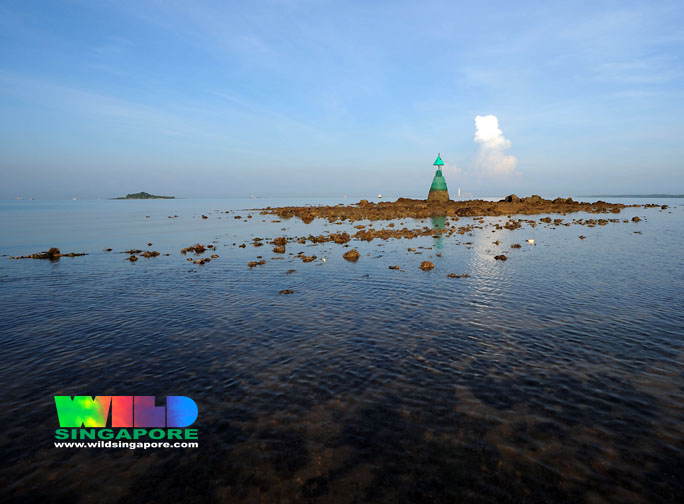
 This island is Pulau Merambong that lies on the Malaysian side of the border that cuts through the Straits of Johor. It's the yellow spot with a green surround on the navigation map above. While Merawang Beacon is the green bit sticking out of the straight-line coast of Tuas. Higher up is the Second Link.
There was recently an article in the New Straits Times about Pulau Merambong which shares a little about what can be found there.
Here's some extracts from Pulau Merambong: Fears of Singapore staking a claim
Satiman Jamin, New Straits Times 9 Jun 08
full article on wildsingapore news
For a small island, Pulau Merambong has three beaches - sandy, rocky and mangrove.
Although marine life is not as abundant as it used to be, the rare kilah or noble volute (Cymbiola nobilis) and some starfish can be found during low tide.
The kilah's sweet flesh and patterned shell are highly sought after.
It is said that seahorses and dugong used to thrive in the waters, but sightings of the creatures are rare nowadays.
A newly-painted lighthouse stands at the southeastern tip of the island. Malaysian and Johor flags perched on the tower are the only visible evidence of our country's sovereignty over the island.
Further inland, a Muslim graveyard dominates the small plains at a foothill.
Fisherman Mohd Khairul Anwar Abdul Rahman, 23, said decades ago, the folk of Gelang Patah would bury their dead on Merambong as the mainland's wild animals could dig up bodies from the graves.
The graveyard is unsafe for the barefooted as the flat, thorny seeds of the sepetir tree carpet the ground.
Sepetir (Sindora siamensis) is in the list of threatened species of the International Union of the Conservation of Nature in 2006.
On the hilltop, there are two more graves under a zinc-roof shed. The kettles and water containers in the shed suggest that people had stayed there before.
Behind the hilltop graves, more than five large holes are found in the wooded area, whose origins are linked to stories of people digging for treasures left by pirates.
Only the sandy and mangrove beaches are accessible from the hilltop.
The steep cliff with jagged rocks and mossy slippery boulders is a natural barrier to the rocky beach.
The rocky beach can be divided into three areas: the rocks and boulders underneath the cliff; the wide expanse of terraced ridges of jagged rocks; and an area of stones and pebbles carved by waves.
Snails, crabs and bivalves live in the cracks and in between rocks, only visible during low tides.
The sandy beach is made up of tiny granules of pulverised rocks, the result of waves pummelling the rocky beach next to it. Thus, the sand has the same reddish brown colour as the rocks.
A few metres from the lighthouse, at the edge of the sandy beach, rambong shrubs abound. It could have been the namesake of the island
 The unique terraced rocky beach of Pulau Merambong
Bernama 8 Jun 08;
full article on wildsingapore news
The Malaysian government should develop the island, he said, adding that it was strategically located at the centre of shipping route to the Port of Tanjung Pelepas, Tanjung Bin power generation plant and Asia Petroleum Hub, as well as to Singapore's Tuas industrial area.
More links
- A blog entry about a day trip to view the marinelife at Pulau Merambong.
- A stopover at Pulau Merambong during a seahorse monitoring trip of the Sungai Pulai area on the MNS Marine Group blog
- Dugong feeding trail taken at Sungai Pulai and nearby Pulau Merambong.
Apr 9, 2008
Tuas with TeamSeagrass
Another bright and early morning today, this time at Tuas with TeamSeagrass volunteers from Schering Plough.
Led by the ever energetic Sheryl, the team got a quick briefing. It was a tad early in the morning, but the team still valiantly gave a hearty hello for the group photo.
 Meanwhile, I headed off to check out the beacon area, the first time in more than a year.
  Last year, things were not so good there. But this year, things are very much back to normal!
The coral rubble was covered in all kinds of plants and animals. These included flowery soft corals, hydroids (the stinging kind were also back), and worm-like synaptid sea cucumbers festooned all the slippery ascidians (a kind of colonial animal).
 The sea fans were really back in full 'bloom'. Tuas is the only intertidal area where we can see so many different kinds of sea fans.
 Sea fans are actually animals, although they look like colourful plants.
 In fact, each sea fan is a colony of many tiny animals called polyps.
 The polyps are the tiny white things on this orange sea fan. Each polyp looks like a miniature sea anemone, with a long tubular body, topped with tentacles.
The beacon area is also full of hard corals and other spectacular animals. Yes, I saw a big Cake sea star (Anthenea aspera), the first sighting for Tuas. Although it's not uncommon to see these sea stars near reefs.
 There are many kinds of hard corals at Tuas.
Hard corals are also colonial animals made up of many tiny polyps. The Anemone coral (Goniopora sp.) has polyps with long bodies. The most common hard coral at Tuas are the Disk corals (Turbinaria sp.)
 Sheryl reported an increase in sand on the shore. And indeed, sand seems to be covering many of the hard corals like the one above.
Another hard coral I only see commonly on our Northern shores is this boulder shaped Sandpaper coral (Psammocora sp.) which has tiny petal-like patterns. This is an unidentified hard coral that was also common on Tuas.
 The shores near the beacon were covered in this thick, leathery soft coral.
 Leathery corals are also colonial, with tiny short polyps. Instead of a hard skeleton, they live in a shared leathery tissue.
My first sighting of the Snaky sea anemone (Macrodactyla doreensis) for the year! In fact, I haven't seen these anemones since the big flood in early 2007. Other special encounters included a tiny electric blue fishie (which we've seen before elsewhere including Sentosa and Sisters, but still haven't found out its name).
 And another pretty unidentified fish.
 But we all know that this is a seahorse (Hippocampus sp.)! We've seen them before at Tuas, so it's nice to see that they are still here. And yes, the seahorse is a fish!
 Alas, all too soon it was time to go home. On the way back, along the sandy shore, sand stars and sand dollars!
 Wow, the Tuas shore is indeed flourishing!
Other blog entries about the trip
Other encounters on the teamseagrass blog

