Showing posts with label news. Show all posts

Aug 22, 2008

Second chance for Singapore to save its rare species

Chay Hoon shares some of her thoughts about our precious wildlife in this Straits Times article today.

Second chance for Singapore to save its rare species
The rediscovery of 'extinct' wildlife serves to motivate nature enthusiasts
Kimberly Spykerman, Straits Times 22 Aug 08;
full article also on the wildsingapore news blog.

WHEN it comes to wildlife native to these shores, it seems people here just do not know enough, grumbles Miss Toh Chay Hoon, a 31-year-old nature enthusiast.

In her spare time, the accountant does her bit to introduce people to the flora and fauna here by leading nature walks on offshore islands such as Pulau Ubin and Pulau Semakau.

She recalled an incident at Changi Beach last year, when a beach-goer found a threatened species of marine snail commonly known as the Bailer Snail, so named because its large shell is said to have been used to bail out water from leaky boats.
She said with dismay: 'He was going to take it home and cook it - even after I told him it was an endangered species! People have to learn to appreciate animals in their natural environment.'

People here are not aware of the rich variety of animals and plants in these parts, largely 'because because they don't get out there and explore', she said.

And given that some animals native to these shores have staged a 'comeback' in recent years, nature enthusiasts like her believe it is time Singaporeans sat up and took notice of the creatures that share their environment.

Miss Toh, for one, is always on the lookout for a great find.

In June last year, she thrilled the local scientific community by spotting the multi-armed starfish called the Basket Star while on a pre-dawn trip to the coral reefs off Sisters Islands.

A relative of the common Sea Star, it had not been seen in waters here since 1896. Its distinguishing feature is the basket-like shape formed by its many arms.
Miss Toh said of her find: 'I never expected to see a Basket Star. Till then, the only one I'd seen was a skeleton at the Raffles Museum of Biodiversity.'

She left the fragile starfish where she found it, and came away with just memories and a few photographs.

Aug 15, 2008

A saltwater lake at the Southern Islands?

Here's some recent info and comments in the print media about our Southern islands ...

Lianhe Zaobao 14 Aug 08
translation from the colourful clouds blog

Extracts:

"我国南部岛屿四周海域日后可能建造巨型的人工咸水湖?
(Man-made seawater lake/lagoon may be constructed in waters around the southern islands?)

刚于上个月底卸下圣淘沙南部岛屿发展计划执行董事职务的李张秀虹,昨天接受本报专访时说,一旦这个人工咸水湖的构思得以落实,相信将能为南部岛屿注入独特风情,日后政府出售地段发展旅游胜地时,预料将能卖得更好的价钱。
("If the idea of the man-made seawater lake/lagoon can be implemented, it will inject a unique style to the southern islands. In addition, it may help fetch a better price if the Government sells the lots for tourism development in the future." Said Mrs Pamelia Lee, ex-managing director of Sentosa and southern island development project, in an interview with Zaobao.)

打从80年代就接手南部岛屿发展计划的李张秀虹(66岁)透露,她已征询过专业顾问的意见,在南部岛屿周围海域筑起堤围来形成一个巨大的咸水湖,技术上应该没有问题。
(Mrs Lee, who has been handling the southern island development project since the 80's said that she had consulted the views of professional consultants regarding the building of embankment to form a huge lake/lagoon. And technically speaking, it should not be a problem.)

这么一来,游人便可在被蔚蓝海洋包围着的湖水中,更安全地尽情享受各种水上活动,甚至可在湖畔建造诗情画意的船屋(Houseboat)。
(If such is a case, tourists will be able to enjoy various water sports activities surrounded in blue water safely. Picturesque Houseboats can also be built within the lake/lagoon.)
  
她说:“如果建有咸水湖,岛上就能提供更多空间让游人划船和进行水上运动,也能建造船屋等。目前世界上有不少度假胜地设有咸水湖和船屋,但它们的规模和特色同我的概念不一样。”
(She said that the islands will be able to provide more space for tourists to do boating/other water sports as well as constructing houseboats if the lake/lagoon is built. She also mentioned that the lake and houseboats that she has in mind are very different from those currently found in other resorts in some parts of the world.)

据知,有关计划还需通过海事及港务管理局(MPA)的批准才能落实。
(It is understood that the plan needs the approval by Maritime and Port Authority of Singapore(MPA) in order for it be able to implement.)


Keep southern islands' natural and spiritual wealth
Letter from Malcolm Tan, Straits Times Forum 14 Aug 08;
also on the wildsingapore news blog

I REFER to yesterday's article, 'Southern islands at crossroads'. I read with alarm that the departure of Mrs Pamelia Lee as managing director of Sentosa Leisure Group (SLG) may jeopardise the eco-paradise potential of the southern islands. It is indeed sad to learn that Mrs Lee seems to be the 'lone voice' in SLG, fighting for the preservation of the natural heritage of the southern islands.

I have stayed on St John's Island and crossed to Lazarus Island many times, and my photos attest to the fact that the two islands have much natural and spiritual wealth to offer Singaporeans and foreigners that cannot be found elsewhere on the mainland. Amid our hectic urban schedules, my friends and I have always found our spiritual refuge on the two islands with their many naturally therapeutic highlights.

The seas around the two islands are amazingly clear at certain times of the year and support much marine fauna and flora that are rare on the mainland. Many of these can be seen clearly on an especially low tide. One of our last stretches of natural coastal rocky shores in Singapore is also found here, with plenty of intact seashells lying buried in the soft sand. There is even a stretch of naturally soft sand bar on Lazarus Island, where one can walk to an outlying rock without getting completely submerged, even at high tide.

Moreover, nowhere else in Singapore can one see as many as 18 Brahminy Kites soaring gracefully in the air, spotting for prey and even occasionally diving down to the sea to take fish out with a quick and well-timed swoop. Add to these, the spectacular 'red ball' sunset over the open sea and the occasional sighting of pink dolphins in the water and one can understand why these islands are so magical.

The many Singaporeans and foreigners I met on the islands all agreed the authorities should preserve them in their natural state for posterity. It would be sad indeed if these islands are converted into another casino or another rich man's exclusive playground. That would be the sad day when most ordinary Singaporeans like me cannot claim the southern islands are part of our homeland as we have no access to their natural beauty. When that happens, the authorities should not be surprised if some of us choose to seek 'greener pastures' elsewhere. For we would then have truly seen that this country is an elitist one, where only dollars and cents matter, despite all the recent hype about the importance of work-life balance, nature conservation and eco-tourism.


[update: Sentosa announces new shore attractions in 2009 and new master plan by end of the year. More on the wild shores of singapore blog]

Aug 13, 2008

Fate of the Southern Islands

Today's article about the fate of the Southern Islands suggested a review of plans and developments on Kusu, St John's, the Sisters Islands, Kias, Lazarus and Seringat ...

Southern islands at crossroads
Fate of eco-paradise in the balance after fervent champion's departure
Serene Goh, Straits Times 13 Aug 08;

THE vision of the southern islands as an eco-paradise hangs in the balance with the departure of their champion, Mrs Pamelia Lee.

Sentosa Leisure Group (SLG) announced last week that Mrs Lee would be 'stepping aside' as managing director of the six-island cluster after 17 years on the project.

Her last day was July 31. The group's management has yet to announce a successor, or if there would even be one.

Pundits and eco-enthusiasts have raised concerns about whether the next head will share Mrs Lee's passion for nature conservation.

Last year, The Straits Times reported rumours in the tourism industry of a possible third casino to be housed on the islands - Kusu, St John's, the Sisters Islands, Kias, Lazarus and Seringat - perhaps by 2016.

It was a move Mrs Lee opposed. She felt the unspoilt nature of the islands could be preserved while generating revenue through eco-getaways or boutique residences.

When asked, the 66-year-old tourism veteran shied from hints that a difference of opinion had led to her parting ways with the group.

SLG also declined to comment on this at its low-key farewell for Mrs Lee, and remained tight-lipped about plans for the Southern Islands.

It would only say: 'There is no change to how the development is being handled and we will provide an update at an appropriate time.'

Mrs Lee had led efforts to lay the islands' basic infrastructure for development, including reclamation works, island links as well as the construction of a submarine trench for power cables, all completed in 2006.

She told The Straits Times in an interview yesterday that she had hoped to place the project, finally, in the 'gentle hands' of a developer who would undertake construction that would 'fit, not fight' the green environment there, a counterpoint to Sentosa's playground for the masses.

New inhabitants might be happy to walk, ride bicycles and dwell in houses 'no taller than coconut trees', she said, 'or stop and watch a sunset or a hermit crab running on the sand'.

In December 2006, investors voiced concerns that it would be complicated to maintain the islands' pristine environments while generating maximum yields, Mrs Lee said then.

Then in April last year, the Southern Islands' development was put on ice, with little explanation from the Singapore Tourism Board (STB). The temples on Kusu and St John's swimming lagoons and trekking routes were left as existing attractions.

More than a year later, this delay has become the reason for Mrs Lee's departure.

With the islands' infrastructure completed, her work is done. Further developments of the islands can proceed only in tandem with a concrete plan from a developer.

The fate of the Southern Islands lies in the hands of SLG's new CEO Mike Barclay (Sentosa press release about Mike Barclay, PDF file). He takes over on Aug 25.

What were the developments to these southern islands?

Kias and Seringat used to be submerged reefs like Cyrene Reefs.
from the Southern Islands Development Guide Plan (DGP) 1996

These submerged reefs were buried and reclaimed to form Kias-Seringat through reclamation completed in 2000.Lazarus Island was connected to St. John's island by a causeway.

In 2000, the plan was to offer visitors a Mediterranean resort-like setting only 17 minutes away by ferry, patterned after Italy's renowned vacation spot, Capri. Details later revealed included plans for a five-star 290-room hilltop hotel, a three-star 170-room beachfront hotel, 70 waterfront homes and 1,700 units of housing. (from Various plans for Southern Islands, by Teh Jen Lee, The New Paper, 31 Mar 04)

When plans for the Integrated Resort on Sentosa was announced in 2004, "an MTI spokesman said these plans for the Southern Islands will be 'reviewed'". At that time, there was even talk of a road from Sentosa to the islands, or a causeway, like the one linking the mainland and Jurong Island. (from Road to link Sentosa to St. John's Island? by Teh Jen Lee, The New Paper, 31 Mar 04)

In 2004 it was announced: "Soon you may be able to sun-tan on a pristine new beach a short ferry ride away. Given that trash is often found on mainland beaches, you'll be glad to know that an 800-metre long beach on Pulau Seringat in the southern islands is almost complete." (Our newest man-made beach, by Teh Jen Lee The New Paper, 24 Sep 04)

Thousands of cubic metres of sand were imported from Indonesia to make the beach. The sand was checked for sandfly eggs so that visitors will be spared the insect's bites, which can be itchy. Another $120 million was spent to bring water, electricity, gas and telecommunication infrastructure from Sentosa to the islands. (from The newly redeveloped St John's and Lazarus islands have beautiful beaches and sparkling waters, by Teh Jen Lee The New Paper 2 Dec 06)

In 2006, massive landscaping was reported of the 1km reclaimed beach on Lazarus to simulate a natural environment so that it would look 'natural and wild'. 5,000 lorry-loads of soil measuring two storeys high when piled up were brought in by barges, an entire coconut plantation in Malaysia was bought, about 1, 000 trees was trucked and shipped to the island. To meet the 36 cubic metres of water needed every day to keep the plants growing, a 400-sq-m-wide pond was created to collect rainwater and ground water tapped. This was part of the $60 million worth of reclamation and infrastructure work on the southern islands of Pulau Seringat, Kias, St John's, Lazarus, Kusu and Sisters' islands. (from Lazarus beach makeover wins firm top landscaping award, by Tan Hui Yee The Straits Times 13 Dec 06)

In Dec 06, it was announced that Singapore Tourism Board (STB) may launch a request for concepts, possibly in the first quarter of 2007. One idea is to develop the islands into a 'premium resort', a getaway for the rich. Other ideas include eco-tourism and cultural tourism, and even possibly a third casino in Singapore, although it is not known if STB would consider offering a casino licence to any developer of the islands. (from The newly redeveloped St John's and Lazarus islands have beautiful beaches and sparkling waters, by Teh Jen Lee The New Paper 2 Dec 06)

More media articles

Investor feedback to plans for Southern Islands, Dec 06
  • No new plans for Kusu temple despite resort move
    Ansley Ng, Today Online 1 Dec 06
  • All powered up and ready for offers, Infrastructure in place, time is right to attract investors, Serene Goh, The Straits Times 1 Dec 06
  • Targetting nature lovers and the well-heeled, The Straits Times 1 Dec 06
  • Investors give positive feedback to the Southern Islands' development, May Wong, Channel NewsAsia 30 Nov 06
Playground of the rich, Nov 06
  • Southern Islands may be next big tourist attraction, One plan being considered: Make them a getaway for the rich, Krist Boo, The Straits Times 29 Nov 06
  • STB plans to develop Southern Islands into tourist attraction, Jeana Wong Channel NewsAsia 29 Nov 06
  • Kusu: Playground of the rich? Tourism Board looks into ideas to develop S'pore's six southern islands to attract the super-rich, Ansley Ng, Today Online 29 Nov 06
  • Southern Islands could be premium resort: STB, Super-exclusive haven for billionaires, location for third casino are some possibilities, Arthur Sim, The Business Times (Singapore) 29 Nov 06
Third casino? Jan 07
  • Asia's mini-Monaco by 2015? STB to put out feelers for interest in developing the Southern Islands into an exclusive yet accessible resort, third IR unlikely, Tor Ching Li, Today Online 19 Jan 07
  • Southern Islands home to third IR? Smaller, more luxurious resort will feature F&B, spa, health and beauty facilities
  • By Arthur Sim, Business Times Singapore 18 Jan 07


[update: Sentosa announces new shore attractions in 2009 and new master plan by end of the year. More on the wild shores of singapore blog]

Jul 29, 2008

Feedback requested for a Sustainable Singapore

[update: at mid-point of the feedback gathering process, not many voices for our wild shores. Please speak up for our shores.]

Here's an opportunity to speak up for our wild places ...


From the Sustainable Singapore page on the MEWR website:

As a responsible member of the international community, Singapore would want to play our part in mitigating greenhouse gas emissions. We would also wish to sustain economic growth and maintain our quality of life. By being more efficient in the way we use resources, Singapore would be contributing towards reducing carbon emissions while positioning ourselves well for a more carbon-constrained world that may emerge if ongoing negotiations on climate change result in a post-2012 global agreement.

The vision:

Sustainable development for Singapore means being able to support future economic and population growth while maintaining a quality living environment that is clean, green and healthy.

The vision for Singapore is to be a lively and liveable global city – a city that is distinctive in its ability to offer a unique combination of economic opportunity, vibrant lifestyle and quality environment, for a cosmopolitan population, providing a good home for current and future generations of Singaporeans. It would also be a city that continues to be attractive to the foreign talent and investments which help us to grow the economy and high-value jobs.

Priority Areas:

To achieve this vision and address the domestic and international challenges which are emerging, the IMCSD will focus its efforts on three priority areas:
  • Resource management
  • Pollution control
  • Quality of the physical environment.
Concurrently, further efforts will be made on two supporting fronts –
  • encouraging people and industries to adopt practices that are sustainable in the long term and
  • developing new capabilities and technologies which optimise resources and improve environmental performance.
Our initiatives:

We should make our existing buildings more energy and resource efficient, as they form the bulk of our built environment.

To further distinguish Singapore as a City in a Garden, new areas such as skyrise greenery, and measures to better document and protect existing biodiversity are being studied too.

Resource efficiency (i.e. energy efficiency, water efficiency and waste minimisation and recycling) will be actively promoted among industry and businesses.

Efforts to encourage greater use of public transport contribute to sustainable development since public transport not only minimises land requirements but is more energy efficient than other transport modes.

Give your Feedback
  • What else can the Government do to ensure Singapore continues to be a lively and liveable city?
  • What can ordinary Singaporeans do to support a sustainable Singapore?


Links to media reports on the wildsingapore news blog

Wanted: Public's ideas for a greener Singapore
Feedback from the ground to shape 10-year programme
Tania Tan, Straits Times 29 Jul 08;

Sustainable if costs don’t tip the scales
Today Online 29 Jul 08;

Jul 18, 2008

Fishy origins of speech

Amazing what we can learn from a humble fish.

Researchers report toadfish sing to attract mates
Randolph E. Schmid, Associated Press Yahoo News 17 Jul 08;

It's not exactly Tony serenading Maria in "West Side Story," but for all their homeliness toadfish also sing to attract mates. OK, singing may be a stretch; it's more of a hum. But it turns out to be useful, for science as well as the fish.

Exploring how their nervous system produces sounds is allowing scientists to trace the earliest developments of vocalization in other animals, including people.

Many animals communicate vocally — birds chirp, frogs thrum, whales whistle — and comparing the nerve networks in a variety of vertebrates suggests that making sounds originated in ancient fishes, researchers report in Friday's edition of the journal Science.

The sounds of whales and dolphins are well known, but most people don't realize fish also make sounds, lead researcher Andrew H. Bass of Cornell University said in a telephone interview. He's a professor of neurobiology and behavior.

"I'm not saying fish have a language or are using higher powers of the brain," he added quickly. "But some of the networks of neurons, nerve cells in the brain, are very ancient."

The whole nervous system basis that led to speech originated in fish hundreds of millions of years ago, he said.

He studied the hindbrain in the larvae of midshipmanfish and toadfish, which grow up to produce more than one type of sound.

"It's not as complex as what you hear mammals and birds doing; it's the simplest type of communication ... but the parts of the nervous system that generate sounds are easiest to study in these fish," Bass said.

His team found two major uses of sound.

One is the hum in which the male sings to attract the female to his nest. Bass characterized it as like the drone of bees or a motor running.

The second type is a threat sound, more of a grunt or growl, to protect nesting territory.

The locations of the vocal nerves described in the study are consistent with the organization of the vocal systems in frogs, birds and mammals, supporting the idea of a common early development, Daniel Margoliash and Melina E. Hale of the University of Chicago comment in a perspective on Bass's study.

However, they add: "The story of the evolution of vocalizations is still being written, both for its deep ancestral roots and for its most modern development."

The research was funded by the National Science Foundation and the National Institutes of Health.

Jul 16, 2008

Wildlife: A luxury we can live without?

Jean-Christophe Vie, BBC Green Room 15 Jul 08;

Despite our ever-increasing knowledge of the natural world, too many people still see it as just another means to make money, says Jean-Christophe Vie.

In this week's Green Room, he setsout his argument why the planet's rich diversity of life needs to be preserved in its entirety.

In the world of economics, what nature provides for us is often seen in terms of immediate returns.

Forests, for example, are valued for their timber. When a country needs money, the forests can be cut down and the capital immediately released.

This may contribute to the nation's Gross Domestic Product, but in reality, the country has lost resources and becomes poorer.

The rationale for preserving wildlife is based on a variety of societal values including aesthetic, moral and spiritual ones, as well as more practical ones, such as contributing to the economy and human livelihoods.

It is also based on a precautionary approach and, in my view, common sense. If a species is there, I am firmly convinced that it has a good reason to be.

Nature has developed over millions of years to produce the most favourable environment for us to live in. Before attempting to disturb the subtle balance on which we all depend, with unknown consequences, we should look carefully at what we have and know.

In fact, we still know very little of the diversity of life on our planet, but we know enough to get a global view of what is happening.

Almost a century ago, some "visionaries" sounded the first alarm bells. They have long been called "alarmists" but their predictions have slowly become reality.

Even today, when you tell the truth about the environment, many will deny the facts and try to block action; this will inevitably result in a bigger problem in the future.

Out of focus

We spend enormous energy and lose precious time by trying to demonstrate the obvious: wildlife in its integrity is vital for us.

Instead, those who do not believe that, or think human ingenuity will solve all our problems, should be asked to demonstrate that they can live without nature.

For a very long time, conservationists have been portrayed as misanthropists, caring more for animals than other human beings. But human rights and preservation of the environment are complementary.

The environment should always be a key pillar of development aid. Humans and nature go hand in hand.

Nowadays, when the spectrum of an economic recession is looming in various part of the world, the fact that nature can sustain humankind freely is not the least of its benefits, especially for the world's poor.

There is increasing recognition of the services nature provides to us, such as clean water and healthy soils for growing crops. But considering the competition between wild species and humans on a very crowded planet, one can ask if there is there room for both of us?

There is no doubt that nature can survive without humans - and has done so, for the most part, since time began.

Humans surviving without nature is certainly not true so we have no choice but to find enough space for nature.

Despite the very limited knowledge of life on Earth, some people do not hesitate to claim that some species have no interest to humans, that we should sort them out and get rid of "redundant" species and eliminate "pests".

So should nature be preserved in its entirety, meaning all species? I say yes, without any hesitation.

Not a luxury

Almost all countries agreed at the 2002 World Summit on Sustainable Development in Johannesburg, South Africa, or through the Convention on Biological Diversity, that we should significantly reduce biodiversity loss as a means to fight poverty.

Every day there is a stronger consensus that, without preserving nature, the Millennium Development Goals to eradicate hunger and poverty, provide education, or combat diseases, cannot be achieved.

This is, for me, a clear response. Nature is not a luxury; it should be preserved at all costs. However, we are still losing species, as shown by the IUCN Red List of Threatened Species.

While many are not extinct yet, the Red List shows that many are slipping slowly towards extinction. We are witnessing a collective failure to meet these agreed goals.

In parallel, the good news is that we are documenting more and more conservation successes. It shows that a clear understanding of the problems and taking appropriate collective actions, nature can be preserved.

Increasingly, human overpopulation is recognised as the biggest challenge. The need to feed this growing population is increasing the pressure on nature.

Decisions will continue to be taken in a context of emergency and without appropriate thinking or incorporation of environmental considerations, as has been the case with the uncontrolled development of biofuels.

Our ability to live with nature can also be questioned. We hear that there are too many whales depleting fish stocks, too many elephants destroying farmers' plantations, too many tigers or sharks killing people, too many wolves eating sheep, too many mosquitoes transmitting diseases, too many frogs making noises, too many trees spreading leaves in our gardens; the list could go on forever.

Quantity and quality

The positive side of this is that we still have species to fight against. Once gone, will there be anyone else other than our neighbours to fight with?

Species abundance is also important. We need large quantities of fish if we want to feed the world. We need enough pollinators and soil invertebrates to maintain food production.

We need a healthy population of prey to maintain predator populations. We need a large numbers of wildebeests in the Serengeti to attract tourists and ensure the fertilisation of the savannah.

The same applies to salmon, whose spawning migration is the basis of an entire food chain. Massive animal migrations or congregations of spectacular animals are the guarantee that tourists will see what they have paid to come and watch.

We need enough predators to control herbivore populations; Olive Ridley turtles ensure reproductive success by swarming beaches in mass to lay their eggs.

Wildlife is not just a question of diversity but also of quantity. The collapse of cod stocks in the northern Atlantic is the perfect illustration; cod can still be found but, for unknown reasons, the stock was never able to recover and can no longer sustain an economy.

In 2050 the human population will stand at more than nine billion, with an increased demand for goods, so what does sustainable development really mean?

Can it be achieved without drastic changes? Do we want nature to be confined in zoos and botanic gardens or isolated pockets where rich tourists could go and watch what once covered most of our planet?

Global changes and new emerging threats will not allow us to maintain this static model. Climate change, invasive species and diseases do not stop at the borders of national parks. The risk cannot continue to be evaluated by our decision-makers in terms of success at the next election.

Fortunately, it seems that showing a real commitment to the preservation of our planet is starting to pay off in political terms.

A return to more spiritual values and the findings of a study on the economics of ecosystems and biodiversity might bring the key additional elements needed for a real push in favour of the preservation of the diversity of life and, more broadly, all forms of diversity on our generous planet.

Jean-Christophe Vie is deputy chairman of the IUCN's Species Survival Group, and author of the book Le Jour au L'Abeille Disparaitra...

The Green Room is a series of opinion articles on environmental topics running weekly on the BBC News website

Jul 11, 2008

How the flatfish became one-sided

Flatfish evolution was neither fluke nor turbot-charged
from Yahoo News 10 Jul 08;

Starting with Charles Darwin, evolutionary biologists have fretted and fought over the origins of flatfish, among the handful of weird, deeply asymmetrical creatures in Nature's bestiary.

Did flatfish wind up with two eyes on the same side of a lopsided skull through a few chance mutations?

Or did this happen gradually, over tens of millions of years?
The answer, in turns out, has been gathering dust for nearly two centuries in museum drawers, according to a study to be published Thursday in the British journal Nature.

That was where Matt Friedman, a graduate student at the University of Chicago, found two fossils that clearly show a glacial evolutionary shift from normal upright fish to their bug-eyed, bottom-hugging descendents.

Each dates from the Eocene epoch, some 45 million years ago, and one -- Heteronectus chaneti -- is an entirely new genus and species.

The other is from the Amphistium genus, whose earliest known specimens date back some 200 million years.

Both are true "missing links," with one eye just below the dorsal fin on the side of the fish closest to the ocean floor.

For reasons unknown to scientists, some species of modern flatfish, such as turbot, have both eyes on the left side, while other -- halibut and sole, for example -- see from the right side.

The two fossils "deliver the first clear picture of flatfish origins, a hotly contested issue in debates on the mode and tempo of evolution," said Friedman.

There can no longer be any doubt, he said in a statement: "The evolution of the profound cranial asymmetry of extant flatfishes was gradual in nature."

The flatfish controversy has vexed scientists for at least 150 years, and even provided fodder for creationist challenges to the very notion of Darwinian evolution.

All the great figures of early evolutionary biology weighed in with theories falling roughly into two schools.

The absence of any fossils showing a halfway point between normal fish and flatfish led some to believe that change took place in dramatic leaps, a process they called "saltation".

Others, including Darwin himself, predicted that we would one day find evidence of a gradual eye migration that mirrors the maturation of living forms.

When flatfish are only days old they are perfectly symmetrical.

But they rapidly metamorphose as they grow, with one eye migrating toward the other.

Neither of the key fossils rediscovered by Friedman had been examined with modern scientific tools for fear of causing damage.

But Friedman was finally allowed to treat a single specimen housed in the Naturhistorisches Museum in Vienna with a weak acid bath, and to carry out computer-based tomography imaging of the skull of another specimens at the Natural History Museum in London.

Both fossils had been found in limestone quarries in northern Italy.

Jul 2, 2008

Reel Revolution: The Environment

Reel Revolution is The Substation Moving Images youth film mentorship programme that pairs teams of youths with established filmmakers and challenges youths to produce video essays on social issues.

Mentors this year include Jasmine Ng (of "Eating Air" fame), Eng Yee Peng ("Diminishing Memories"), Jeremy Sing ("A Wake") and Eric Lim ("Remember Chek Jawa")

The theme this year is "Our Environment", to be interpreted as widely as possible. I.e. It can mean the natural environment, the political environment, the journalistic environment, workers' environment, the history of the surroundings etc.

The programme will also feature talks by prominent members of civil society which is ideal for networking and the sharing of ideas and resources amongst the various groups. N. Sivasothi and Ria Tan will be presenting on environmental issues during the "Learning Talks sessions"

12th July – Learning Talks 1: Meet the Changemakers
(The Substation, 7.30 - 10.30pm)
The speakers for this session are Mr. Brown from mrbrown.com, Alex Au from yawningbread.org, Ria Tan from wildsingapore wildsingapore.com and Gerald Giam from The Online Citizen.
To attend, please register by 11th July.

19th July – Learning Talk 2: Meet the Changemakers
(Singapore Art Museum, 7.30 – 10.30pm)
The speakers for this session are NMP Siew Kum Hong, Daniel Tung from Action For Aids, N. Sivasothi from the Raffles Museum of Biodiversity and John Gee from Transient Workers Count Too.
To attend, please register by 18th July.

What the programme hopes to achieve

1. Encourage youths to articulate and discuss concerns creatively
2. Spur insightful, intentional and innovative filmmaking
3. Hone the skills of young talents through mentorship, practical and theoretical work
4. Develop youths as leaders, effective communicators and facilitators
5. Raise awareness of the environment amongst youth living in Singapore
6. Showcase youth talents and contributions

Who should participate?

1. Young people from ages 15 to 35 currently living in Singapore
2. Young people with a burning passion for social issues
3. Up to 4 members per team

Important dates
4th July – Reel Revolution Introductory Seminar
7th July – Mentorship Programme Application Deadline
12th July – Learning Talks 1
19th July – Learning Talks 2
15th August – Video Submission
30th August – Reel Revolution Powwow

For more information visit revolution.youth.sg
or contact Beng Kheng, Programme Manager – Moving Images
6337 7535 / bengkheng@substation.org

Jul 1, 2008

Scientific names for sale

Want scientific immortality? Name a sea worm
Alicia Chang, Associated Press Yahoo News 30 Jun 08;

Jeff Goodhartz is single and has no children. But he wanted to ensure the family name would live on after he's gone.

So he paid $5,000 to have a newfound sea worm given the Goodhartz name, "goodhartzorum."

"This really jazzes me up," said the 55-year-old high school math teacher whose namesake is translucent with a flamboyant blue tuft. "It will be out there, the family name."

And it will be swimming in the Belize mangroves where someone else discovered it.

Goodhartz bought the naming rights from the Scripps Institution of Oceanography, which unveiled its name-a-species program earlier this year. This modern twist on taxonomy is a way to raise research money, and lots of groups have been doing it.

But its growing popularity has rekindled a debate over whether the practice invites fake discoveries and has led to a push for oversight.

"It is conceivable that someone could fabricate a new species in order to make money, if it were shown to be lucrative," said Andrew Polaszek, an entomologist at the Natural History Museum in London.

Taxonomy ranks among the world's oldest professions, dating back to 18th century Swedish botanist Carl Linnaeus, who popularized the classification system still in use today. Of the 30 million or so species of animals, plants and microbes on Earth, only about 1.8 million have been named and identified so far.

Traditionally, the discoverer gets to christen the new organism. All living things have a two-part scientific name, usually in Latin. It's common for discoverers to name a new species after themselves or in honor of their spouses, children, colleagues, benefactors or even celebrities.

In recent years, species names have gone from finders keepers to being auctioned off or sold to donors to support research as other funding has dried up. Not all species are created equal. The rarer and more evolved the organism, the more money it tends to fetch.

Doug Yanega, an entomologist at the University of California, Riverside, wants a clearinghouse to review and publish animal names. Right now, species monikers are scattered across scores of scientific journals — some with weaker peer review than others.

Global efforts are under way to catalog species, but they tend to sort out existing names and compliance is voluntary. The Census of Marine Life, which chronicles sea animals, last week confirmed 122,500 marine species names so far and 56,400 aliases — different names that have been given to the same species over the years.

Yanega has no problem with credible scientists selling naming rights to fund their work, but he fears unethical people could see this as a moneymaking scheme.

"The potential for abuse is still too large," Yanega said. "It's too easy to do an end-around and exploit the system."

Most researchers say faking species names is a rare occurrence, but that could change if it became profitable.

The International Commission on Zoological Nomenclature, which publishes rules on animal names, doesn't have a position on the matter, said Ellinor Michel, who heads the group.

At Scripps, before an animal is put up for sale, researchers run a background check in scientific journals and perform DNA tests to make sure it's unique.

"We wouldn't offer a species name unless we're absolutely certain it's never been described before," said Scripps curator Greg Rouse, who had an Australian feather-duster worm — Pseudofabriciola rousei — named for him by a colleague.

Rouse is also the discoverer of Goodhartz's featherworm. Rouse found it in an underwater mangrove while snorkeling off the coast of Belize two years ago. It is not only a new species, but part of a new genus of Belize featherworms too, he said.

Though the species will be called goodhartzorum, Rouse is still deciding the genus name.

Among the more successful conservation groups to sponsor species names is the German nonprofit Biopat, which has raised $700,000 since 1999 for biodiversity research through the sale of more than 100 species ranging from frogs to beetles to spiders.

Several recent high-profile online auctions have put a spotlight on naming rights.

In 2005, the Wildlife Conservation Society raised $650,000 for a new monkey species in Bolivia. The primate was named after the highest bidder, Internet casino GoldenPalace.com, known for all sorts of oddball purchases including a grilled cheese sandwich half that the owner claimed bore the image of the Virgin Mary.

The monkey's scientific name — Callicebus aureipalatii — is Latin for "Golden Palace," but it's informally known as the "GoldenPalace.com Monkey."

Last year, the Florida Museum of Natural History netted $40,800 from an anonymous donor for a novel Mexican butterfly species. The insect was named after a deceased Ohio mother of three sons who fought in World War II.

Zoologist Jon Norenburg of the Smithsonian's National Museum of Natural History has nothing against the species name trade since taxonomy is steeped in vanity and selling names falls into that tradition. But he warned that someone's preferred name may not always pass scientific muster.

"Donors need to be aware that there's the possibility that their name could get sunk," he said. "It's kind of like financial investing. You need to ask, `What's the fine print?'"

Besides the Belize featherworm, Scripps also has sold a $5,000 Australian featherworm to a woman who planned to name it after her husband as an anniversary gift, and a $10,000 spiny worm to cell phone maker Nokia Corp.

Nokia spokeswoman Jackie Evory said the company held a contest and will Latinize the winning entry, which happens to be its slogan, "Connecting People."

Still up for grabs is a $15,000 sea slug, a pair of bone-feeding worms for $25,000 each and $50,000 rare hydrothermal vent worm. Donors receive a framed photo of their namesake and a copy of the scientific paper that describes the species.

Goodhartz, the teacher from suburban San Diego, never bushwhacked through tropical rain forests or dived in perilous waters to hunt for undiscovered critters.

But he's headed for scientific immortality and understands there will always be people who disagree with his purchase.

"I haven't earned this like a scientist," he said. But he added, "If it helps Scripps, how can that be bad?"

On the Net: International Commission on Zoological Nomenclature: http://www.iczn.org
Scripps Institution of Oceanography: http://sio.ucsd.edu

Jun 30, 2008

"Remember Chek Jawa": an interview with director Eric Lim

Remember Chek Jawa, an independent film which took about six years to produce, shows an alternative side of urban Singapore and the congregation of the human spirit to save what is left of our natural environment.

Once destined to be put up for reclamation, Chek Jawa has won the hearts of people from all walks of life and has since averted it’s terrible fate. Through their undying determination and great efforts, the film embraces the power of human will and how one person can make all the difference. Eric Lim talks more about his experience.

Find out Eric Lim's thoughts about questions such as...

In the process of making this documentary, what were some of the difficulties you faced?

In the film, Mr Joseph Lai mentioned that “not many Singaporeans took the effort to go and find out things” which is partly the reason why Chek Jawa was only discovered recently, despite so many “nature groups and academics”. He went on to say that there is “something missing”. What do you think is this missing factor in Singapore society?

How has making this film changed you? In terms of your perception on conservation and ‘the human spirit’.

Full interview on the Sinema Old School website

See also the Remember Chek Jawa website for more about the film.

Thanks to an alert on the Singapore's Heritage, Museums & Nostalgia blog

More links

Shell is looking into a new petrochemicals facility

How big will the facility be? "to be economic, the new SMPO investment should ideally be as large as Shell Chemical's world-scale, US$500 million Ellba Eastern joint venture with Germany's BASF on Jurong Island".

Where in the world will it be located? "Singapore is being considered as the investment site, but has to compete with others in the Middle East and Asia".

If in Singapore where will it be located?
"A factor favouring Singapore for the SMPO investment will be the availability of feedstocks like ethylene, propylene and benzene from Shell's new US$3 billion petrochemical cracker which is currently being built and scheduled to start operations in late 2009 or early 2010. Having an integrated manufacturing hub will be an advantage in the competitive SMPO market".

This cracker is probably the one on Pulau Bukom, which next to Pulau Hantu and near Cyrene Reefs.

What is the output of the facility? "Chemical intermediates used to make final products such as polystyrene containers and rubber soles."

Shell seeking JV partners for new plant
Singapore being considered for the SMPO facility
Ronnie Lim, Business Times 30 Jun 08;

SHELL Chemicals is talking to potential partners for a significant new styrene monomer/propylene oxide (SMPO) facility - expected to cost at least US$500 million - which could be built in Singapore, a senior executive told BT.

Its general manager for SMPO & derivatives, Fang Yea-Yee, said that the strong Asia-Pacific demand for SMPO - which are chemical intermediates used to make final products such as polystyrene containers and rubber soles - underpins the project.

'A lot of work is going on, and we are in discussions with possible joint venture partners,' he said, elaborating on news that first emerged last month of the planned SMPO investment.

Iain Lo, its vice-president, ventures and developments for the Asia Pacific/Middle East, had told BT in May that a 'decision is expected soon' on the project.

Singapore - one of Shell's main refining and petrochemical hubs - is being considered as the investment site, but has to compete with others in the Middle East and Asia.

While Mr Lo did not give project details, he indicated that to be economic, the new SMPO investment should ideally be as large as Shell Chemical's world-scale, US$500 million Ellba Eastern joint venture with Germany's BASF on Jurong Island.

Ellba has a production capacity of 250,000 tonnes of PO and 550,000 tonnes of SM.

Mr Fang declined to say which companies Shell Chemicals was trying to get aboard its latest SMPO project, and whether it was considering different joint venture partners depending on the site chosen.

A BASF spokesman contacted by BT earlier last week said that it was not in discussions with Shell at this point of time on the latest SMPO investment.

A factor favouring Singapore for the SMPO investment will be the availability of feedstocks like ethylene, propylene and benzene from Shell's new US$3 billion petrochemical cracker which is currently being built and scheduled to start operations in late 2009 or early 2010.

Having an integrated manufacturing hub will be an advantage in the competitive SMPO market, Mr Fang told a petrochemicals conference in Bangkok recently.

'Shell believes the strong growth in Asia-Pacific demand for both styrene and propylene oxide will continue to create attractive opportunities for new SMPO investments,' he said.

Overall, regional growth remains robust - especially with China remaining the major global growth engine for styrenics - and Shell sees this trend continuing for the long-term, he added.

full article also on the wildsingapore news blog

More about petrochemicals and our southern islands.

Nature guides may soon need to be certified

From the article below, main points of the certification move are:

Why? "to eliminate the risk of shoddy tours and ill-informed guides", "to standardise the quality of information" among the rapidly increasing number of guides due to "rapidly growing number of eco-tourists". "This is meant to be a comfort to the public who want to engage a service, so they will know that the person doing the guiding has a consistently high level of knowledge".

Applies to whom? "all those conducting eco-tours will have to go for training".

Any exemptions? "will not apply to teachers and their students, or people who want to share what they know with friends".

For which locations?
"apply to the roughly 300 green spaces under the jurisdiction of NParks " including "Bukit Timah Nature Reserve, the Sungei Buloh Wetland Reserve and Chek Jawa in Pulau Ubin".

What are the details?
"The details of the programme have not been established", said Dr Leong Chee Chiew, NParks chief operations officer

How much will certification cost?
NParks "has not come up with the cost of the proposed training programme, nor has it decided if there will be a difference in what professional guides and volunteers will have to pay for training". "The fee would be more than $100 but would not be onerous. Subsidies will be made available to locals".

What's next? "
Consultations will be held with eco-guides later this year before its plans are cast in stone"


Nature guides may soon need to be certified
Proposed NParks rule designed to raise quality of guides
Shobana Kesava, Straits Times 30 Jun 08;

BY THE end of next year, all nature guides who show local and foreign tourists around Singapore's parks and reserves could need a certificate from the Government.

The proposed rule, designed to eliminate the risk of shoddy tours and ill-informed guides, would apply to the roughly 300 green spaces under the jurisdiction of the National Parks Board (NParks).

The list includes some of Singapore's biggest and most popular parks, such as the Bukit Timah Nature Reserve, the Sungei Buloh Wetland Reserve and Chek Jawa in Pulau Ubin.

NParks chief operations officer Leong Chee Chiew said: 'We would like to standardise the quality of information given out to those who are interested in nature.'

NParks said a big reason for its proposal was the rapidly growing number of eco-tourists visiting its parks and reserves. The demand has prompted a need for more people - both volunteers and professionals - to get into the guiding game.

NParks said there are 1,600 registered volunteer guides, but it is unclear how many are active. There could be hundreds of other private volunteers, according to some estimates.

Most guides are nature lovers or members of conservation groups who offer free tours. But there are a handful of professionals who charge about $100 per hour for excursions.

Eventually all those conducting eco-tours will have to go for training, though the details of the programme have not been established, said Dr Leong.

NParks' director of industry, Mr P. Teva Raj, said this will not apply to teachers and their students, or people who want to share what they know with friends.

'This is meant to be a comfort to the public who want to engage a service, so they will know that the person doing the guiding has a consistently high level of knowledge,' he said.

Seven experienced nature guides who spoke with The Straits Times agreed that training would be valuable.

But they were riled by the idea that they might require accreditation. Some see it as an insult after decades of promoting Singapore's natural heritage, while others think it goes against the spirit of volunteerism.

A guide certified by the Singapore Tourism Board (STB), Mr Grant Pereira, 59, said: 'I don't see a reason for external guidelines. I am a certified guide by the STB, I am extremely good at the few guided tours I specialise in. Why is this necessary?'

It appears that not every eco-tourist needs licensed guides. Nature lover Nassera Guerroumi, 36, who is from France and came to live in Singapore two years ago, does not think certification is necessary beyond training in first aid.

'Why formalise it? People who do this love nature or they wouldn't bother sharing their passion. I don't need Latin names of plants, or someone talking all the time, I just want to be safe and know where to go to have an experience,' she said.

NParks has not come up with the cost of the proposed training programme, nor has it decided if there will be a difference in what professional guides and volunteers will have to pay for training.

Mr Raj, when pressed, said the fee would be more than $100 but would not be onerous. He said subsidies will be made available to locals.

President of the Nature Society of Singapore, Mr Shawn Lum, 45, said that, in principle, NParks' idea is excellent.

'It ensures that NParks, as a custodian of our natural heritage, has an idea of who are leading walks and if they're being done responsibly. The devil is in the detail which stakeholders would want to help the authorities pin down. But this is worth it,' he said.

Mr Raj said consultations will be held with eco-guides later this year before its plans are cast in stone.

SCHEME MAY BACKFIRE

'Some of the ideas like safety training are great, but I'm afraid the certification might become a barrier to volunteerism. Having to pay may discourage people and certificates cannot guarantee quality in content-delivery and style.'
VOLUNTEER NATURE GUIDE NOVEMBER TAN, 26

ROOM FOR IMPROVEMENT

'I've seen exceptional guides but I've also seen guides who allow tourists to stay close to a bird's roosting site for too long, not knowing such behaviour will prompt the birds to abandon the site. This does not help the precious wildlife we have left.'
WILDLIFE CONSULTANT SUBARAJ RAJATHURAI, 45

NParks to consult Australian institute on guide training scheme
Straits Times 30 Jun 08;

THE National Parks Board (NParks) has turned to an Australian tourism body to help it establish what information guides should know about Singapore's nature reserves.

Recommendations from the government-linked William Angliss Institute Specialist Centre for Tourism are likely to form the basis of a proposed NParks scheme to accredit guides.

NParks recently put 19 of its senior nature guides and staff through a week-long review by the Australian institute that tested their knowledge.

Guides had to demonstrate their skills in guided walks at the Singapore's new HortPark, and traditional haunts such as Sungei Buloh Wetland Reserve, the central catchment area and the Bukit Timah Nature Reserve.

NParks' senior outreach officer, Ms Karen Teo, 35, went through the test, the results of which are expected in the next few weeks.

She trains some of the 1,600 volunteers registered with NParks.

'I've not really had formalised training, so it was good to find out I was doing a lot of things right and that...I could do more to promote larger campaigns, for example, against climate change,' she said.

The Australian institute said shortcomings were spotted in areas of risk management, including how to handle someone with heat stroke.

When ready, Singapore's new accreditation programme will likely set a minimum standard of general knowledge for guides and require them to know first aid.

They will also have to understand how to minimise the impact of tours on the environment.


full articles also on the wildsingapore news blog

Jun 27, 2008

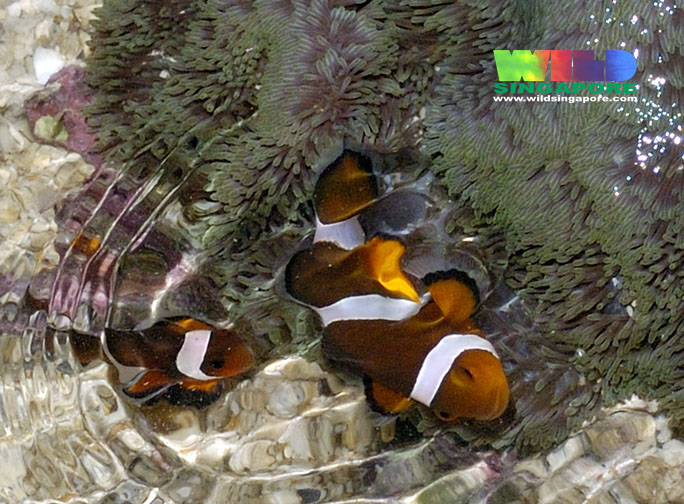
Nemo no more?

Let's join some dots ...

  • Nemo is not eaten by people.
  • Nemo is taken from the wild only for the aquarium trade.
  • Since the film "Finding Nemo"...
  • Demand for Nemo in the aquarium trade rose sharply.
  • Wild populations of Nemo dropped sharply.
  • Nemos are now candidates for listing as endangered and could become locally extinct where they are overharvested.
More in this article ...

I can't find Nemo! Pet trade threatens clownfish
Hannah Strange, The Times 26 Jun 08;
full article on wildsingapore news

Five years after the hit film that endeared the clownfish to audiences the world over, Nemo is becoming increasingly difficult to find.

The lovable tropical species, immortalised in the smash Pixar movie Finding Nemo, is facing extinction in many parts of the world because of soaring demand from the pet trade, according to marine biologists.

Parents whose children who fell in love with Nemo at the cinema are seeking out the clownfish in ever greater numbers, leading to over-harvesting of wild specimens because captive breeding programmes cannot cope with demand.

Dr Billy Sinclair, of the University of Cumbria, who has been studying clownfish populations for five years, says the species should now be listed as endangered.

Studies of clownfish on Australia’s Great Barrier Reef have revealed a dramatic population decline since the release of the movie in 2003. Shoals that used to number dozens of clownfish have dwindled to just a few specimens, leaving them with difficulty breeding, Dr Sinclair says.

“In one coral reef we looked at in Keppel Bay, clownfish populations have dropped from 25 to just six in two years,” he says. The number of clownfish caught accidentally by commercial fishing operations had also seen a large drop since the movie’s release.

Over-harvesting for the pet trade at a time when many reefs are starting to die back from bleaching - caused by rising sea temperatures - is thought to be the main culprit.

Dr Sinclair said the film – the best-selling DVD of all time at over 40 million copies – had done much to educate children about marine life. But as the tiny, brightly-coloured creature had since become a “must-have” pet, captive breeding programmes could now only meet about 50 per cent of demand. The rest are captured from the wild.

“I am not saying it is solely down to over-harvesting as climate change is clearly having an impact on the coral reefs and anemones on which the clownfish live,” Dr Sinclair says.

“But existing harvesting programmes will have to be reviewed in the light of what is happening to the reefs or we could see local extinctions in the near future.”

Following the release of
Finding Nemo, it became a favourite screening at snorkelling and diving hotspots around the world. But within months, the scuba diving industry was reporting a steep decline in sightings of the diminutive creature, while some pet suppliers saw an eight-fold increase in sales.

Jun 26, 2008

The sea bottom off Pulau Sudong is being measured

ENVIRONMENTAL SAMPLING AND ACOUSTIC EXPERIMENTS AT THE SELAT PAUH ANCHORAGE
from PORT MARINE NOTICE NO. 123 of 2008 dated 24 June 2008

26 Jun 2008 to 04 Jul 2008, 0800 to 1700 hours daily excluding Saturdays and Sundays at Selat Pauh Anchorage

There will be measurements of ocean water and sea-bottom properties by unmanned vehicles and surface craft. The unmanned craft will be operating in a 500m radius of the work boats. Acoustic communication tests will also be carried out in the working area. A safety boat will be in attendance during the entire period of experiment at the anchorage. Further enquiries relating to the project can be directed to Ms Regina Chan, the project coordinator, at Tel 9835 1615 or email: regina@smart.mit.edu

wildfilms note: this area is just off Pulau Hantu and the natural shores on Pulau Semakau.

This project continues in Sep 08. More on the wild shores of singapore blog.

Sorting out names of marine life

What's behind the scientific name of marine creatures? Here's an article outlining some of the issues in naming lifeforms.

Scientists seek to sort sundry names for sealife
Randolph E. Schmid, Associated Press 26 Jun 08;

The underwater world and the underworld have at least one thing in common — lots of aliases. The Census of Marine Life, an effort to catalog all species of life in the oceans, has validated 122,500 species names so far, as well as 56,400 aliases, different names that have been applied to the same species over the years.

"Convincing warnings about declining fish and other marine species must rest on a valid census," Mark Costello of the University of Auckland in New Zealand, said in a statement.

"This project will improve information vital to researchers investigating fisheries, invasive species, threatened species and marine ecosystem functioning, as well as to educators," the scientist said. "It will eliminate the misinterpretation of names, confusion over Latin spellings, redundancies and a host of other problems that sow confusion and slow scientific progress."

Modern scientific naming was introduced in the 1750s by Swedish scientist Carl Linnaeus in an effort to organize the list of living things.

The idea was good, but over the years different scientists "discovered" and named what turned out to be the same thing, resulting in more than one scientific name for several species.

Halichondria panicea — the breadcrumb sponge — is the champ so far, having been given 56 names in the scientific literature since it was first named in 1766, according to researchers compiling the census. Among them: Alcyonium manusdiaboli (1794), Spongia compacta (1806), Halichondria albescens (1818) and Seriatula seriata (1826).

Not even Linnaeus was exempt, research shows. It turns out that over time he assigned four names to the same species of sperm whale.

So the census is compiling a World Register of Marine Species to sort out the nomenclature, a project that shed light on the many aliases of sea creatures.

When they discover marine species with more than one scientific name, the oldest one wins, but the others are listed in the register for cross reference.

The register is being hosted by the Flanders Marine Institute in Belgium.

"Describing species without a universal register in place is like setting up a library without an index catalog," said Philippe Bouchet, a census scientist.

The first Census of Marine Life is expected to be released in 2010 including more than 230,000 species, but that is only a fraction of the species thought to exist in the oceans.

Researchers are cataloging about 1,400 new marine species each year, a rate experts say will take more than five centuries to complete the total list.

World Register of Marine Species: http://www.marinespecies.org

Jun 25, 2008

Singapore is getting greener; now for a bluer Singapore

extracts from Singapore is getting greener
by Arti Mulchand, Straits Times 25 Jun 08;
full article on wildsingapore news

The area of the island covered by greenery has gone up from 36 per cent in 1986 to 47 per cent last year, despite the country's population shooting up from 2.7 million to 4.6 million during this period.

One reason: 10 per cent of the land here is set aside for nature reserves and parks, allowing for biodiversity in habitats including lowland rainforests, freshwater swamp forests and coastal forests to be conserved, said NParks chief executive Ng Lang.
Over the years, a network of park connectors, streetscape and waterfront greenery has also added to the shades of green.

This means Singapore's rich biodiversity has been able to flourish as well - the island is now home to over 2,900 species of plants, 360 species of birds and 270 species of butterflies, with more species of flora and fauna yet to be identified.

It means that despite rapid population growth, Singapore has been able to recover from the loss of species to an extent that there is a balance, Mr Ng added.


Singapore's greening even got the nod from Dr Ahmed Djoghlaf, executive secretary of the United Nations' Convention on Biological Diversity, who gave a presentation on cities and biodiversity at the World Cities Summit yesterday,

'Unsound urban management is not the unavoidable destiny of cities. Sound urbanisation and ecologically managed cities can exist. Singapore, the garden in the city, is indeed living testimony of this reality,' he said.

The country is also taking a step forward in the global protection of biodiversity.

Early next year, a panel of experts and policymakers will meet in Singapore to craft a 'Cities Biodiversity Index', so cities can better manage biodiversity and integrate it into urban planning.

The idea for it came from Minister for National Development Mah Bow Tan at the Bonn Diversity Summit in Germany last month, to assist cities in benchmarking their biodiversity conservation efforts.

Commenting on it, Mr Ng said: 'You can't manage what you can't measure. So it will create a more scientific approach to helping countries know where they stand relative to others.'

The index will be ready before the next UN biodiversity conference, to be held in Nagoya, Japan in 2010. Countries will then assess their progress in achieving previously set biodiversity targets.

Their progress is crucial, said Dr Djoghlaf, who added that the rapid urbanisation of the world has led to an unprecedented loss of biodiversity, and that as the population of city dwellers balloons, the level of urgency escalates.

'The battle to protect biodiversity - and life on earth - will be won or lost in cities,' he said.

But it is not just species in danger - the jobs of three million people are at risk, for example, if marine life is lost, he added.

'We need to re-engineer our approach to development...People must realise that the loss of biodiversity will also have an economic impact and threaten livelihoods. We are conserving the economy of tomorrow,' he said.

Related articles

Bringing wildlife back to the city: Singapore’s idea
Sheralyn Tay, Today Online 30 May 08

Unfortunately for our shores, reclamation and coastal development has not had an equally happy result. Here are maps taken from the book "Singapore Waters—Unveiling Our Seas" by Nature Society (Singapore).

This was the coastline in 1950.And the coastline in 2002.Hopefully if the same attention to terrestrial biodiversity can be focused on our marine heritage, we can reduce the losses and perhaps even encourage a recovery in some of our coastal habitats.

Jun 24, 2008

What happens to reef life when fishing is banned?

Here's a montage of extracts of various reports.
Full reports on the wildsingapore news blog.


A controversial decision to halt commercial and recreational fishing across vast areas of the Great Barrier Reef has proven remarkably effective for reviving numbers of coral trout.

On 1 July 2004 the Australian Government threw a protective net over the Great Barrier Reef by banning fishing in about a third of the marine park.

The move, which locked fishermen out of 100,000 square kilometres of the reef, created intense community debate, with the Government offering compensation packages to those affected by the ban.

This sweeping approach to conservation was the first of its kind--such a large-scale ban on fishing was unprecedented.

Surveys following the ban show that numbers of coral trout "have increased by over 60% in no-take areas around two groups of inshore islands – Palm Island and the Whitsundays – 18 months to two years after rezoning. By contrast, coral trout numbers in nearby fished areas did not change.".

A second team found that coral trout numbers had increased in no-take zones around reefs from 32 to 200 kilometres off-shore. "In four of these offshore regions, numbers of coral trout were between 31 and 64% higher compared to unprotected regions nearby, just two years after the zoning took place."

The two teams are monitoring 160 different species of fish, but so far only numbers of coral trout have changed since the rezoning.

Comments by scientists include:

"It's a very positive start, but full recovery of coral trout will take 10 to 15 years of really effective protection"

"Our results provide an encouraging message that bold political steps to protect biodiversity can produce rapid, positive results for exploited species at ecosystem scales"

"The study is encouraging, but no-take areas are only part of the solution. The risk is that this may not be adequate, in the long run, to sustain the ecosystem as a whole. Pollution, climate change, and water quality can also drive down fish numbers".

What is coral trout?
Coral trout is a term used for various kinds of groupers, among the favourite seafood in our part of the world.

from the CRC Reef Research Centre website

The term coral trout actually describes a number of different species belonging to Family Serranidae (Groupers) including:

  • Common coral trout or Leopard trout: Plectropomus leopardus
  • Blue-spot trout: Plectropomus laevis
  • Footballer trout: Plectropomus laevis (a different colour morph of blue spot trout)
  • Bar-cheeked trout or Island trout: Plectropomus maculatus
  • Passionfruit trout or Leopard trout: Plectropomus areolatus
Coral trout are the favourite target fish for all sectors of the fishery because they are a good eating fish and command high market prices locally and overseas. The total commercial catch of coral trout was reported at over 1500 tonnes in 1998.

Jun 20, 2008

"What do reefs mean to you?" ReefCheck photo competition

2008 Reef Check Underwater Photo Contest
ReefCheck is organising the International Photo Contest "What do reefs mean to you?" in celebration of the International Year of the Reef 2008.

The goal is to inspire people, through images, to take actions to protect reefs.

Photo submissions open July 1-August 31, 2008.

Pictures speak a thousand words
In celebration of the International Year of the Reef 2008, Reef Check is running an International “What do reefs mean to you?” Photo Contest.

The contest will highlight the numerous ways in which people value their local reefs through activities such as diving, snorkeling, surfing and fishing, as well as indigenous cultural activities and commercial ventures such as tourism. The goal is to persuade people, through appreciation of these images, to take actions that benefit these ecosystems.

The Reef Check International website will host a photo gallery portal where participants, upon becoming members of the RC network, can upload photos and vote for favorites. Participants can submit entries from July 1st, through August 31st, 2008. The categories are:

Tropical coral reefs
People and the Reef
Creative Visions of Coral Reefs
Animal Behavior

California rocky reefs
Teams in Action
Indicator Organisms

Young photographer - tropical and california reefs
Beauty of the Reef

More details on the ReefCheck website

Jun 10, 2008

Pulau Merambong: an island off Tuas

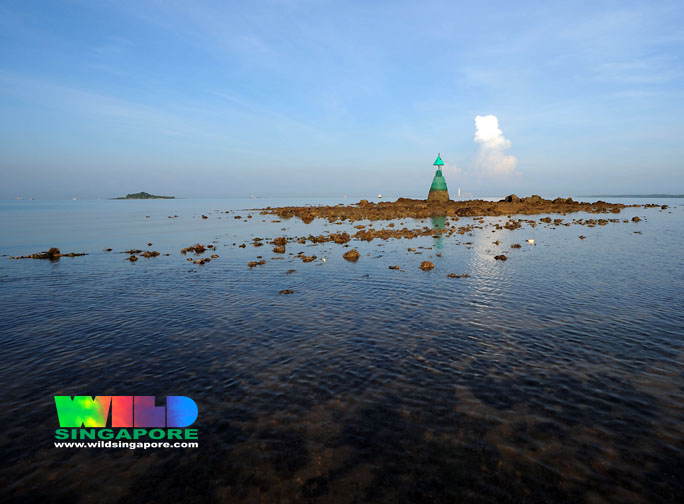
There is an intriguing island that can be seen in the distance from the Tuas shore. In the photo above, it's the island in the distance to the left of the green Merawang Beacon, which marks the natural shore spared from reclamation at Tuas.
This island is Pulau Merambong that lies on the Malaysian side of the border that cuts through the Straits of Johor. It's the yellow spot with a green surround on the navigation map above. While Merawang Beacon is the green bit sticking out of the straight-line coast of Tuas. Higher up is the Second Link.

There was recently an article in the New Straits Times about Pulau Merambong which shares a little about what can be found there.

Here's some extracts from Pulau Merambong: Fears of Singapore staking a claim
Satiman Jamin, New Straits Times 9 Jun 08
full article on wildsingapore news

For a small island, Pulau Merambong has three beaches - sandy, rocky and mangrove.

Although marine life is not as abundant as it used to be, the rare kilah or noble volute (Cymbiola nobilis) and some starfish can be found during low tide.

The kilah's sweet flesh and patterned shell are highly sought after.

It is said that seahorses and dugong used to thrive in the waters, but sightings of the creatures are rare nowadays.

A newly-painted lighthouse stands at the southeastern tip of the island. Malaysian and Johor flags perched on the tower are the only visible evidence of our country's sovereignty over the island.

Further inland, a Muslim graveyard dominates the small plains at a foothill.

Fisherman Mohd Khairul Anwar Abdul Rahman, 23, said decades ago, the folk of Gelang Patah would bury their dead on Merambong as the mainland's wild animals could dig up bodies from the graves.

The graveyard is unsafe for the barefooted as the flat, thorny seeds of the sepetir tree carpet the ground.

Sepetir (Sindora siamensis) is in the list of threatened species of the International Union of the Conservation of Nature in 2006.

On the hilltop, there are two more graves under a zinc-roof shed. The kettles and water containers in the shed suggest that people had stayed there before.

Behind the hilltop graves, more than five large holes are found in the wooded area, whose origins are linked to stories of people digging for treasures left by pirates.

Only the sandy and mangrove beaches are accessible from the hilltop.

The steep cliff with jagged rocks and mossy slippery boulders is a natural barrier to the rocky beach.

The rocky beach can be divided into three areas: the rocks and boulders underneath the cliff; the wide expanse of terraced ridges of jagged rocks; and an area of stones and pebbles carved by waves.

Snails, crabs and bivalves live in the cracks and in between rocks, only visible during low tides.

The sandy beach is made up of tiny granules of pulverised rocks, the result of waves pummelling the rocky beach next to it. Thus, the sand has the same reddish brown colour as the rocks.

A few metres from the lighthouse, at the edge of the sandy beach, rambong shrubs abound. It could have been the namesake of the island


The unique terraced rocky beach of Pulau Merambong
from Spotlight: 'Let's not lose Pulau Pisang', New Straits Times 9 Jun 08

from Pulau Merambong Waters A "Prohibited Area" For Local Fishermen
Bernama 8 Jun 08;
full article on wildsingapore news

The Malaysian government should develop the island, he said, adding that it was strategically located at the centre of shipping route to the Port of Tanjung Pelepas, Tanjung Bin power generation plant and Asia Petroleum Hub, as well as to Singapore's Tuas industrial area.

More links

Jun 9, 2008

Resorts World Sentosa and sharks fins

Here's extracts of some recent comments carried in the media on the issue...

from Of sharks' fins and highrollers
liang dingzi, Today Online 5 Jun 08
full article on wildsingapore news

AS someone who abhors any form of cruelty to animals, whether inflicted out of perversion or for commercial purposes, I applaud Resorts World at Sentosa (RWS) for its decision to keep sharks’ fin off its menu when it opens in 2010. I hope other restaurants will soon follow suit.

I find the commitment, however, somewhat half-hearted and disconcerting when it was revealed that high rollers at the resort may continue to feast on the Chinese delicacy. This is clearly a case of robbing Peter to pay Paul, negating the good that would have been otherwise achieved.

Worse, it suggests that compassion is a tradeable commodity — that wealth buys the right to be above the civilised norm that is being promoted. It does not matter that the consumption by high rollers will be confined to private rooms.

To say only a small quantity is eaten in private does not eradicate the cruelty involved to the animal and also insults logic. There is no middle ground, where the supposed balance meets.

from It’s about cruelty, not profits
Letter from Dudley Au, Today Online 9 Jun 08
full article on wildsingapore news

To say only a small quantity is eaten in private does not eradicate the cruelty involved to the animal and also insults logic.

There is no middle ground, where the supposed balance meets.


from Smaller steps to a better fin-ish?
Letter from Peter Tan, Today Online 7 Jun 08;
full article on wildsingapore news

We should celebrate that 90 per cent of sharks’ fin will not be consumed at RWS, rather than lament the10 per cent that may be.


from One man’s foie gras is another man’s poison
Letter from Teo Puay Kim, Today Online 7 Jun 08;
full article on wildsingapore news

I would like to propose the banning of the French delicacy foie gras in Singapore. We should be writing to all French restaurants to remove this distasteful dish that involves a high level of cruelty to ducks and geese.

Compassion is not a tradeable commodity :—: we should be fair to the ducks and geese as well.


from Resort's shark's fin ban 90% effective
Reply from Resorts World Sentosa, Straits Times Forum 5 Jun 08
full article on wildsingapore news

WE REFER to Mr Ace Kindred Cheong's online letter yesterday, 'Shark's fins menu: Why the double standards?', penned in response to Resorts World at Sentosa's (RWS) decision not to have shark's fin on the menu when we open in 2010.

First, we are glad to have another supporter for the shark conservation cause. RWS decided last year that we would not want to have shark's fin on the menu in order to advance our message to protect the oceans.

It is a bold decision for any casino resort to take, given that the majority of customers to global casinos are Asians, for whom delicacies such as shark's fin soup is a popular item at banquets.

RWS' final decision carries the concession that an exemption will be made only in the private gaming rooms, only upon request, and only if the customer rejects similar quality alternatives on the menu.

We recognise that this policy is a compromise, not the ideal, and open to criticism. Nevertheless, we are consoled by the fact that having the dish removed from menus effectively does away with at least 90 per cent of any shark's fin that could have been consumed on the premises.

We had to contend with a piece of business reality, but we believe that taking the first step to make a difference is better than not moving at all.

RWS' hope is that, somewhere down the road, we could report that we have not had to serve up a single bowl of shark's fin at the resort, for as long as shark finning remains unsustainable. To do that, we would need all the help from conservation supporters like Mr Cheong. You could help us convince the unconverted.


More links
  • Sentosa IR says ‘no’ to shark’s fin
    Original press release and media reports on wildsingapore news