This afternoon, despite threatening clouds, a determined bunch of Naked Hermit Crabs headed out to Belayar Creek to deal with the monster gill nets there. To finish up the job we started in an earlier trip. Led by the intrepid Andy Dinesh, we set about to remove the massive network of nets abandoned on the shore. They are half buried so there's a fair bit of digging to do.
 Then cutting them up and dragging them out. Thank goodness we have many hands and strong backs today.
 There were nets even in deeper waters.
 I felt as if we dragged out more than our body weight in nets.
 There was a particularly long one (about 50m long) across the Creek itself, ending at Keppel Club.
 We dragged it out to the Keppel Club shore and the Club staff were kind enough to offer to dispose of them. This saved us from heaving the nets out over the soft mud to the Labrador side of the shore. Thank you!
 And as we were hauling out nets, there was a boat just off the shore, setting down a fish trap as big as a man.
 The guy notices us.
 And we note their registration number.
 Andy found a very sick and dying heron. Poor thing.
 Just as we thought we took it all out, as we were leaving the shore, we came across MORE junk stuck among the rocks at the high water mark!
 We sure hauled out a lot of nets and junk! The iron rod Ivan hauled out is taller than himself! (He says now he has a tongkat longer than Ron's!)
 The tired team is quite pleased to have cleared most of the junk off the shore. June, Andy, July, Joe Lai, Ivan and Tiong Chin, all having fun with poor Robert H. who really tired out from all the work.
 And what an incredible amount of junk it was. Besides nets, there were thick ropes, barbed wire, plastic bags in various stages of disintegration, lots of golf balls, CDs and even insect repellent.
 This is killer litter! We saw some crabs and little fishes stuck in the nets.
 But gill nets can do far worse. Here's a photo of dugongs drowned in gill nets in Abu Dhabi.
 Singapore has dugongs too. What a terrible shame if these abandoned nets killed our gentle dugongs. Tomorrow, we are going to clean up the Northern coast, which we suspect is visited by dugongs.
We're looking into doing this more seriously and regularly. If you'd like to help out, drop me an email. Ria at hello@wildsingapore.com
Dec 22, 2007
Taking out the trash: Berlayar Creek, Labrador

Dec 12, 2007
Labrador Nature Reserve: Trashed?
A short low tide and drizzly, but Justin and I thought we should check out the situation at Labrador. The tide was still high when we arrived, so we decided to check the rest of the shore.
The signboard for the experiment was still lying on the shore. The original location of the signboard on the jetty above is obvious. Work is currently being done on the jetty, it appears the railings are being replaced. Perhaps the signboard fell off during the work? Let's hope there is an effort to clean up anything that fell off the jetty in the process of the work.
The shore was pretty clear of debris until we got to the cofferdam. At first I was very heartened to see that the seagrasses were still there near the cofferdam.
 But alas, there was a large accumulation of rubbish right next to the cofferdam. As well as a large pile of concrete pillars, probably parts of the structure that was originally on the shore at that location.
 In addition to the assortment of marine litter, there were large blue boards on the shore. What are they and where did they come from? They looked like part of signage.
 Looking further up the beach and the origin of this trash was immediately clear.
 There were many large ropes that looked like they were deliberately tied to the signage poles, and other junk near the deteriorating signage.
 And more trash and trashed structures.
 A closer look at the signage.
We walked through the gap in the signage to look at the cofferdam. It's humungous. In the distance is a very large cruise ship coming in to the mainland.
The high shore at the cofferdam is festooned with an incredible amount of trash. Ropes, plastic, furniture. It was mind boggling. Nevertheless, there was a row of various statues and offerings that appeared to be kept in good order despite the wet weather recently. So there must be someone coming regularly to take care of them.
 And the tree there was still draped in yellow cloth with a well-kept statue under it, protected by plastic sheeting.
 As we walked back to the entrance, Justin pointed out the trash that was deliberated stuffed into crevices in the natural cliffs.
 From green fencing (probably the one that originally marked the boundary of Labrador), to a large tire and black trash bags.
 And there was an abandoned outboard motor on the shore as well!
 Justin points out that this was too heavy to have drifted up to the shore. It must have been deliberately abandoned here. We also saw parts of an achor, and other construction debris.
By the time we got back, the tide was lower but the light fast going out. Alas, the large concrete slabs were still on the shore. The rectangular ones further down the shore were still there. Including the one further in the water. By feeling around in the water, we ascertained the PVC pipes around the second concrete slab have been removed.
The triangular slab higher up on the shore was also still there. And it was still falling apart.
 We also saw bits of PVC pipes here and there on the shore.
This picture kind of says it all ... As Andy said it, our Nature Reserve deserves more respect than this.
I feel it's time ordinary people did something about the situation. What say you about organising a clean up to get rid of all this trash? There's a lot of it, and most are very large. But with enough people with strong hands and hearts, I believe it can be done.
Update on correspondence with Singapore Polytechnic: I have not heard from Singapore Polytechnic since my last email on 25 Nov. No response to questions following the Straits Times article about the concrete slabs, and no response to my offer to give a talk about the shores to staff and students at Singapore Polytechnic.
See also
Justin's Labrador Speaks a Thousand Words
beachbum's comments on updates on Labrador namely:
1. The Singapore Government (LKY’s time) reputedly spent $10 million to clean up our waterways in the 1980s.
2. Singapore Polytechnic's Environmental Policy (as of May 2005)
Singapore Polytechnic will protect, care for and continually improve our environment by complying with relevant legislation and requirements, and maintaining an effective Environmental Management System that enables us to create a cleaner and healthier environment for ourselves and future generations.
Additionally, Singapore Polytechnic's Green Pledge is
that Parliament decided on two separate occasions to legislate that no one should dump anything on Singapore’s shores: PARKS & TREES ACT and ENVIRONMENTAL PUBLIC HEALTH ACT
Dec 5, 2007
Reef Restoration by 'engineering' techniques: what are the issues?
As I was posting the article "Electricity revives Bali coral reefs" today on wildsingapore news, I realised the significance of the following comments on 'engineering' techniques in reef restoration. In particular, on the practice of such techniques on our shores.
Here are some extracts for thought, emphasis mine.
Extracts from a Resolution "Regarding the Need for Scientific and Financial Evaluation of Coral Reef Rehabilitation Methods" (PDF) submitted at INTERNATIONAL CORAL REEF INITIATIVE (ICRI)General Meeting Seychelles, 25th – 27th April 2005
1. Tropical coral reefs have been extensively damaged by pollution, overfishing, sedimentation, coral bleaching and disease throughout large areas of the Caribbean and Indo-Pacific regions.The International Coral Reef Initiative (ICRI) is a partnership among governments, international organizations, and non-government organizations. It strives to preserve coral reefs and related ecosystems by implementing Chapter 17 of Agenda 21, and other relevant international conventions and agreements of the Convention on Biological Diversity, December 1994.
More recently there has been damage due to natural events (e.g. tropical storms and the devastating tsunami of 26 December 2004);
2. The area of reefs damaged during these events is often vast, covering hundreds to thousands of square kilometres, such that the economies of local communities and countries are adversely affected;
3. Naturally Governments and the private sector with economic interests in coral reefs will seek ‘quick’ solutions, some based on engineering principles to ‘repair’ the damage and to accelerate natural recovery processes;
4. These agencies, however, may lack the capacity or expertise to evaluate the scientific and costs-to-benefit relationships of proposed coral reef rehabilitation techniques and to apply them in an effective and sustainable way;
5. Most coral reefs have considerable natural recovery capacity, provided that there are supplies of suitable coral, fish and other larvae, and that chronic disturbances such as excess sedimentation, pollution and over-fishing are minimised. Coral reefs can begin to recover immediately, with new coral growth and fish stocks naturally re-colonising the ecosystem within one to two years; complete recovery may take longer depending on the environment;
6. A wide range of ‘engineering’ techniques have been proposed as reef reconstruction or rehabilitation techniques by various commercial and non-commercial organizations. These include:
i. a mechanism using wire frames through which electricity is passed to accrete calcium carbonate and accelerate the growth of transplanted corals;
ii. installation of artificial reefs, including concrete structures; and
iii. mechanisms for re-cementing and re-gluing corals and other organisms to the substratum.
8. [It is} acknowledged that there is often a valid case for rehabilitation of damaged reefs and that some innovative and new approaches to coral reef conservation and management may potentially have applications, however we are concerned that there have been insufficient peer-reviewed, long-term scientific studies of reef rehabilitation using these and other techniques.
Moreover, there have been few cost-benefit analyses to assess effectiveness of the methods over natural recovery processes.
The available evidence suggests that some techniques may be useful in specialized cases, but all have limited or no application and value for large-scale coral reef rehabilitation.
In addition to effectiveness considerations, construction of any engineered structure on a coral reef must be evaluated against any potential environmental damage caused during construction or later degradation;
The proponents of this ICRI Resolution are in agreement that:
• Artificial reefs of any kind cannot replace a natural reef and do not function as effectively as a living coral reef;
• Coral reefs can usually repair themselves quickly if environmental conditions are suitable, and chronic disturbances are reduced;
• These techniques have the potential to cause environmental damage to coral reefs and associated ecosystems during construction and operation;
• Investments in coral reef conservation and preservation should therefore focus on removing the causes of coral reef decline and facilitating natural and longterm recovery.
The proponents of this ICRI Resolution suggest that the following basic questions should be answered prior to applying reef rehabilitation methods:
• Is a lack of colonisable habitat a limiting factor for coral settlement and reef development?
• What it the area of damaged reef that is targeted for rehabilitation?
• What are the chances for natural recovery of the reef? For example: are there available natural sources of coral larvae; are there stable habitats for settlement; and are environmental conditions favourable for reef growth?
• What is the cost per square meter of treatment to achieve a viable functioning reef?
• How much will a proposed treatment cost to repair a substantial area of damaged reef?
• What are the potential economic of sociological returns if a reef is rehabilitated?
• What are the likely impacts on surviving reef areas used as a source of collected transplant colonies?
• What is the likelihood of survival to normal growth and reproduction of colonies transplanted onto artificial structures?
• Have the causative stresses that led to reef damage been addressed/removed?
• Will any added structures be stable in the long-term and not degrade, thereby creating a future problem?
Dec 4, 2007
5 Dec is International Volunteer Day
 On World Volunteer Day, a special THANK YOU to all the volunteers on the wildfilms crew and to the beachfleas and all the wonderful people who have supported the efforts for our shores.
There is much to do and it would not have been possible without all of you.
Excerpt of message from the UN Secretary-General
on International Volunteer Day, from the world volunteer web
The challenges facing our world are vast and complex -- from resolving conflicts and building peace, to alleviating poverty and reaching the other Millennium Development Goals.Full text of message on the wildsingapore news blog
Tackling these challenges requires all of us to work together -- Governments, international organizations, the private sector and civil society in its broadest sense.
Volunteers play an indispensable role in these efforts. Yet, the remarkable contribution of voluntary action around the world is not sufficiently recognized.
Dec 3, 2007
Labrador's living intertidal shore
At high tide, when murky waters conceal the intertidal zone, most people might dismiss our shores as being dead. But just because we can't see anything, doesn't mean that there is nothing interesting on the shore.
An intertidal zone is the area of shore that is exposed (and covered) as the tide changes. At low tide, the water often becomes crystal clear and the wonderful range of marine life can be easily seen by ordinary people without having to swim or dive.
Here are some of the sights that we used to see on Labrador during low tides before it got impacted by coastal development and other works there.
A natural and complete intertidal zone is made up of several different kinds of ecosystems. The coral reefs found in deeper waters are part of the continuum of these ecosystems. The Labrador Nature Reserve shore ecosytems include the coastal forest on the natural cliffs, the natural rocky shores, sandy shores, seagrass meadows, coral rubble and corals on the reef flats which are exposed at spring low tides. The subtidal reefs are part of these as well. These ecosystems are now rare and those on Labrador are the last on the mainland.
The different ecosystems interact and affect one another. Some marine life rely on the different ecosystems to survive. For example, some fishes shelter in seagrass meadows while they are small and move out to the reefs and deeper waters as they mature. Some prawns that we eat do the same. Labrador's large meadow of Sickle seagrass (Thalassia hemprichii) are the last on the mainland, and probably the largest that are accessible to the general public. This is a photo of the seagrasses taken in Jan 05. Labrador also has patches of other kinds of seagrasses throughout the intertidal zone. There used to be a lush meadow of Spoon seagrasses (Halophila ovalis) where the cofferdam now is.
Sometimes, we would see large carpet anemones among the seagrasses. As elsewhere on our shores, these are homes to tiny anemoneshrimps. Among the seagrasses were all kinds of fishes
 Including the Milk-spotted pufferfish (Chelonodon patoca) and filefishes (Family Monacanthidae)
  The well camouflaged Feathery filefish (Chaetodermis penicilligerus) takes a keen eye to spot.
 Mating Coastal horseshoe crabs (Tachypleus gigas) were sometimes seen on the shore. They are on the list of threatened animals of Singapore due to habitat loss.
 Among the seagrasses, one might spot the pretty Moon crab, or the elusive but very common Hairy crab.
The coral rubble area may appear dead, but it's full of life! The dead corals provide a surface for animals such as sponges to grow. And fascinating creatures that feast on sponges may be found there. These include nudibranchs such as the stylishly margined pale yellow Glossodoris atromarginata and the brightly spotted green Ceratosoma sp. nudibranch.
 These are two nudibranchs seen whose identity we're still not quite sure of.
Crabs, shrimps and other animals were also commonly seen among the coral rubble. The bright red Mosaic crab (Lophozozymus pictor) is highly poisonous to eat. It is also on the list of threatened animals of Singapore. Many kinds of swimming crabs were also encountered, but this one with the blue rings on its legs is seldom seen elsewhere.
The coral rubble is a great place to spot octopuses. While divers often seldom encounter these animals, on the intertidal, we regularly see several of different sizes on a single trip. They are more active at night.
While there are a wide variety of snails on our shores, surely the most stunning must be the Spider conch (Lambis lambis). There were regularly seen on Labrador's intertidal shore.
Labrador intertidal got hard corals meh? Yes, it does! And many different kinds too. There used to be a particularly large clump of branching corals that can be seen at low spring tide.
 And other kinds of branching corals were also seen, such as Pocillopora sp.
 Branching hard corals shelter all kinds of animals, including seahorses!
 There were also many large boulder corals, some half a metre or more in diameter.

 The above are probably Favid hard corals.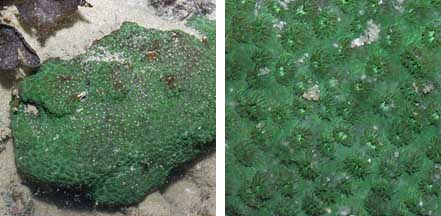
 Some unknown boulder corals in bright colours.
 There were also several large Psammocora sp. hard corals.
There were also many colonies of disk- and plate-shaped hard corals.
 Some plate corals covered large areas of a metre or more.
Encrusting corals like this Goniopora sp. is particularly common even among the coral rubble. While Anemone hard corals (Goniopora sp.) are often mistaken for anemones rather than hard corals.
 Among the living hard corals on the intertidal are other animals such as soft corals and sea anemones such as the branched tentacle sea anemone (Phymanthus sp.) and small shy star-like anemones.
 Colourful reef fishes were also encountered on the intertidal.
 Such as these two kinds of butterflyfishes: the Kite butterflyfish (Parachaetodon ocellaris) and the Copperbanded butterflyfish (Chelmon rostratus).
A careful observer might spot the Spot-tail frogfish (Lophiocharon trisignatus)!  It is actually quite regularly sighted by the wildfilms team as they are very experienced in documenting the shores.
The volunteer team that visits Labrador have been documenting all our shores for the last six years, in still and video. While we are there, we also monitor impacts to the shores such as collection, abandoned driftnets, fishtraps and other abandoned equipment, and impacts of coastal developments.
Among the issues raised in the past include
Poaching of hard corals on Labrador
Large amounts of driftnets abandoned at Berlayar Creek
Collection of rare animals on Changi
and impact of reclamation at Sentosa for the Integrated Resort
which includes comments on the EIA
The team also supports visiting scientists who come to study our shores including
trips with Dr Daphne Fautin (world authority on sea anemones)
trips with Dr Dan Rittschoff and his students from the US
The team also participates in studies of the shores such as
Kok Sheng's study of the recovery at Chek Jawa following the mass deaths earlier this year and Sijie's study of the dog-faced watersnake.
The team also works with efforts such as the relocation of corals at Labrador prior to work on the cofferdam.
Most of the team members are also very active volunteer guides on many of the walks offered to the public (Chek Jawa, Semakau) as well as with groups such the Naked Hermit Crabs and TeamSeagrass.

