SAND MINING AT AREA 1
AND DUMPING AT (i) JURONG ISLAND LNG PROJECT
AND (ii)PASIR PANJANG TERMINAL PROJECT WORKING AREAS
from PORT MARINE NOTICE, NO. 140 OF 2008 dated 31 Jul 2008
This is a revision of Port Marine Notice No 106 of 2008.
The working area at PPT has been revised and working period extended.
With effect from 1 Aug 08 to 31 Jan 09
DREDGING AREA: Area 1, Eastern part of Singapore (wildfilms note: no map included of this area in the Port Notice)
DUMPING AREA (Jurong Island Project – Working Area A & B)
DUMPING AREA (Pasir Panjang Terminal Project – Working Area 6)
24 hours daily including Sundays and Public Holidays.
The reclamation works will involve dredging by Trailer-Suction-Hopper-Dredger (TSHD) at Area 1.
Area 1 extends from the Singapore Port Limit into the westbound lane of the Traffic Separation Scheme (TSS) within the Singapore Strait.
All dredged materials will be dumped at Jurong Island project (see Working Area A and B of plan Attachment-1) and Jurong Island LNG project (see Working Area C of plan Attachment-1) and Pasir Panjang Terminal project (See Working Area 6 of plan Attachment-2)
Further enquiries relating to the project can be directed to the following Project Co-ordinators:
Jurong Island project and Jurong Island LNG project: Mr. A. Muhaimin at Tel No: 98178572, email: muhaimin@pkdbh.com.sg; and
Pasir Panjang Terminal project: Mr. Y. Abe at Tel No: 9664 8810, email: y.abe@mypenta.net .
Jul 31, 2008
Dredging and dumping at Jurong and at Labrador
posted by
ria
at
9:27 PM
0
comments
links to this post
labels: cyrene reef, labrador, mpa notice, threats, tuas
Cyrene Reef exhibit at the Raffles Museum from 12 Aug
Singapore’s Natural Heritage - Cyrene Reef
Located west of Labrador Beach, between Pulau Bukom and Jurong Island, Cyrene Reef is situated in the middle of a busy shipping lane. The wonders of this reef are only reveal at low tides. Flaunting a long sand bar flanked by lush sea-grass meadows and lagoons of coral rubble, Cyrene Reef is rich in marine diversity despite its proximity to offshore refineries and other developments.
This small exhibit showcases the beauty of Cyrene Reef and its inhabitants.
from the RMBR news blog
More about Cyrene Reef.
More about the RMBR public gallery and how to get there.
Opening hours: Monday to Friday: 9am-5pm (Closed on Saturday, Sunday and Public Holidays)
Location: Block S6, Level 3, National University of Singapore, Science Drive 2
Website: http://rmbr.nus.edu.sg/
Contact: 6516-5082
posted by
ria
at
7:30 PM
0
comments
links to this post
labels: cyrene reef
Changi: A closer look
3am and we're on Changi for the last of this year's morning spring low tides. We've learnt that it pays to take a closer look when out on the shores.
This patch of shore may look boring at first glance, but it has lots of interesting animals! Can you see at least four of them? OK, the photo is rather low res.
There was a mantis shrimp at the top left corner. This hunter has snazzy fold-up pincers that resemble the arms of the more familiar insect, the praying mantis. It's not a true shrimp and belongs to a separate Order Stomatopoda.
In the middle is a living Gong gong (Strombus canarium), its pair of eyes on stalks sticking out from under the well camouflaged shell.
On either side of the snail, the tiniest little Striped hermit crab (Clibanarius sp.) that I've seen. And a tiny scorpion fish, probably Paracentropogon longispinis. Indeed we saw lots of fishes today at Changi. Here's more about the fishes we saw today.
Taking a closer look at the many Window pane shells (Placuna sp.) on the shores, I noticed fuzzy stuff on the surface of one.
They are the feathery tentacles of keelworms (Family Serpulidae) that settled on the shell!
Here's a closer look at another bunch of keelworms that settled on a log on the shore.
Hard surfaces also provide a place for animals such as hydroids to settle.
Although they look like colourful plants, these are actually colonies of tiny animals.
Here's a closer look at the individual polyps that make up the colony.
And another look.
I also came across a strange looking sea anemone.
After I took a close look, I realised it had much longer tentacles!
But these were so transparent I nearly missed them!
Even large animals are well hidden! Such as the ghost crabs!
The ghost crabs (Ocypode cerathophthalmus) come out of their burrows at night but it appears, even when they are out hunting on the shores, they can skulk half buried in the sand!
Ghost crabs move really fast!
Here's one that's settled down to let us take a photo of it.
Today the tide was really low so we could venture out quite far. Where we saw a Bailer snail (Melo melo)!
In our explorations, we have only seen this snail regularly at Beting Bronok. It's nice to see it also on Changi.
We also saw lots of sea cucumbers today, as well as other echinoderms. More about these sightings.
Also seen today, several small carpet anemones (Stichodactyla sp.), lots of big white sea urchins (Salmacis sp.), a large Peacock sole (Pardachirus pavoninus) in deeper water, some moon crabs, lots of swimming crabs of all sizes, plenty of hermit crabs many with anemones on their shells, many 'pencil' sea pens, and many active moon snails (mostly Polinices didyma).
Missing today: big peacock anemones (Order Ceriantharia) (there were a few of the smaller kind), button snail shells (Umbonium vestiarum).
posted by
ria
at
7:15 PM
0
comments
links to this post
labels: changi
Fishes at Changi
There were lots of tiny little fishes among the seagrasses at Changi this morning.
A really tiny butterflyfish! It's probably a Kite butterflyfish (Parachaetodon ocellatus).
A miniscule filefish (Family Monacanthidae) with an even tinier nearly transparent fish swimming above it. Only its golden eyes are obvious!
Another tiny black fish. I have no idea what it is. It was too tiny and moving about too much to take a good shot of.
Of course Changi has other fabulous fishes that are larger, but still require a keen eye to spot. These were all found by Master Seeker Chay Hoon.
A rather large seahorse that's hairy (Hippocampus kuda).
A beautiful Feathery filefish (Chaetodermis penicilligerus).
This is probably a fang-blenny (Family Blennidae).
And several fishes that I have no idea of their identity.
This is probably a flathead (Family Platycephalidae) although it's not very flat.
And another flathead.
And this odd little fish with a pair of bristles under its chin.
Seagrass meadows such as those on Changi are a nursery for baby fishes. Some of which are important species to fishermen. Among those seen today were Rabbitfishes (Family Siganidae) and this perch, probably Pelates quadrilineatus .
There were also lots of prawns among the seagrasses.
Conserving seagrasses at nearby Chek Jawa and Pulau Sekudu will allow everyone to enjoy fishes and other marinelife. Protected seagrasses provide a safe place for young fishes to grow up and populate the surrounding waters.
posted by
ria
at
7:05 PM
0
comments
links to this post
labels: changi
Curious Cucumbers of Changi
This morning, we seemed to have encountered quite a few strange sea cucumbers on Changi. Although the common name is sea cucumber, these are animals and not vegetables. They belong to Phylum Echinodermata which includes sea stars, sea urchins, sand dollars and feather stars.
Marcus found this cuke. This is the second time we've seen it, the first time also on Changi. It has an obvious underside and not very long tube feet.
Robin was very interested in having a look at it, but we didn't find it when we went with him. At first, I thought the sea cucumber above was a 'cleaned up' version of the sea cucumber below.
But when we went sea cucumber searching with Robin a few months ago, he pointed out that this 'sandy' sea cucumber is not covered with sand. It actually resembles sand in texture and colour!
And here was another strange sea cucumber tucked up against a Window pane shell and other debris. It had really long tube feet arranged in rows along the body.
And YET another sea cucumber that I can't recognise. It seems to have its long tube feet in rows along the length of the body.
There was this elongated sea cucumber with tube feet all over the body. It was very active, moving about in the water, stretching out and contracting. I'm not sure if it's a rather active Ball sea cucumber (Phyllophorus sp.) or some other kind of sea cucumber.
Of course, there were lots Thorny sea cucumbers (Colochirus quadrangularis) which have soft 'thorns' on the upperside and a distinct underside with rows of little red tube feet.
Less commonly seen is the Warty sea cucumber (Cercodemas anceps). Also seen were lots of ball sea cucumbers buried in the sand bars (Phyllophorus sp.) together with smooth sea cucumbers. As well as one Sandfish sea cucumber (Holothuria scabra).
Changi is a great site for echinoderms!
Today we saw more sand dollars than usual. Usually, we see only a handful. But today, there were quite a few close to one another on several parts of the shores.
There were lots of sand stars (Astropecten sp.) of various sizes.
And one star with only one complete arm!
There were also tiny ones with a different pattern.
Several of them actually.
And here's another one.
We will await Kok Sheng's study to find out whether these sea stars are different species or just different patterns of the same species.
If anyone has ideas of about the identities of these animals, please do share. Constructive views are always welcomed so that we together we can learn more about our shores.
Kok Sheng saw even more splendid stars today at a different part of Changi! More on his wonderful creations blog.
posted by
ria
at
7:00 PM
0
comments
links to this post
labels: changi
Jul 29, 2008
Feedback requested for a Sustainable Singapore
[update: at mid-point of the feedback gathering process, not many voices for our wild shores. Please speak up for our shores.]
Here's an opportunity to speak up for our wild places ...
From the Sustainable Singapore page on the MEWR website:
As a responsible member of the international community, Singapore would want to play our part in mitigating greenhouse gas emissions. We would also wish to sustain economic growth and maintain our quality of life. By being more efficient in the way we use resources, Singapore would be contributing towards reducing carbon emissions while positioning ourselves well for a more carbon-constrained world that may emerge if ongoing negotiations on climate change result in a post-2012 global agreement.
The vision:
Sustainable development for Singapore means being able to support future economic and population growth while maintaining a quality living environment that is clean, green and healthy.
The vision for Singapore is to be a lively and liveable global city – a city that is distinctive in its ability to offer a unique combination of economic opportunity, vibrant lifestyle and quality environment, for a cosmopolitan population, providing a good home for current and future generations of Singaporeans. It would also be a city that continues to be attractive to the foreign talent and investments which help us to grow the economy and high-value jobs.
Priority Areas:
To achieve this vision and address the domestic and international challenges which are emerging, the IMCSD will focus its efforts on three priority areas:Concurrently, further efforts will be made on two supporting fronts –
- Resource management
- Pollution control
- Quality of the physical environment.
Our initiatives:
- encouraging people and industries to adopt practices that are sustainable in the long term and
- developing new capabilities and technologies which optimise resources and improve environmental performance.
We should make our existing buildings more energy and resource efficient, as they form the bulk of our built environment.
To further distinguish Singapore as a City in a Garden, new areas such as skyrise greenery, and measures to better document and protect existing biodiversity are being studied too.
Resource efficiency (i.e. energy efficiency, water efficiency and waste minimisation and recycling) will be actively promoted among industry and businesses.
Efforts to encourage greater use of public transport contribute to sustainable development since public transport not only minimises land requirements but is more energy efficient than other transport modes.
Give your Feedback
- What else can the Government do to ensure Singapore continues to be a lively and liveable city?
- What can ordinary Singaporeans do to support a sustainable Singapore?
Links to media reports on the wildsingapore news blog
Wanted: Public's ideas for a greener Singapore
Feedback from the ground to shape 10-year programme
Tania Tan, Straits Times 29 Jul 08;
Sustainable if costs don’t tip the scales
Today Online 29 Jul 08;
posted by
ria
at
9:00 AM
0
comments
links to this post
labels: news
Jul 27, 2008
Another first record for Cyrene Reef?
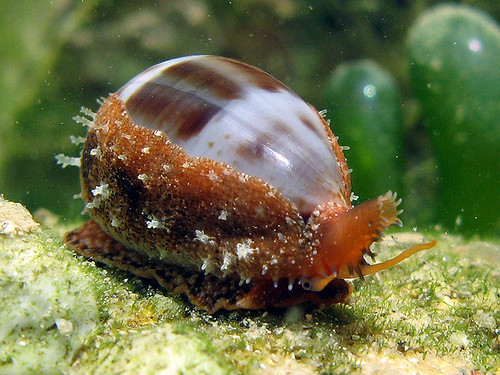
Chee Kong has shared the identity of this cowrie on his flickr. It is Blasicrura teres, a possible new record for Singapore! He also added a link to an article on the taxonomic status of this species on the man and mollusc website. From the site, it appears identifying this cowrie is a really 'complex' issue :-)
The cowrie was found by Chay Hoon during our recent trip to Cyrene Reef. Here's her photo of it on her flickr.
Here's photos of the shell, the upper side
Side view
Underside, with the very handsome animal retracted.
Wow! This is exciting!
Update (28 Jul): Thanks to comments from "Collector" on this blog, ChimCK has posted an amendment to this identification on his flickr
"Previously suspected to be Blasicrura teres and hence another possible new record in Singapore.Ah well, I'm just glad there are special animals on Cyrene, even if they are not first records!
Further reading of literature and comments from knowledgeable collectors suggest that this specimen is more likely to be Erronea walkeri walkeri.
This species has been recorded in Singapore.
Some species of Erronea have similarly looking soft parts (e.g., mantle, foot and papillae)".
Thanks to everyone for contributing to the issue. We sure learn a lot when we discuss with one another!
posted by
ria
at
12:01 PM
6
comments
links to this post
labels: cyrene reef
Jul 25, 2008
Massive dredging off Cyrene Reef begins
DREDGING WORKS FROM JURONG ISLAND TO PULAU ULAR
from PORT MARINE NOTICE NO. 139 of 2008 dated 23 Jul 2008
With effect from 30 Jul 08 to 30 Nov 08, at Selat Pandan, Sinki Fairway and West Keppel Fairway, 24 hours daily, including Sundays and Public Holidays.
Dredging works will be carried out by the grab dredger “Pandora” within the sectors as indicated in the chartlet. The grab dredger will be held in position by a 4-point anchor mooring system within the working area. The anchors will be marked by marker buoys. The safety working zone is a circular area of 200-metre radius centred at the dredger. A safety boat will be deployed in the immediate vicinity of the working area to warn other craft of the project work.
Further enquiries relating to the project can be directed to Mr P Bogers, the project manager, at Tel No: 9139 6094 or email bog@vanoord.com
wildfilms note: besides this dredging work, the massive reclamation project at Pasir Panjang Port is also near Cyrene Reef.
posted by
ria
at
7:29 PM
0
comments
links to this post
labels: cyrene reef, mpa notice, threats
Marine construction off Labrador continues
MARINE SOIL INVESTIGATION AT PASIR PANJANG TERMINAL PHASES 3 AND 4
from PORT MARINE NOTICE NO. 138 of 2008 dated 23 Jul 2008
With effect from 26 Jul 08 to 19 Sep 08 at West Keppel Fairway, 24 hours daily, including Sundays and Public Holidays.
Soil investigation works will be carried out by means of marine boring using jack-up barges. The tug boat will be used for the shifting of the jack-up barges. There are no anchors required for the jack-up barges. The safety zone is a circular area of
30-metre radius centred at the locations of the jack-up barges. A safety boat will be deployed to warn other vessels to keep clear of the barges for the whole duration of the works.
Further enquiries relating to the project can be directed to Mr Y Abe, the project co-ordinator, at Tel: 9664 8810, email: y.abe@mypenta.net.
wildfilms note: this is a continuation of the massive reclamation project to develop Pasir Panjang port.
posted by
ria
at
7:14 PM
0
comments
links to this post
labels: cyrene reef, labrador, mpa notice, threats
Jul 22, 2008
Another Cyrene Walk
6am and we're back on Cyrene with new friends.
Another successful landing! Siva has upload a great video clip of the amphibious landing with a 360 degree view of Cyrene Reef, and the taking of the obligatory traditional group photo.
Today our first-time guests are Ryan and Edwin from the "I Want to Go to Cyrene" facebook group who submitted this post about Cyrene, and who learnt about Cyrene at Reel Revolution. And Aubrey and Jia Chien participants of the Reel Revolution effort. As well as Mingjuan and Chai Joo of Cicada Tree Eco Place. We are also joined by James from NParks, and Siva and Airani from the Raffles Museum as well as of course the Naked Hermit Crabs.
Just a few steps onto Cyrene and we are already fascinated by the sand dollars and sea stars at our feet!
With help from Robert and Andy, we soon find the Knobbly sea stars and long-spined black sea urchin, amidst the colourful colonial anemones and other creatures of the coral rubble.
As Andy shared about the sea urchin, I desperately hunted for the Nemo anemone.
And I found the nem! And today, we saw a little bit of the tail of the anemonefish! Ryan asked lots of interesting questions about anemonefishes too.
The young ladies from Reel Revolution are diligently recording all our finds!
And Jun walks ALLLL the way from the other end to show the group the same cushion star that we looked at yesterday.
She shared about this special star as well as the white sea urchin that were plentiful at the area where she was at.
Meanwhile, Andy has found a carpet anemone with a pair of anemone shrimps!
We all take a closer look at it and at first it's hard to spot the shrimps as they are rather transparent.
This is the mama shrimp. She is bigger and has more white spots.
We come across another sandy patch full of common sea stars! Behind us in the shipping channel, a huge ship transporting cars passes by.
We quickly had a look at the reef before the tide turned. And Mingjuan spots a cuttlefish! The deeper water is full of hard and soft corals and all kinds of other strange creatures.
The hard corals are found even quite high up on the shore among the seagrasses.
The seagrasses near our landing point is just teeming with baby Knobbly sea stars!
I couldn't help taking lots of photos of them.
They come in all colours and patterns!
The seagrass meadows are really a nursery for all kinds of animals. These are the white ribbon-like egg masses of possibly a nudibranch.
And another egg mass with tiny coils of eggs, laid on a seagrass blade.
We saw a really tiny butterflyfish! This is the tiniest one I've ever seen.
And among the seagrasses, a Blue dragon nudibranch (Pteraeolidia iantinia).
Further along, Chee Kong spots this small Melibe nudibranch! Andy also spots the big Dendrodoris that we saw yesterday, and Chee Kong finds a purple Nepanthia sea star.
As we gather to go home, the team share this special find by Chay Hoon.
I have no idea what it is! It may be another first record! We'll have to wait as the experts are consulted. Fabulous! (Update: Chee Kong just updated on the identity of this fabulous snail).
DHI is on the reef for this low tide. They swim back to their boat! I always tell our party that if they are late for the tide, they will have to do this too.
On the way back, we take a quick look at the activities on the shores of the West Coast.
Huge oil rigs are being worked on.
As well as a really enormous ship with strange contraptions on it.
I think this is what they call a 'rust bucket', being towed into the working area of the West Coast shore.
And the Polytechnic people were out on the water today.
It was great weather again, thanks to Melvin. Unfortunately, Melvin is not feeling too well today. We hope he gets better soon as we can't go to Cyrene without him!
Over the last two days, the "I've Been to Cyrene" buttons were launched!
Everyone who goes (and survives to return) gets one!
If you want to go to Cyrene, simply join the blogging contest! Hope to see you on Cyrene!
More about what was seen on Cyrene on Kok Sheng's wonderful creations blog with really gorgeous photos of the sunrise, more stars and other exciting finds.
posted by
ria
at
6:28 PM
3
comments
links to this post
labels: cyrene reef
Jul 21, 2008
Cyrene walk with URA
6am and at daybreak, an intrepid group from URA join us to explore Cyrene Reef!
Thanks to Bert (in orange) who gathered this sporting group for an early morning trip. And of course, thanks to the ever valiant Melvin who takes us there and back in more or less one piece, but doesn't seem to own a shirt.
Another successful landing!
While the Star Trackers, Naked Hermit Crabs and Dr Tan Koh Siang and Lim Swee Cheng from TMSI head off to do their work, YC and I bring our guests to explore Cyrene.
We get straight down to checking out this glorious shore. Here's YC sharing about the amazing marine life found on the reef. Reminiscent of Chek Jawa, there are sand dollars, peacock anemones, carpet anemones and their shrimps, fan shells, fan worms and other creatures of the seagrass and sandy shores. We visited the Nemo anemone but the fish was in hiding and didn't show a fin today. Alas.
Sea urchins, synaptid sea cucumbers and sea stars are abundant here too. The Common sea star (Archaster typicus) above is particularly prolific on Cyrene, which unfortunately, no longer is the case at Chek Jawa. So we must appreciate even our common marine life as they may be lost before we know it.
Cyrene we realise now from the work by the Star Trackers, is an important shore for baby Knobbly sea stars (Protoreaster nodosus). And there were lots and lots of these babies!
Today we are very lucky to have some experienced Naked Hermit Crabs with us to find special stuff. And July has found another star!
He walked all the way back from the end of Cyrene to show it to the group.
It's a small Cushion star (Culcita novaeguineae), which doesn't quite look like a star until you look at the underside which has five parts. That was a really special treat! Thanks July!
On the way from the seagrass area to the reefs, we came across a gigantic nudibranch!
It is some sort of Dendrodoris, possibly Dendrodoris tuberculosa, see entry on Dr Bill Rudman's Sea slug forum.
It has a distinctive underside with spots. I've only seen something like it once before, at Pulau Semakau. What a great find!
We quickly and carefully waded out to the reefs to catch a glimpse of the corals there before the tide turned. Fortunately, we didn't encounter Mr Stonefish.
The reefs has lots of corals as well as the usual nudibranchs like Glossodoris atromarginata and the Phylids, and flatworms too! We also came across a few mushroom corals. And all kinds of fishes zoomed by in the water. We also watched a few worm eels, a worm-like fish that burrows. And met Eunice the Worm of Love: the Giant reefworm (Eunice aphroditois) can grow to 1m long and looks like a centipede. Quite scary when you first see it.
The reefs at Cyrene also has stupendously large soft corals of all kinds of shapes. Here's a bunch that are bigger than all of us put together!
One of the keen eyed ladies spotted this in the water and we wondered for a while what it was until we realised it was a flatfish! And it's the Peacock sole (Pardachirus pavoninus). I've not seen this on the southern shores before. What an excellent find!
The guests are impressed by the clear water and the abundant variety of marine life despite the proximity of major industrial facilities. YC did a really great job guiding, so I got to slack off a lot.
We explore more of the reef even as the tide turns.
As we head back, another special find by the rest of the team!
It's the marvellous Melibe nudibranch! This predator has an expandable hood that it uses to grab at small (and ostensibly slow moving) prey. This is really a special find and this nudibranch seems to be common only on Cyrene Reef. Here's our first sighting of it on Cyrene in April (after looking for it for nearly four years on all our other shores), and again on other trips to Cyrene in May and again in May. Chay Hoon has a video of it swimming!
The Melibe sparks off a paparazi frenzy of shooting, complete with impromptu umbrella to shield from glare.
All too soon, the tide turned and it was time to go home.
We began the trip in a mizzle (miserable drizzle) . But thanks to Melvin's presence, it stopped during our trip! And only started up again as we headed home. Melvin is a miracle weather wizard.
But just as we were about to board the boat, Jun found a blob on the sand. July gave a hand at digging it up and lo and behold, it's a sea cucumber that none of us have seen before!
Could it be another new record for Cyrene? We'll have to consult the experts and find out more! There's so much to learn about this amazing reef!
But now it's time to go home as the tide is really rushing in!
Cyrene is quickly disappearing under the rising sea with just slivers of it in front of Pulau Bukom in the background.
As the first team heads back, we wave goodbye to the second team left standing on a fast disappearing shore.
I'm looking forward to more exciting finds and another bunch of guests for tomorrow's trip to Cyrene! We also hope our URA friends will come back for another visit!
posted by
ria
at
1:02 PM
6
comments
links to this post
labels: cyrene reef
Jul 20, 2008
Chek Jawa with TeamSeagrass
5am and the intrepid Seagrassers were gathered again for another round of monitoring, this time at Chek Jawa.
It's our first time going to Chek Jawa so early in the morning, just to catch the low tide.
This year, there are not many good low tides during daylight on a weekend.
The seagrasses were doing very well indeed!
But how is the rest of Chek Jawa faring? We've always been concerned about recovery since the mass deaths of some key Chek Jawa marine life following massive flooding in 2007.
This is my first predawn trip to Chek Jawa so it was a good opportunity to check out the marine life that is more active in the dark.
Carpet anemones and peacock anemones seemed to be doing fine. They festooned the shores like many-coloured flowers.
There were also some of these maroon sea anemones that infest Pulau Sekudu. But they were not so plentiful on Chek Jawa.
And one sea anemone that I've not seen before. Or is it some kind of peacock anemone? Hmmm...
The coral rubble was very bare.
While there were many clumps of these long branched purple sponges, there were very few other sponges.
Chek Jawa is best known for its echinoderms: a group which includes sea stars, sand dollars and sea cucumbers.
There were lots of biscuit sea stars (Goniodiscaster scaber).
Several cake sea stars (Anthenea aspera).
Including this very pretty pink cake sea star!
Even the rarely spotted Nepanthia sp. sea star was spotted.
As expected, sand stars (Astropecten sp.) were particularly plentiful, especially near the North sand bar.
And two of these bluish baby knobbly sea stars (Protoreaster nodosus) were seen in the seagrass area! This is the first time for me!
Alas, we were unable to find any of the Common sea stars (Archaster typicus).
Sea cucumbers were also plentiful today.
There were several of the warty sea cucumbers (Cercodemas anceps) which are usually less commonly seen.
Elsewhere, thorny sea cucumbers (Colochirus quadrangularis) are usually more common, but today on Chek Jawa only a few were seen.
It was good to see lots of ball sea cucumbers (Phyllophorus sp.) and a few smooth sea cucumbers.
It was particularly heartening to see several large sandfish sea cucumbers (Holothuria scaber). These edible sea cucumbers are very rare on our other more accessible shores.
The shores of Chek Jawa were teeming with sand dollars!!
There were countless cake sand dollars (Arachnoides placenta) especially on the North sand bar.
A huge surprise were the large numbers of keyhole sand dollars seen (Echinodiscus truncatus). These sand dollars are usually rather rare. And those seen today included a huge one that measured 9cm across!
Nobel volutes (Cymbiola nobilis) were wiped out in the flood of 2007 so it was nice to see a small one today. The snail in the photo on the right is an olive snail (Family Olividae), my first sighting on Chek Jawa. I also saw one Miliaris cowrie (Cypraea miliaris).
I didn't see any nudibranchs except for the large Armina babai. Several were seen by the Team. But Chay Hoon said a Cerberilla was also seen, while I did see one egg ribbon on a rock so the nudis are around.
At first I thought the little black things under this peacock anemone was strange looking Phoronid worms. But it turned out to be a tiny sea pen!
Besides this flowery sea pen (Family Vertillidae), there were also a few of these white 'sea pencils' (which have yet to be identified). But the sea pens with the orange 'root' (Pteroides sp.) were not seen.
Still Missing in Action: Besides the missing Common sea stars (Archaster typicus), no Button snails (Umbonium vestiarum) were seen, and the area where they used to be is now full of tubeworms.
As we head home, we take a closer look at the beautiful Memecylon edule tree which is in full bloom.
This rare coastal tree was once thought to be lost to Singapore, until these specimens were rediscovered on Chek Jawa.
Another rare coastal tree is Barringtonia racemosa with these pendulums of delicate flowers. This tree was planted at Chek Jawa as part of efforts to conserve our native plants.
The terrestrial elements of Chek Jawa are more obvious to visitors. But what is truly special about Chek Jawa is the intertidal marine life. It is not only precious but also vulnerable as the mass deaths demonstrated. Regular studies such as TeamSeagrass and other documentation efforts help keep track on what is happening on this shore.
posted by
ria
at
9:45 PM
3
comments
links to this post
labels: chek jawa, pulau ubin
Jul 19, 2008
Sentosa with TeamSeagrass
5am and I'm out on Sentosa early to catch the outgoing tide before the TeamSeagrass monitoring starts at 6am.
And the high shore is teeming with land hermit crabs (Coenobita cavipes). At first I thought the rustling among the leaves were rats!
These large hermit crabs forage at night among leaf litter and other debris deposited by the tide on the high water mark. They are now rarely seen on the mainland, possibly because cleaners assiduously remove all trash from our public beaches. This marvellous animal is listed among our threatened animals.
Another creature active in the dark on the high shore is this crab with red eyes, possibly (Eriphia sp.). There were lots of them busily foraging this early morning. Later, after sunrise, I didn't see these crabs or the land hermit crabs out on the shore anymore!
It was a delight to see not one but TWO of these Mosaic crabs (Lophozozymus pictor). They are highly toxic and shouldn't be eaten. This crab is listed among our threatened animals.
A special surprise was this swimming crab with banded legs, spotted by Sam. I've seen it once on Sentosa a long time ago, and only a few times at Labrador. So it's nice to see it again. I don't really know what it is.
Among the coral rubble were several of these large flatworms (Acanthazoon sp.). But alas, I failed to spot any nudibranchs or other slugs.
Another common worm on this shore is Eunice. The Giant reefworm (Eunice aphroditois) can grow to 1m long! It slithers out quietly to snatch a bite of seaweed before slipping back into its hiding place among the rubble.
I've been seeing cowries regularly on Sentosa too. This snail covers its shell with a part of its body, so it is sometimes mistaken for a slug. Most people only recognise it when they see the underside. Dead cowrie shells are more familiar than living ones.
Among the larger fishes encountered was this small Brown sweetlips (Plectorhinchus gibbosus). It looks just like a dead leaf!
Of course Sentosa we love for its living corals. Hard and soft corals are colonies of tiny animals called polyps.
In leathery soft corals, the polyps have branched tentacles and live in a shared leathery tissue. Some look like flat omelettes.
Here's another kind of leathery soft coral that look like discarded surgical gloves, with fat fingers.
In hard corals, the polyps have smooth tentacles and create a hard skeleton. The entire colony is made up of the joined up skeletons of countless polyps.
Here's possibly a Favid coral (Family Faviidae). The polyps create a maze-like pattern that reminds me jig-saw puzzles.
Porites corals (Porites sp.) have tiny tiny polyps that form a boulder-shaped colony.
This is another kind of hard coral that also forms boulder-shaped colonies. It is Goniopora sp. and there are tiny brown acoel flatworms on the green polyps. So we can't really tell the hard corals apart simply by the colony shape.
This is Psammocora sp. which forms short branches and the polyp tentacles are tiny.
Turbinaria sp. often forms plates, sometimes in 'ruffles'. The polyps are a little larger.
Not all hard corals are attached to the ground. This mushroom coral (Polyphyllia sp.) is a free-living hard coral. It has long tentacles with white tips. And for the first time, I noticed that the tentacle tips may be branched! Wow.
There is also a beautiful specimen of the Staghorn coral (Acropora sp.)! This kind of coral is rarely seen on our shores.
Here's a closer look at the polyps. This kind of coral is distinguished by a big cylindrical polyp at the branch tip. It is among our fast growing corals.
The nice thing about seeing corals at night is that many of them have their polyps expanded.
They are quite beautiful if you take a closer look at them.
Alas, I came across one colony that was bleaching. Many hard corals harbour symbiotic algae in their bodies (called zooxanthalae). The algae makes food from sunlight (which is why hard corals need clear water) and shares the food with the coral host. In return the corals provide a place to stay and other substances the algae needs. It is the algae that gives hard corals their colours.
When a hard coral bleaches, it has lost its symbiotic algae and thus turns white or colourless. The polyps are still alive, as can be seen from the closer look above. Hard corals bleach when they are stressed: too hot, pollution, water too murky. Without their symbiotic algae, bleached hard corals eventually may die.
During the TeamSeagrass monitoring today, the Team also noticed that the seagrasses are doing poorly compared to previous visits.
Just off Sentosa, major reclamation work on the Pasir Panjang port extension is on going. These look like the barges involved in that project.
Around the corner, reclamation on Sentosa for the IR has also started.
This large barge looked like it was moving out of the IR site.
On the way out I paid closer attention to the sign that Sentosa had placed at this beach.
It's nice that they had posted a 'final reminder' about not removing marine life from this beautiful natural shore.
It was really nice to have some of the Reel Revolution participants join us for this trip! I hope they found the trip interesting and meaningful.
posted by
ria
at
6:25 PM
1 comments
links to this post
labels: sentosa
Jul 18, 2008
Whispering on the shores
4am, the moon is full and there is a whispering on the shore.
I'm checking out a shore next to the Causeway for the first time.
And what is making that endless, incessant quiet chatter?
Barnacles!
These tiny immobile animals covered every inch of the soft silty ground, and any other hard surface that is submerged at high tide!
Barnacles are crustaceans just like crabs and shrimps. They have feathery feet that they extend out of their shell to gather food from the water. And even though the shore was exposed, barnacles were still sticking their feet in and out of the shell. This action by countless barnacles resulted in the susurration that murmured over the shore!
In the relentless effort to keep tabs on our other more magnificent shores, there are few tides left for other shores that seem less promising. At first glance, the shore might seem mucky, disgusting and dead.
But a closer look will reveal tiny animals living in the soft ground or busy feeding. An enlargement of the photo above reveals...
Tiny amphipods, tiny anemones, tiny worms. And probably lots of other creatures too tiny to be seen with the naked eye!
In fact, the shores were teeming with anemones.
Most were really small. In the photo above were NINE anemones. Here's a closer look at some of them...
I think they are quite beautiful.
In so many different patterns too!
The anemone with a pair 'whiskers' in contrasting colours seem to be particularly common on this shore.
There were also pale and transparent ones.
And some larger ones too.
I saw two of the delightful anemones that I usually only see near mangroves.
They have 'petals' around the mouth.
And a striped body column!
I'm not quite sure what is happening with this anemone...
It is spitting something out? Eating it? A very odd situation that I've not encountered before.
And the soft ground was riddled with flatworms!
There are three flatworms in the photo above. Hmm...making flatworm babies?
The worms simply 'flowed' in and out of the many little holes, cracks and crevices in the soft ground. There were really a lot of them.
There were also a few clumps of what appears to be orange sponges.
All this tiny life supports other creatures. Such as crabs.
The Stone crab (Myomenippe hardwickii) is a tough crab that seems to be found on almost every Northern shore. There were also several flower crabs (Portunus pelagicus).
There were not many fishes in the shallow pools, and I only came across this one which darted away into a burrow under a stone. I don't know what kind of fish this is.
Nearby, I noticed big and little herons feeding quietly on the dark shore. The shore isn't as spectacular as some of our other shores. But it certainly is alive and part of the larger food chain.
posted by
ria
at
2:40 PM
0
comments
links to this post
Fishy origins of speech
Amazing what we can learn from a humble fish.
Researchers report toadfish sing to attract mates
Randolph E. Schmid, Associated Press Yahoo News 17 Jul 08;
It's not exactly Tony serenading Maria in "West Side Story," but for all their homeliness toadfish also sing to attract mates. OK, singing may be a stretch; it's more of a hum. But it turns out to be useful, for science as well as the fish.
Exploring how their nervous system produces sounds is allowing scientists to trace the earliest developments of vocalization in other animals, including people.
Many animals communicate vocally — birds chirp, frogs thrum, whales whistle — and comparing the nerve networks in a variety of vertebrates suggests that making sounds originated in ancient fishes, researchers report in Friday's edition of the journal Science.
The sounds of whales and dolphins are well known, but most people don't realize fish also make sounds, lead researcher Andrew H. Bass of Cornell University said in a telephone interview. He's a professor of neurobiology and behavior.
"I'm not saying fish have a language or are using higher powers of the brain," he added quickly. "But some of the networks of neurons, nerve cells in the brain, are very ancient."
The whole nervous system basis that led to speech originated in fish hundreds of millions of years ago, he said.
He studied the hindbrain in the larvae of midshipmanfish and toadfish, which grow up to produce more than one type of sound.
"It's not as complex as what you hear mammals and birds doing; it's the simplest type of communication ... but the parts of the nervous system that generate sounds are easiest to study in these fish," Bass said.
His team found two major uses of sound.
One is the hum in which the male sings to attract the female to his nest. Bass characterized it as like the drone of bees or a motor running.
The second type is a threat sound, more of a grunt or growl, to protect nesting territory.
The locations of the vocal nerves described in the study are consistent with the organization of the vocal systems in frogs, birds and mammals, supporting the idea of a common early development, Daniel Margoliash and Melina E. Hale of the University of Chicago comment in a perspective on Bass's study.
However, they add: "The story of the evolution of vocalizations is still being written, both for its deep ancestral roots and for its most modern development."
The research was funded by the National Science Foundation and the National Institutes of Health.
posted by
ria
at
1:37 PM
0
comments
links to this post
labels: news
Jul 17, 2008
Massive reclamation at Labrador continues
RECLAMATION AT PASIR PANJANG TERMINAL AND PASIR PANJANG WHARVES
from PORT MARINE NOTICE NO. 134 of 2008 dated 16 Jul 2008
This is a revision of Port Marine Notice No.117 of 2008. The working area has been revised and working period extended.
With effect from 19 Jul 08 to 18 Jan 09, Location : In the vicinity of Pasir Panjang Terminal and Pasir Panjang Wharves, within a working area bounded by the following co-ordinates (see attached plan)
24 hours daily including Sundays and Public Holidays. Works will include reclamation, dredging, soil investigation, caisson construction, demolition of PW 1 and PW 2 and removal of submarine cables and pipelines. Soil investigation works will be carried out by jack-up barges attended to by tug boats. Safety boats will be deployed in the vicinity of the work area to warn other craft and vessels of the project works.
Further general enquiries can be directed to Mr Y Abe, the project coordinator, at Tel: 9664 8810, email: y.abe@mypenta.net.
wildfilms note: This is the work site in relation to Cyrene Reef (coloured yellow).
See also post on recent visit to Labrador.
posted by
ria
at
6:02 PM
0
comments
links to this post
labels: cyrene reef, labrador, mpa notice, threats
Jul 16, 2008
Wildlife: A luxury we can live without?
Jean-Christophe Vie, BBC Green Room 15 Jul 08;
Despite our ever-increasing knowledge of the natural world, too many people still see it as just another means to make money, says Jean-Christophe Vie.
In this week's Green Room, he setsout his argument why the planet's rich diversity of life needs to be preserved in its entirety.
In the world of economics, what nature provides for us is often seen in terms of immediate returns.
Forests, for example, are valued for their timber. When a country needs money, the forests can be cut down and the capital immediately released.
This may contribute to the nation's Gross Domestic Product, but in reality, the country has lost resources and becomes poorer.
The rationale for preserving wildlife is based on a variety of societal values including aesthetic, moral and spiritual ones, as well as more practical ones, such as contributing to the economy and human livelihoods.
It is also based on a precautionary approach and, in my view, common sense. If a species is there, I am firmly convinced that it has a good reason to be.
Nature has developed over millions of years to produce the most favourable environment for us to live in. Before attempting to disturb the subtle balance on which we all depend, with unknown consequences, we should look carefully at what we have and know.
In fact, we still know very little of the diversity of life on our planet, but we know enough to get a global view of what is happening.
Almost a century ago, some "visionaries" sounded the first alarm bells. They have long been called "alarmists" but their predictions have slowly become reality.
Even today, when you tell the truth about the environment, many will deny the facts and try to block action; this will inevitably result in a bigger problem in the future.
Out of focus
We spend enormous energy and lose precious time by trying to demonstrate the obvious: wildlife in its integrity is vital for us.
Instead, those who do not believe that, or think human ingenuity will solve all our problems, should be asked to demonstrate that they can live without nature.
For a very long time, conservationists have been portrayed as misanthropists, caring more for animals than other human beings. But human rights and preservation of the environment are complementary.
The environment should always be a key pillar of development aid. Humans and nature go hand in hand.
Nowadays, when the spectrum of an economic recession is looming in various part of the world, the fact that nature can sustain humankind freely is not the least of its benefits, especially for the world's poor.
There is increasing recognition of the services nature provides to us, such as clean water and healthy soils for growing crops. But considering the competition between wild species and humans on a very crowded planet, one can ask if there is there room for both of us?
There is no doubt that nature can survive without humans - and has done so, for the most part, since time began.
Humans surviving without nature is certainly not true so we have no choice but to find enough space for nature.
Despite the very limited knowledge of life on Earth, some people do not hesitate to claim that some species have no interest to humans, that we should sort them out and get rid of "redundant" species and eliminate "pests".
So should nature be preserved in its entirety, meaning all species? I say yes, without any hesitation.
Not a luxury
Almost all countries agreed at the 2002 World Summit on Sustainable Development in Johannesburg, South Africa, or through the Convention on Biological Diversity, that we should significantly reduce biodiversity loss as a means to fight poverty.
Every day there is a stronger consensus that, without preserving nature, the Millennium Development Goals to eradicate hunger and poverty, provide education, or combat diseases, cannot be achieved.
This is, for me, a clear response. Nature is not a luxury; it should be preserved at all costs. However, we are still losing species, as shown by the IUCN Red List of Threatened Species.
While many are not extinct yet, the Red List shows that many are slipping slowly towards extinction. We are witnessing a collective failure to meet these agreed goals.
In parallel, the good news is that we are documenting more and more conservation successes. It shows that a clear understanding of the problems and taking appropriate collective actions, nature can be preserved.
Increasingly, human overpopulation is recognised as the biggest challenge. The need to feed this growing population is increasing the pressure on nature.
Decisions will continue to be taken in a context of emergency and without appropriate thinking or incorporation of environmental considerations, as has been the case with the uncontrolled development of biofuels.
Our ability to live with nature can also be questioned. We hear that there are too many whales depleting fish stocks, too many elephants destroying farmers' plantations, too many tigers or sharks killing people, too many wolves eating sheep, too many mosquitoes transmitting diseases, too many frogs making noises, too many trees spreading leaves in our gardens; the list could go on forever.
Quantity and quality
The positive side of this is that we still have species to fight against. Once gone, will there be anyone else other than our neighbours to fight with?
Species abundance is also important. We need large quantities of fish if we want to feed the world. We need enough pollinators and soil invertebrates to maintain food production.
We need a healthy population of prey to maintain predator populations. We need a large numbers of wildebeests in the Serengeti to attract tourists and ensure the fertilisation of the savannah.
The same applies to salmon, whose spawning migration is the basis of an entire food chain. Massive animal migrations or congregations of spectacular animals are the guarantee that tourists will see what they have paid to come and watch.
We need enough predators to control herbivore populations; Olive Ridley turtles ensure reproductive success by swarming beaches in mass to lay their eggs.
Wildlife is not just a question of diversity but also of quantity. The collapse of cod stocks in the northern Atlantic is the perfect illustration; cod can still be found but, for unknown reasons, the stock was never able to recover and can no longer sustain an economy.
In 2050 the human population will stand at more than nine billion, with an increased demand for goods, so what does sustainable development really mean?
Can it be achieved without drastic changes? Do we want nature to be confined in zoos and botanic gardens or isolated pockets where rich tourists could go and watch what once covered most of our planet?
Global changes and new emerging threats will not allow us to maintain this static model. Climate change, invasive species and diseases do not stop at the borders of national parks. The risk cannot continue to be evaluated by our decision-makers in terms of success at the next election.
Fortunately, it seems that showing a real commitment to the preservation of our planet is starting to pay off in political terms.
A return to more spiritual values and the findings of a study on the economics of ecosystems and biodiversity might bring the key additional elements needed for a real push in favour of the preservation of the diversity of life and, more broadly, all forms of diversity on our generous planet.
Jean-Christophe Vie is deputy chairman of the IUCN's Species Survival Group, and author of the book Le Jour au L'Abeille Disparaitra...
The Green Room is a series of opinion articles on environmental topics running weekly on the BBC News website
posted by
ria
at
9:46 AM
0
comments
links to this post
labels: news
Jul 15, 2008
One Third of Reef-Building Corals Face Extinction
One third of reef-building corals around the world are threatened with extinction, according to the first-ever comprehensive global assessment to determine their conservation status.
Coral reefs are home to more than 25 percent of marine species, making them the most biologically diverse of marine ecosystems.
Researchers identified the main threats to corals as climate change and localized stresses resulting from destructive fishing, declining water quality from pollution, and the degradation of coastal habitats.
“These results show that as a group, reef-building corals are more at risk of extinction than all terrestrial groups, apart from amphibians, and are the most vulnerable to the effects of climate change,” said Roger McManus, CI’s vice president for marine programs.
“The loss of the corals will have profound implications for millions of people who depend on coral reefs for their livelihoods.”
Staghorn (Acroporid) corals face the highest risk of extinction, with 52 percent of species listed in a threatened category.
The Caribbean region has the highest number of highly threatened corals (Endangered and Critically Endangered), including the iconic elkhorn coral (Acropora palmata) which is listed as Critically Endangered.
The high biodiversity “Coral Triangle” in the western Pacific’s Indo-Malay-Philippine Archipelago has the highest proportions of Vulnerable and Near-Threatened species in the Indo-Pacific, largely resulting from the high concentration of people living in many parts of the region.
Corals from the genera Favia and Porites were found to be the least threatened due to their relatively higher resistance to bleaching and disease.
In addition, 141 species lacked sufficient information to be fully assessed and were therefore listed as Data Deficient. However, researchers believe that many of these species would have been listed as threatened if more information were available.
By 2012, the GMSA plans to complete its comprehensive first stage assessment of the threat of extinction for over 20,000 marine plants and animals, providing an essential baseline for conservation plans around the world, and tracking the extinction risk of marine species.
Full IUCN press release on the IUCN website
More media articles about this report on the wildsingapore news blog.
posted by
ria
at
10:37 PM
0
comments
links to this post
Jul 13, 2008
Another Cyrene first record?
Just came across this on ChimCK's flickr!
This is what ChimCK shared about the snail.
Variegated Sundial (Heliacus variegatus)
A possible first record in Singapore.
This specimen was laying an egg mass in the aquarium three weeks after being collected from Cyrene Reef.
The operculum of this marine snail is conical, which is uncommon in gastropods. I wonder if the shape of the operculum is an adaptation for the diet of this zoanthid-feeding animal.
posted by
ria
at
11:04 PM
1 comments
links to this post
labels: cyrene reef
Sharing Cyrene at Reel Revolution
Today I had a great time sharing about Cyrene Reef with a fabulous gathering at Reel Revolution.
Reel Revolution is The Substation Moving Images youth film mentorship programme that pairs teams of youths with established filmmakers and challenges youths to produce video essays on social issues.
It was also a real treat to meet finally meet Beng Kheng, the stalwart man behind the entire amazing programme. And of course the other speakers: Gerald Giam from The Online Citizen, Alex Au from yawningbread.org and the famous Mr. Brown from mrbrown.com
Gerald shared insightful thoughts about "Navigating Singapore's new media environment" and the power of alternative media, i.e., blogs and such.
Alex shared a delightful series of stories about "Same sex marriage and the different kinds of relationships". I wish I could tell thought-provoking stories like he does.
Mr Brown did a great introduction to life as a bicycle commuter sharing on ""A view from the saddle: Seeing, smelling and hearing my country anew". Alas, when he was giving his talk my camera was marooned at the other end of the room so I didn't take photos of his fabulous folding bicycle which was with him.
The audience was really fantastic. Thanks everyone for the sporting group photo!
They asked good questions covering issues like trampling, and what can one person REALLY do to make a difference QUICKLY. Alas, I don't think there is a quick or easy solution to issues that are complex and involve so many stakeholders. We just have to slowly work things out as we go along, in the meanwhile finding out everything we can about our shores and working with the many people who care about our shores.
Quite a few were interested in joining us for our next Cyrene trip! This is fabulous! I hope some of them will be moved to film Cyrene.
Best of all, I was given this wonderful personalised name tag with a smiley on it.
It was a wonderful evening, getting out to meet different people and learning new things.
N. Sivasothi will share about our natural heritage at the next Learning Talk session with Reel Revolution on 19 Jul (Sat) at the Singapore Art Museum, 7.30 – 10.30pm. The session is free and open to the public. So do drop by for some inspiring discussion and insights into different aspects of Singapore.
posted by
ria
at
12:11 AM
0
comments
links to this post
labels: cyrene reef
Jul 11, 2008
How the flatfish became one-sided
Flatfish evolution was neither fluke nor turbot-charged
from Yahoo News 10 Jul 08;
Starting with Charles Darwin, evolutionary biologists have fretted and fought over the origins of flatfish, among the handful of weird, deeply asymmetrical creatures in Nature's bestiary.
Did flatfish wind up with two eyes on the same side of a lopsided skull through a few chance mutations?
Or did this happen gradually, over tens of millions of years?
The answer, in turns out, has been gathering dust for nearly two centuries in museum drawers, according to a study to be published Thursday in the British journal Nature.
That was where Matt Friedman, a graduate student at the University of Chicago, found two fossils that clearly show a glacial evolutionary shift from normal upright fish to their bug-eyed, bottom-hugging descendents.
Each dates from the Eocene epoch, some 45 million years ago, and one -- Heteronectus chaneti -- is an entirely new genus and species.
The other is from the Amphistium genus, whose earliest known specimens date back some 200 million years.
Both are true "missing links," with one eye just below the dorsal fin on the side of the fish closest to the ocean floor.
For reasons unknown to scientists, some species of modern flatfish, such as turbot, have both eyes on the left side, while other -- halibut and sole, for example -- see from the right side.
The two fossils "deliver the first clear picture of flatfish origins, a hotly contested issue in debates on the mode and tempo of evolution," said Friedman.
There can no longer be any doubt, he said in a statement: "The evolution of the profound cranial asymmetry of extant flatfishes was gradual in nature."
The flatfish controversy has vexed scientists for at least 150 years, and even provided fodder for creationist challenges to the very notion of Darwinian evolution.
All the great figures of early evolutionary biology weighed in with theories falling roughly into two schools.
The absence of any fossils showing a halfway point between normal fish and flatfish led some to believe that change took place in dramatic leaps, a process they called "saltation".
Others, including Darwin himself, predicted that we would one day find evidence of a gradual eye migration that mirrors the maturation of living forms.
When flatfish are only days old they are perfectly symmetrical.
But they rapidly metamorphose as they grow, with one eye migrating toward the other.
Neither of the key fossils rediscovered by Friedman had been examined with modern scientific tools for fear of causing damage.
But Friedman was finally allowed to treat a single specimen housed in the Naturhistorisches Museum in Vienna with a weak acid bath, and to carry out computer-based tomography imaging of the skull of another specimens at the Natural History Museum in London.
Both fossils had been found in limestone quarries in northern Italy.
posted by
ria
at
9:30 AM
1 comments
links to this post
labels: news
Jul 10, 2008
How are corals relocated from Sentosa IR worksite doing?
On the Sentosa Resorts World website
In keeping with our blue footprint, in July 2007, RWS engaged marine biologists from appointed consultancy firm, DHI Water & Environment Singapore, to relocate corals and other marine life around the Sentosa northern coastline affected by reclamation works to the Southern Islands.See the video clip on the Sentosa Resorts World website of the coral relocation and status of relocated corals one year after, link on this page.
After a year in their new homes, we are proud to share that the relocated corals are thriving beautifully.
Here's some screen shots from the clip, ostensibly the 'before' situation.

Some information provided in the clip:- "About 100 corals were moved".
- "Reported coral density along Sentosa's surrounding waters was sparse with less than 10% of the area covered with reefs".
- Also 'rescued': frogfish, nudibranchs, one octopus, more than a dozen seahorses
- "In Apr 2008 a marine survey shows that more than three quarters of transplanted corals are doing well."
- "The seahorses had settled into their new home."
- The coral relocation involved careful removal, transportation and relocation of more than 600 corals of 33 genera, measuring 20cm to 100cm across.
- Marine creatures such as nudibranches, seahorses and frogfishes were relocated as and when they were encountered during the relocation.
from Coral relocation at Sentosa Integrated Resort reclamation site DHI website 23 Jul 08 - At least 200 corals - of some 20 varieties - measuring 30 to 50cm across will be moved in cages over three weeks by marine biologists from consultancy firm DHI Water & Environment.
- Despite trying to "save as much as possible," DHI estimates some two-thirds of the corals will be sacrificed.
from Sentosa corals to move to Southern Islands by Shobana Kesava, Straits Times 7 Jul 07
- The survival rate of relocated corals in Singapore is about 80 to 90 per cent.
from The big reef move by Daphne Chuah, Today Online 7 Jul 07
Related post: "Possibilities of a truly integrated development?"
posted by
ria
at
7:52 PM
3
comments
links to this post
Cyrene Critters
Here are some creatures that were seen on our trip to Cyrene:The proverbial knobbly sea star on Cyrene.
But baby ones are the cutest!
A really large black sea cucumber. It was probably around 20-30 cm long.
A synaptic cucumber. Why was it thus named? My guess: the ends of the cucumber look like the axon terminals of a neuron (nerve cell, found in our nervous system) which send signals across a synapse to another neuron. But that's just a guess. Heh.
The underside of a sand star. It proceeded to flip itself over.. rather gracefully too, I might add.
Sea urchin. Painful if you get poked by the spines. The little bulb-like thing in the middle is actually.. er-hem.. its anus. It's mouth is on the bottom so naturally you'd want your anus to be as far from your mouth as possible.
A carpet anemone with an anemone shrimp on it! (the bunch of white spots is the shrimp. I've seen it while diving in Indonesia but never thought I'd find it in Singapore.)
A snapping shrimp. Hard to see but one of its claws is much bigger than the other. I've heard that they can actually shatter thick aquarium glass, so definitely think twice before buying one for your aquarium.
posted by
anna
at
11:43 AM
0
comments
links to this post
labels: cyrene reef
What is a Red List?
Earlier, I posted the happy story of the return of a Bailer snail.
From Ng, P. K. L. & Y. C. Wee, 1994. The Singapore Red Data Book: Threatened Plants and Animals of Singapore. The Bailer snail (Melo melo) is "thought to have been exterminated from our waters, but a recent isolated sighting confirms their continued presence".
An anonymous comment was left on this post:
"I doubt they are threatened as the book says, but probably common in deeper waters. Drift nets snag them very frequently. Likewise, noble volutes are very common. It's about time someone revises the 'book' that we are so fond of drawing reference from."Before we make comments about the hard work put into writing a book and drawing up a list, let's find out more about these issues shall we?
What is a Red List?
from About the IUCN Red List
The IUCN Red List is the world's most comprehensive inventory of the global conservation status of plant and animal species. It uses a set of criteria to evaluate the extinction risk of thousands of species and subspecies. These criteria are relevant to all species and all regions of the world. With its strong scientific base, the IUCN Red List is recognized as the most authoritative guide to the status of biological diversity.On a local scale, the Red List of Singapore serves the same purposes but may have different animals with different status from the global Red List.
The overall aim of the Red List is to convey the urgency and scale of conservation problems to the public and policy makers, and to motivate the global community to try to reduce species extinctions.
How is the Red List drawn up?
from About the IUCN Red List
The IUCN Red List Categories evolved over a four-year period through extensive consultation and testing with more than 800 SSC members, and the wider scientific community. The more precise and quantitative Red List Categories and Criteria were adopted by IUCN in 1994.Is a Red List of any use?
from About the IUCN Red List
A Red List can answer questions such as:Is everything on the Red List extinct?Uses of a Red List include:
- How threatened is a particular species?
- What are the threats to a species?
- How many threatened species occur in a given country?
- How many known extinctions have there been?
- Draws attention to the magnitude and importance of threatened biodiversity
- Identifies and documents those species most in need of conservation action
- Provides a global index of the decline of biodiversity
- Establishes a baseline from which to monitor the future status of species
- Provides information to help establish conservation priorities at the local level and guide conservation action
- Helps influence national and international policy, and provides information to international agreements such as the Convention on Biological Diversity (CBD) and the Convention on International Trade in Endangered Species of Wild Fauna and Flora (CITES).
No.
from About the IUCN Red List
There are nine categories in the IUCN Red List system:Classification into the categories for species threatened with extinction (Vulnerable, Endangered, and Critically Endangered) is through a set of five quantitative criteria that form the heart of the system.
- Extinct
- Extinct in the Wild
- Critically Endangered
- Endangered
- Vulnerable
- Near Threatened
- Least Concern
- Data Deficient
- Not Evaluated.
These criteria are based on biological factors related to extinction risk and include: rate of decline, population size, area of geographic distribution, and degree of population and distribution fragmentation.
What are the details of each category on the Red List?
from About the IUCN Red List
EXTINCT (EX)
A taxon is Extinct when there is no reasonable doubt that the last individual has died. A taxon is presumed Extinct when exhaustive surveys in known and/or expected habitat, at appropriate times (diurnal, seasonal, annual), throughout its historic range have failed to record an individual. Surveys should be over a time frame appropriate to the taxon's life cycle and life form.
EXTINCT IN THE WILD (EW)
A taxon is Extinct in the Wild when it is known only to survive in cultivation, in captivity or as a naturalized population (or populations) well outside the past range. A taxon is presumed Extinct in the Wild when exhaustive surveys in known and/or expected habitat, at appropriate times (diurnal, seasonal, annual), throughout its historic range have failed to record an individual. Surveys should be over a time frame appropriate to the taxon's life cycle and life form.
CRITICALLY ENDANGERED (CR)
A taxon is Critically Endangered when the best available evidence indicates that it meets any of the criteria A to E for Critically Endangered (see Red List Categories and Criteria booklet for details) and it is therefore considered to be facing an extremely high risk of extinction in the wild.
ENDANGERED (EN)
A taxon is Endangered when the best available evidence indicates that it meets any of the criteria A to E for Endangered (see Red List Categories and Criteria booklet for details), and it is therefore considered to be facing a very high risk of extinction in the wild.
VULNERABLE (VU)
A taxon is Vulnerable when the best available evidence indicates that it meets any of the criteria A to E for Vulnerable (see Red List Categories and Criteria booklet for details), and it is therefore considered to be facing a high risk of extinction in the wild.
NEAR THREATENED (NT)
A taxon is Near Threatened when it has been evaluated against the criteria but does not qualify for Critically Endangered, Endangered or Vulnerable now, but is close to qualifying for, or is likely to qualify for, a threatened category in the near future.
LEAST CONCERN (LC)
A taxon is Least Concern when it has been evaluated against the criteria and does not qualify for Critically Endangered, Endangered, Vulnerable or Near Threatened. Widespread and abundant taxa are included in this category.
DATA DEFICIENT (DD)
A taxon is Data Deficient when there is inadequate information to make a direct, or indirect, assessment of its risk of extinction based on its distribution and/or population status. A taxon in this category may be well studied, and its biology well known, but appropriate data on abundance and/or distribution are lacking. Data Deficient is therefore not a category of threat. Listing of taxa in this category indicates that more information is required and acknowledges the possibility that future research will show that threatened classification is appropriate. It is important to make positive use of whatever data are available. In many cases great care should be exercised in choosing between DD and a threatened status. If the range of a taxon is suspected to be relatively circumscribed, and a considerable period of time has elapsed since the last record of the taxon, threatened status may well be justified.
NOT EVALUATED (NE)
A taxon is Not Evaluated when it is has not yet been evaluated against the criteria.
posted by
ria
at
11:28 AM
10
comments
links to this post
Jul 9, 2008
A Nemo on Hantu
Since Ria has already done such a great job blogging about our trip to Hantu, here's just one more photo to add to the collection...
Image quality isn't so great but at least two of us saw a nemo (clownfish) in an anemone that was still underwater. (it's the white spot in this photo...) My first time seeing one on our shores. Very exciting! =)
And here's a worm eel that was trying very hard to burrow and seek cover but had some trouble so I was able to snap some pictures of it.
It's a type of fish. Not a worm. Heh.
posted by
anna
at
9:24 PM
0
comments
links to this post
labels: pulau hantu
Jul 8, 2008
Cyrene walk
At sunrise, a bunch of us are gathered to visit Cyrene Reefs!
And just before we made the brave amphibious landing, Teresa spots the Hawksbill turtle that Melvin says he's been seeing over the last few trips! What a great start to the trip!
We make a safe landing, thanks yet again to Melvin. Unfortunately, the weather is starting to loom...oops.
Dr Raju is here again to do a GIS survey of Cyrene Reefs (here's some of his past surveys of our shores), Robin and Hassan are doing Star Tracker work, while the Naked Hermit Crabs Jun, July (yes, the Crabs have several months in the Team :-) and Vyna are off to recce the reefs.
I get the pleasure of introducing Cyrene to the rest of the team. We take a quick group photo, interrupting Dr Raju who is still busy calibrating his GPS equipment.
We had a great time! Much excitement as Ivy sees her first Knobbly sea star on Cyrene! We see lots of baby Knobblies too, which result in more "oohs" and "aahs". We also drop by to see the Nemo in her anemone (still too shy to show much of herself) and spot several worm eels along the way. Just like Chek Jawa, the seagrass meadows are full of carpet anemones and peacock anemones. Of course there were lots of Common sea stars and sand dollars.
In fact, Cyrene is just thick with echinoderms. We saw these representatives of the echinoderms in one pool. A pale Knobbly sea star, a small long-spined black sea urchin, and a worm-like synaptid sea cucumber!
The group is really easy to please and are even enthusiastic about seeing the butt end of the acorn worm!
Along the way, we spot little egrets. Bee Choo (the only one with a bino and who knows birds) tells us it's a Reef egret. Isn't it amazing how these birds can be at home just in front of major industrial installations.
We come to a patch that is full of hairy sea hares! We have to be really careful not to step on any of them.
Soon we reach the reefs of Cyrene and marvel at the many hard and soft corals there.
The soft corals are really large and plentiful! We come across a very large flatworm, a first for some of the guests. Unfortunately, we are slugless today and didn't see any nudibranchs. But we had a great time out on Cyrene. Thanks to all guests for the pleasant company!
Although we didn't get anyone from the "I want to go Cyrene" facegroup applying to join this trip, we are very fortunate to have Annabelle (at left) joining us. Because she has been managing the facebook group while she was in the US! Thank you Annabelle. She's back for a short visit and just in time to join us!
Meanwhile, the weather is really building up in the distance over Jurong Island.
And over the city. With lightning over the mainland.
Here's a closer look at the photo above, just to show how close Cyrene is to the city! Fortunately (and I attribute it entirely to Melvin), the wet weather completely missed us! We only got a sprinkle on the way home. Another miracle! The cloudy weather in fact, made for a cool and pleasant trip to Cyrene!
Today, the DHI team was also hard at work on Cyrene Reef.
Alas, for some reason, we saw lots of ships today emitting large amounts of black smoke. The above photo on the way in.
And this one just as we were going home.
Despite all these pressures, Cyrene Reefs continues to harbour amazing marine life!
I didn't post any of the sightings today as it's hard to guide and take photos at the same time.
Here's what some of the others have posted about their sightings on this trip.
- Vyna's can you sea me? blog shares some hidden sights for those who open their eyes to our shores.
- July's discovery blog where he got a knobbly star overdose and lots of other discoveries too.
See the gorgeous map of Cyrene that Dr Raju shared based on the readings he took on this trip.
posted by
ria
at
6:41 PM
0
comments
links to this post
labels: cyrene reef
Rock filling near Labrador Nature Reserve
A) ROCK-FILLING OPERATIONS IN WEST KEPPEL FAIRWAY – SSD 7
B) TEMPORARY HOLDING AREA IN WORKING AREA “A” (OFF LABRADOR PARK)
from PORT MARINE NOTICE No. 130 of 2008 dated 7 Jul 2008
This is a revision of Port Marine Notice No 115 of 2008. The working area has been revised and working period extended.
With effect from 15 Jul 08 to 15 Sep 08, at West Keppel Fairway and approaches to Cruise Bay.
Rock-filling works will be carried out 24 hours daily, including Sundays and public holidays, within the shaded areas of SSD-7 (bounded by Points A, B, C, RF-4 and RF-5).
Working area “A”, within the shaded area of “A” (bounded by Point RF1 to Point RF8) in the vicinity of Labrador Park, has been identified as the temporary holding area for the rock-filling works.
Rock-filling Works
Rock-filling work will be carried out by tremie barge at Working Area “SSD-7”. There will be only one (1) barge carrying out rock-filling works in the working Area “SSD-7”. Tremie barge will be held in position by 4-point anchor mooring system. A safety working zone of 200-metre radius is centred at the tremie barge. Safety boats will be stationed in the immediate vicinity to warn other craft of the project work. Emergency safety tug will be stationed at all times to assist during emergency. The tremie barge will be required to shift to Working area ‘A’ where necessary.
Further enquiries relating to this operation can be directed to Mr Emir Himzari, the project co-ordinator at Tel. 9125 5998, e-mail: emir@eastmarine.com.sg.
wildfilms note: This is a continuation of the process of dumping rocks on the submarine cable to Pulau Bukom.
This is the current working area.The working area reported in May 08.
The working area reported in Apr 08.
The working area has moved away from Cyrene Reef ...
Towards Labrador Nature Reserve (MPA should stop calling it Labrador Park). This area is also just off Sentosa's natural shores at Tanjung Rimau.
The rockfilling might seen to be near completion, but all is not calm for Labrador. There is massive sand dumping going on in the same area at the same time ...
posted by
ria
at
2:43 PM
0
comments
links to this post
labels: cyrene reef, labrador, mpa notice
Jul 7, 2008
Accidentally Hantu
6am and we're off. We were originally planning to go to Cyrene but alas, there were boat problems so to Hantu we went instead.
No it's not lightning striking the petrochemical plants. It's daybreak over Pulau Bukom which lies just opposite Pulau Hantu.
Despite the proximity of major industrial installations, the shores of Hantu are very much alive. With these humungous soft corals which seem to keep multiplying!
Each large soft coral, that remind me of fried eggs, is actually a colony of tiny polyps that look like miniature sea anemones with a body column topped by branching tentacles. The polyps live in a shared leathery tissue.
Pulau Hantu is also full of hard corals. They come in a variety of colours and shapes. Hard corals are also a colony of tiny polyps, but each polyp creates a tiny hard skeleton called a corallite. Each colony is made up of the joined up corallites of countless polyps.
This is a pink plate-like Turbinaria sp. coral.
A pretty green boulder-shaped coral with ring-shaped corallites. I don't know what kind of hard coral this is.
A beautiful branching Acropora sp. coral. This kind of coral is rather rarely seen on our intertidal.
And a blue mushroom hard coral (Family Fungiidae). Unlike most other hard corals, most mushroom hard corals are a single polyp!
Another mushroom hard coral, Heliofungia actiniformis. It is also a single large polyp with long tentacles ending in white rounded tips.
Just to make things confusing, there's the Blue coral (Heliopora coerulea). The coral isn't blue and it isn't a hard coral even though it has a hard skeleton.
Their internal skeletons are blue, hence their common name. The blue colour is due to the iron salts that are incorporated into their skeletons. On the outside, they are usually brown because the thin layer of living tissue that covers the outer surface of the skeleton is brownish.
The tiny polyps have eight tentacles with fine branches like other soft corals. Thus they are grouped with other soft corals. True hard coral polyps have smooth tentacles in multiples of six.
Blue corals are considered living relicts of fossil species known from more than 100 million years ago. Most other corals have an evolutionary age of only several hundred thousand years. Blue corals used to be dominant before the last Ice Age when the seas were warmer.
There are indeed a bewildering variety of hard and soft corals on our shores!
And all kinds of other marine life crowd the shores of Pulau Hantu.
Pulau Hantu is a great place to see large sea anemones still common on our reefs. The Magnificent anemone (Heteractis magnifica) is in the photo on the right, and the Giant carpet anemone (Stichodactyla gigantea) is on the left. Both these anemones usually host clown anemonefishes and anemone shrimps. Unfortunately today, I didn't see any. Although Annabelle saw one anemonefish. I do hope this doesn't mean something negative is happening to the shores.
There were also lots of Phymanthus sea anemones with branching tentacles, and the odd star-shaped sea anemone that is NOT Condylactis.
But here's one sea anemone that I've not seen before.
Could it be a Bulb-tipped sea anemone (Entacmea quadricolor) with 'deflated' tentacle tips?
I don't really know.
A good reef is also a great place to find nudibranchs. And today, all the usual suspects were present.
The phyllids are lumpy little nudibranchs without an external gill. The one in the left photo is Phyllidiella pustulosa and the one on the right is Phyllidiella nigra. These two nudibranchs are quite commonly encountered on our reefs. Nudibranchs are generally unpleasant or toxic to eat and advertise this with bright patterns or colours.
Also commonly encountered is the frilly lemon yellow Glossodoris atromarginata, and the nudi-in-pajamas Chromodoris lineolata.
In fact, Glossodoris atromarginata was so abundant they were seen in groups, appearing rather sad and blob-like out of water during the low tide.
I almost missed the Hairy crab (Family Pilumnidae) that was right on top of this Glossodoris atromarginata. Was it about to eat the nudi? The Hairy crab is known to eat toxic animals such as zoanthids. I didn't find out as the crab quickly scuttled away.
Here's a strange sign on the sea wall of Pulau Hantu.
This is rather odd as Pulau Hantu is one of the favourite dive spots in Singapore with many exciting dives conducted by the Hantu Bloggers. And Pulau Hantu is the only site designated as a dive spot in the URA Draft Master Plan's Leisure Plan.
And just off Pulau Hantu, the humungous oil rig located off Pulau Semakau can be seen. Here's the MPA notice about the oil rig.
Here it is in the distance with the seawall and reefs of Pulau Hantu in the foreground.
On the way home, we take more photos of it. Here's indications of the locations of Pulau Semakau, Raffles Lighthouse (RLH) and Pulau Senang. Raffles Lighthouse and the Live Firing Islands of Sudong, Pawai and Senang have some of the last untouched reefs in Singapore. While Pulau Semakau has good natural shores. Let's hope this massive activity does not impact these nearby reefs.
Here's a closer look at the oil rig.
On the way home, we have a faraway look at Cyrene Reef.
It's a submerged reef so hardly anything sticks out.
Except the beacons to mark its location so ships can avoid it.
Let's hope we can go ahead with our plans to go to Cyrene tomorrow!
Andy shares a wonderful clip of an octopus he saw changing colours on the sgbeachbum blog
posted by
ria
at
8:30 PM
1 comments
links to this post
labels: pulau hantu
Jul 6, 2008
A happy day on Changi
6am and it's a super low tide on Changi! The early morning sandy shore was crawling with tiny hermit crabs and tiny little sand stars (Astropecten sp.).
The hermit crabs obviously didn't quite like the sand stars. Sand stars are carnivorous and generally eat mainly snails and clams. But these sand stars are known to be unfussy about what they eat.
Every now and then, a little hermit crab would nip at the tips of the sea star's arms. Then quickly run away!
Like elsewhere, some of these sand stars had tiny little white snails on their arms. These are probably parasitic snails. Must be awful not being able to pick them off your arms.
Another burrowing snail sometimes seen on Changi is this Olive snail (Family Olividae). This particular one seem to have survived a ferocious attack on its thick smooth shell. By a crab?
The underside of the snail was still alright, and the animal itself seemed ok.
The seagrass meadows today seemed a little thin. There was also not much seaweed. There were plenty of large white sea urchins (Salmacis sp.) as well as many skeletons of these sea urchins. So perhaps the 'urchin season' is nearly at an end. There were also quite a lot of sand dollars (Arachnoides placenta).
There were many large carpet anemones but none I saw with anemone shrimps, not even tiny ones. Except for this one.
Here's the big fat mama anemoneshrimp (Preclimines brevicarpalis).
And the smaller, more transparent papa shrimp.
We also saw a large glass anemone and the hermit crabs had little anemones on their shells. But not many other kinds of sea anemones. In fact, there were also very few peacock anemones and sea pens. This is rather odd as this shore is usually teaming with these animals.
Kok Sheng had asked us to check on the situation with the Button snails (Umbonium vestiarum). And we found a patch of these tiny little snails!
I've often been annoyed that these snails tend to float up when we try to take a closer look at them. Makes it difficult to photograph them. Siti mentioned that in some snails, the first chamber is used in flotation. We also noticed that the floating snails tended to stick together, forming 'rafts'.
Dr Dan remarked earlier that this is an important behavioural aspect. This may allow these snails to disperse to new areas quickly. Indeed, as I thought about it some more, it may also be a way for them to escape from predators. If they are dug up while submerged, they float straight up away from the ground thus escaping nasty predatory snails and other animals that can't swim.
As we observed the raft of snails, one by one, the snails would sink and quickly burrow back into the sand. The snails have tiny little eyes on stalks, and a long leaf-like foot. Amazing!
A first-time encounter for me was this strange black fan worm with white spots on its feathery tentacles.
And what a marvellous surprise! Chay Hoon finds a feather star! A first time for me on Changi.
Today we also came across the strange green sea star that was first mentioned in the manta blog in April and again in May.
The big white patch is an injury to the sea star.
Here's a closer look at the upper side. The big 'knobs' are made up of tiny bumps. Something had taken a nibble off the top of this poor sea star.
And a look at the underside.
It has pale pink tube feet with suckers at the tips. We have no idea what kind of sea star this is!
Besides the sand stars, we didn't see any other kind of sea stars on this shore. But there were lots of thorny sea cucumbers (Colochirus quadrangularis), buried ball sea cucumbers (Phyllophorus sp.) and smooth sea cucumbers, some warty sea cucumbers (Cercodemas anceps), one transparent sea cucumber (Paracaudina australis) and the strange beige sea cucumber that looks like sand.
The edible animals seemed particularly scarce today: no Sandfish sea cucumbers (Holothuria scabra), few Gong-gong (Strombus canius), few Fan shells (Pinna sp.), no horseshoe crabs.
There were lots of people out on the shore especially after sunrise.
Some were just looking around.
Some had plastic bags collecting stuff. I couldn't get to see what as they avoided me, but Siti saw someone with some Fan shells. I also came across piles of large Window-pane shells (Placuna sp.) that looked like someone collected them and then changed their minds. In the distance a man with a changkul digging for worms, probably for fishing.
There was much fishing going on at the shore. We had to step over many lines strung out on the shore in the morning. And the team gathered some abandoned lines on the shore. There was also a group of fishermen on an inflatable boat off shore. Later in the morning, one went out into the incoming tide with a cast net.
There was also a big group camping on the shore, probably because tomorrow is a school holiday.
Thus it was very heartening to come across one guy walking out onto the tidal flats to RETURN these two amazing snails! We asked if we could take photos of them and he let us have them.
On the left, a large and living Bailer snail (Melo melo) and on the right, a lovely Noble volute (Cymbiola nobilis). Both these snails are listed among the threatened animals of Singapore due to habitat loss and over-collection.
From Ng, P. K. L. & Y. C. Wee, 1994. The Singapore Red Data Book: Threatened Plants and Animals of Singapore. The Bailer snail is "thought to have been exterminated from our waters, but a recent isolated sighting confirms their continued presence". While the Noble volute is "confined to the region, particularly Singapore and southern Peninsular Malaysia, presently uncommon on our reefs although abundant in the past".
The Bailer snail was very much alive, although it seemed a little slow. The Noble volute was perfectly fine. Our last encounter with someone collecting a Bailer snail had a less happy ending.
After checking on the snails, Samson and HB took them far out into the water to release them. Hopefully, they will be safe from collectors.
What a wonderful way to end a great day out on Changi!
More about this trip and the Melo melo on the manta blog.
posted by
ria
at
8:19 PM
14
comments
links to this post
labels: changi
Jul 5, 2008
BB specials
4am and we're off to BB. This marvelous shore has made some recovery from the flood of 2007 and the team saw lots of special finds thanks to many keen eyes. I'm too slack to post about them all and shall leave it to the rest of the team to post...heh heh.
Here's some of the finds I thought was special.
BB is the only place where I've seen these ball-shaped soft corals in numbers. (They are possibly members of Family Nephtheidae).
They used to be plentiful before the flood, then disappeared, but today have made a fully recovery with lots of large colonies, some 30cm across or more!
Each ball is a colony of many tiny polyps which have tiny branched tentacles. The polyps lie at the tips of thick fat short branches.
This is what a colony looks like when it is submerged.
The cavities formed by the branches of the colony form a snug home for white snapping shrimps! There's usually a pair of these shrimps in each colony. Here's one swimming about in the submerged part of the soft coral.
Here's a closer look at a snapping shrimp that was on the outside of the soft coral.
The shrimps are often peeking out when the soft coral colony is collapsed out of water. But the shrimps are so well camouflaged that it's hard to spot them. Can you see the two shrimps in the photo above?
Well, I didn't either until I got home and processed the photo!!
For some reason, I saw a tiny Kite butterfly fish (Parachaetodon ocellatus) near two of these soft coral colonies. Under the colonies other small animals also find shelter such as little crabs and fishes, and the ordinary burrowing snapping shrimps. So these soft corals appear to have an important role on this shore.
Other first time encounters for me included this pretty snapping shrimp that is very different from the usual ones that I see on our other shores.
It has a really handsome tail and white bands on a slim body. I have no idea what it is.
I also came across this really odd creature with really scary-looking tentacles that appeared to be studded with stingers .
As I was observing it, it suddenly contracted.
It seemed to have caught a little fish. It does seem to be a sea anemone. But what an odd-looking tentacle structure!
There were also several strange peacock anemone-like animals that I've not seen elsewhere. Peacock anemones (Order Ceriantharia) have two rings of tentacles, an outer ring of very long ones, and an inner ring of short ones.
Here's one that doesn't look like anything I've seen before, with a ring of very short inner tentacles.
And another one also with an inner ring of very short tentacles, holding two of its outer tentacles upwards. What strange behaviour.
Lots of other amazing creatures were seen today. Joe Lai saw a moray eel, nudibranchs and other critters, Dr Chua found seahorses, November spotted lots of sea urchins, sea stars and other critters, Chay Hoon of course got us lots of slugs, Sam found a special sea star! There were stars in abundance, octopus, special snails and more!
Let's read all about these on the blogs by the other team members!
- Kok Sheng's wonderful creations blog nudis, sea stars, bailer snail, moray eel and more!
- Sam's ramblings of a peculiar nature everything and more!
posted by
ria
at
12:41 PM
0
comments
links to this post
labels: beting bronok
Jul 4, 2008
Sekudu Survey
3am and a small team were off to check out Pulau Sekudu which lies just off Chek Jawa. The island is now part of the Chek Jawa Wetlands and requires a permit to visit. We were eager to see how this added protection would have affected the marine life there.
The seagrasses were doing well, with lots of healthy carpet anemones of various sizes. Tiny sea pens were seen, although the more common ones with the orange 'root' were not encountered.
There were little sand stars among the meadows, as well as a few white sea urchins (Salmacis sp.) and black sea urchins (Temnopleurus sp.).
This is my first time seeing the black sea urchin on Sekudu. However, we didn't see any pencil urchins (Prionocidaris sp.) this time around.
It was generally 'quiet' compared to earlier visits. Most of the coral rubble was bare, until the tide fell very low. It was only then that the kind of sponge and encrusting growths that we used to see in the past were revealed.
Sponges are not only pretty but also provide places for animals to shelter. Like this bunch of many little hermit crabs.
I have no idea what kind of hermit crabs these are.
Nudibranchs also feed on such encrusting animals and thus more common where there are good growths. So happily, Chay Hoon finally found her nudibranchs after going slugless for two days of field trips.
The coral rubble was infested with the little brown sea anemones that used to be common but disappeared after the flood of 2007.
These little sea anemones are not only back, but I also noticed that there were green ones among the brown ones too! Are they just different coloured versions or entirely different kinds of anemones?
We looked for Knobbly sea stars (Protoreaster nodosus) and altogether we saw five. We also saw several Biscuit sea stars (Goniodiscaster scaber). But all these stars were adults.
It's good to know that at Changi yesterday, we saw lots of baby sea stars. Lying just across from Pulau Sekudu and Chek Jawa, Changi can be a source of new recruits should anything happen to these Ubin shores.
Chay Hoon found this four armed Crown sea star (Asterina coronata)!
Jeff annouced happily "Didn't you know Ria, fore warned is for armed?"... groan.
Our trip was disrupted for a while by a rain shower, so we didn't really explore thoroughly. Some parts of the shore was thick with stinging hydroids, but I could only find one of these beautiful pink soft corals.
On our visit last year, we encountered canoeists who came to Sekudu to remove these soft corals. Let's hope the new measures in place to restrict access to Sekudu will reduce such losses.
Among the special encounters was this pretty moon snail.
We've seen this moon snail on Changi too and a kind reader suggested it might be Tanea euzona.
Dr Chua found this amazing sand dollar! First one, then another!
It was pink! This might be Peronella lesueuri which is listed in Dr Lane's book (Lane, David J.W. and Didier Vandenspiegel. 2003. A Guide to Sea Stars and Other Echinoderms of Singapore. Singapore Science Centre. 187pp.) According to the Guide: "This species is not common in Singapore waters. In recent years, it has been dredged only south of the mainland and then only occasionally."
But the most stunning encounter for me was Nemo of the North!
Originally thought not to exist on our Northern shores, I was quite surprised to find this False clown anemonefish (Amphiprion ocellaris) on Pulau Sekudu!
Unfortunately, clown anemonefishes have been harvested from the wild for the aquarium trade. So much so that they may become locally extinct. Here's more about the situation in Australia. Let's hope this little Nemo and her friends on our other shores are left alone in the wild.
Although there were fewer fish traps on the shores compared to our last trip, we saw an abandoned driftnet stuck among the rocks.
We also saw a fisherman lay a drift net in the channel between Pulau Sekudu and Chek Jawa. I hope all these dangers will not hurt Nemo and all the marine life on this precious little island.
More about encounters on this trip on Kok Sheng's wonderful creations blog.
posted by
ria
at
9:11 PM
3
comments
links to this post
labels: pulau sekudu
Jul 3, 2008
Oil rig work site opposite Semakau's natural shores
OIL RIG “ESSAR WILDCAT” AT THE RAFFLES RESERVED ANCHORAGE
from PORT MARINE NOTICE NO. 129 of 2008 dated 2 Jul 2008
With effect from 6 Jul 08 to 21 Aug 08 at West Jurong Anchorage, 24 hours daily including Sundays and Public HolidaysOff-loading and loading of drilling equipment and maintenance works will be carried out onboard the rig. The work barges will be used for the transportation of the equipment to the shore facility.
Safety boats will be in attendance during the entire stay of the rig at the anchorage.
Further general enquiries relating to the project can be directed to Mr Jimmy Nicol, the project manager, at Tel No: 91188208.
wildfilms note: This area is just opposite the natural shores of Pulau Semakau where public intertidal walks are conducted and where the coral nursery is located. In addition, there was an earlier notice of construction of a fish farm in this area.
Links to more
- Singapore's first coral nursery Tania Tan, Straits Times 16 Apr 08
The oil rig taken from Pulau Hantu.
Taken on the way home with indications of the locations of Pulau Semakau, Raffles Lighthouse (RLH) and Pulau Senang. Raffles Lighthouse and the Live Firing Islands of Sudong, Pawai and Senang have some of the last untouched reefs in Singapore. While Pulau Semakau has good natural shores. Let's hope this massive activity does not impact these nearby reefs.
A closer look at the oil rig.
Here's a photo of the oil rig taken on Pulau Semakau on 3 Aug 08
The work period was extended to September in a follow up notice. More on the wild shores of singapore blog.
posted by
ria
at
4:17 PM
0
comments
links to this post
labels: mpa notice, pulau semakau, threats
Kiasi Krab on Changi
3.30am and we're back on the shores, this time at Changi for the super low tide. This narrow but favourite shore of ours is just teeming with life!
There are at least five creatures visible in this photo, can you spot them all?
OK, some of them are really tiny like the snapping shrimp and little hermit crab, in addition to the bigger sand star, peacock anemone and brittle star.
The seaweeds are in fact, crawling with all kinds of tiny creatures.
There countless tiny crabs. And I saw one tiny sea urchin. This is one reason why we should avoid stepping on thick growths of seaweeds.
Here's another crowded photo with another five visible animals.
Besides the tiny little fishes, it's easy to overlook the big spiral melogena snail whose shell is well camouflaged,
Its little black siphon is sticking out of the shell tip.
Here's another photo of what seems to be big sea anemone and sotong.
But the sotong turns out to be an octopus!
It had arranged its arms around its large head! Here he is spouting water.
When he decided to move, he looked more obviously like an octopus!
The octopuses on our Northern shores look different from those we see on the Southern shores. The Northern octopuses have big heads (relative to their shorter arms) and don't seem to change their skin textures to become spikey or 'hairy' like the Southern octopuses. We still don't know the identity of both of these kinds of octopuses.
Peacock anemones seem to be a favourite hangout for other marine life. Around the tube of this retracted peacock anemone were lots of little black spirals of phoronid worms.
And a little bristley brittle star was nestled among them.
For some reason, this morning I saw at least three peacock anemones with elbow crabs next to them.
This peacock anemone has two elbow crabs nearby. The crabs are well camouflaged: there's one on the upper right corner, and another in the lower middle portion of the photo.
Another fascinating animal is the fan worm. It is a segmented bristleworm with a fan of feathery tentacles on its head. It builds a tube that it lives in.
This particular kind of fan worm is common on Changi, but I seldom see it elsewhere. You can see the segmented body of this worm, with tiny little bristles on segments. It has a delicate fan of feather tentacles which are banded blue and orange with tiny spots.
For unknown reasons, this kind of fan worm is often seen at low tide with its fan held in four 'petals' so it is often mistaken for a flower.
I have no idea why the worm behave in this manner. Other kinds of fan worms don't do this.
Special finds this morning include the Miliaris cowrie (Cypraea miliaris). Can you see it?
I don't blame you if you can't. This snail covers its shell with a part of its body (called the mantle) which has lots of projections. It looks more like a slug when it does this. I didn't find it and it was Super Slug Seeker Chay Hoon who found it.
With the mantle retracted, the beautiful shell is seen.
This pretty cowrie is listed among the threatened animals of Singapore, mainly due to habitat loss and over-collection. I haven't seen it for some time. So it was a relief to see several of them this morning.
Changi of course is just splendid for sea stars. And there were lots and lots and LOTS out this morning! Of various species and sizes. Aren't they beautiful?!
More about telling these kinds of sea stars apart.
Sea stars encountered today included the Cake sea star (Anthenea aspera), Biscuit sea star (Goniodiscaster scaber), Gymnanthenea laevis and of course the Sand star (Astropecten sp.), Nepanthia sp. and the Rock star (Asterina sp.).
And today, we also saw the Transparent sea cucumber (Paracaudina australis)! It's been a long time since I've seen one.
The sea cucumber is smooth and indeed so transparent that you can see its internal body parts!
It has tiny stubby smooth feeding tentacles.
Other sea cucumbers seen include lots of ball sea cucumbers (Phyllophorus sp.), smooth sea cucumbers, thorny sea cucumbers (Colochirus quadrangularis), some warty sea cucumbers (Cercodemas anceps), and stuck on hard surfaces the unidentified orange sea cucumbers.
Of course a seahorse should always be a special find.
But we are seeing them so often these days that we are not appreciating them enough I fear.
Here's some stuff I've never seen before.
I've often seen the shell of this snail, usually with a hermit crab inside. But I've never seen one alive yet.
This one was very much alive and doing something, we don't really know what. It might have been eating something or laying eggs. We waited until it stopped before having a closer look at it.
Here's what it looks like from the under and upper side. I don't know what kind of snail this is.
And here's a really odd sight. Out of water and lying limp, these seem to be some kind of anemone or anemone-like animal.
Here's a closer look at the strange tentacles with ball-shaped tips.
The tentacles surround a conical mouth-like structure. I have absolutely no idea what it is!
And just before the tide turned, I spied a strange anemone I've not seen before.
It had a body column that was 'hairy' and its tentacles were short.
Even more remarkably, as I tried to take a photo of it, it started to MOVE! It was only then that I realised that the anemone was attached to a shell occupied by a hermit crab.
But the hermit crabs was so TINY compared to the gigantic sea anemone!!
Here's a closer look at the sea anemone and the hermit crab.
The sea anemone probably protects the hermit crab from predators like the octopus. If so, this hermit crab is truly extremely kiasi to have such an outsized anemone.
Alas, this marvellous shore is somewhat impacted by careless shore users.
There was this patch of assorted 'rubbish' including litter and half dead animals. Possibly dumped by a collector who changed his mind. The shore was also pock-marked by holes dug up probably by fishermen looking for worms.
More about the encounters on this trip on these blogs
- Kok Sheng's wonderful creations blog
- July's discovery blog
posted by
ria
at
9:17 AM
4
comments
links to this post
labels: changi
Jul 2, 2008
Reel Revolution: The Environment
Reel Revolution is The Substation Moving Images youth film mentorship programme that pairs teams of youths with established filmmakers and challenges youths to produce video essays on social issues.
Mentors this year include Jasmine Ng (of "Eating Air" fame), Eng Yee Peng ("Diminishing Memories"), Jeremy Sing ("A Wake") and Eric Lim ("Remember Chek Jawa")
The theme this year is "Our Environment", to be interpreted as widely as possible. I.e. It can mean the natural environment, the political environment, the journalistic environment, workers' environment, the history of the surroundings etc.
The programme will also feature talks by prominent members of civil society which is ideal for networking and the sharing of ideas and resources amongst the various groups. N. Sivasothi and Ria Tan will be presenting on environmental issues during the "Learning Talks sessions"
12th July – Learning Talks 1: Meet the Changemakers
(The Substation, 7.30 - 10.30pm)
The speakers for this session are Mr. Brown from mrbrown.com, Alex Au from yawningbread.org, Ria Tan from wildsingapore wildsingapore.com and Gerald Giam from The Online Citizen.
To attend, please register by 11th July.
19th July – Learning Talk 2: Meet the Changemakers
(Singapore Art Museum, 7.30 – 10.30pm)
The speakers for this session are NMP Siew Kum Hong, Daniel Tung from Action For Aids, N. Sivasothi from the Raffles Museum of Biodiversity and John Gee from Transient Workers Count Too.
To attend, please register by 18th July.
What the programme hopes to achieve
1. Encourage youths to articulate and discuss concerns creatively
2. Spur insightful, intentional and innovative filmmaking
3. Hone the skills of young talents through mentorship, practical and theoretical work
4. Develop youths as leaders, effective communicators and facilitators
5. Raise awareness of the environment amongst youth living in Singapore
6. Showcase youth talents and contributions
Who should participate?
1. Young people from ages 15 to 35 currently living in Singapore
2. Young people with a burning passion for social issues
3. Up to 4 members per team
Important dates
4th July – Reel Revolution Introductory Seminar
7th July – Mentorship Programme Application Deadline
12th July – Learning Talks 1
19th July – Learning Talks 2
15th August – Video Submission
30th August – Reel Revolution Powwow
For more information visit revolution.youth.sg
or contact Beng Kheng, Programme Manager – Moving Images
6337 7535 / bengkheng@substation.org
posted by
ria
at
8:09 PM
0
comments
links to this post
labels: news
Pasir Ris: some mysterious finds
3am and Chay Hoon and I decide to check out the rest of the large Pasir Ris shore. There's larger patches of seagrasses there!
The shores are rather soft, but teeming with life. In the rather clear waters of this last of the morning super low tides, there are swimming crabs, sea stars and hermit crabs.
Lots of hermit crabs! In huddles here and there. Hmm, I wonder what they're up to?
And a super abundance of sand stars (Astropecten sp.).
In various sizes from tiny to large.
For some reason, I saw a lot of them upside down today. I also saw the remains of a disintegrated star. Was it attacked? Or is something else happening to them? There were also many with lost arms, like this poor star with three regenerating arms.
The masses of black short-spined sea urchins (Temnopleurus sp.) was seen again.
These sea urchins 'carry' stuff like shells, which is why there are so many clam shells among the sea urchins. I'm not sure why they gather in groups like this. They seem rather smaller than usual for it to be for mating. Possibly for protection?
A mystery echinoderm was this purplish sea cucumber in the middle of the sand flat.
I have no idea what it is.
And a mystery fish!
It has a very long first dorsal fin and pretty colours on the tail and the rest of the dorsal fin.
I tried to take a closer look at it but the fish disappeared into a burrow as soon as I approached.
There were also several of these large beautiful shells on the shore.
The shells are empty. I have no idea what kind of snail made this shell and where they live. In deeper water? Burrowing in the sand?
Another puzzle were these clumps of bubbles on the sand.
Several were seen, like delicate glass ornaments.
Another glassy marvel is this beautiful sea anemone which I call the glass anemone because it reminds me of blown glass.
It's also sometimes seen on our other northern shores. It is one of our common sea anemones that have yet to be identified.
This soft shore is full of all kinds of different anemones. Including this odd little dark anemone that I've not seen before.
A closer look reveals rows of bumps along the body column.
And pretty yellow spots in the centre on the oral disk, as well as along the short arms.
These soft shores remind us very much of Changi. As in Changi, there were also some peacock anemones with attendant black phoronid worms, several small and large carpet anemones some with tiny shrimps in them. The sea pens are not abundant here, I saw only one stick-like Virgularia sp. Also missing were brittlestars, biscuit sea stars, thorny sea cucumbers and mantis shrimps that we regularly see on Changi. Although there were lots of sand collars, I didn't manage to find any living moon snails.
There were not many moon crabs (Family Matutidae) at Pasir Ris. I saw this rather 'weedy' moon crab. It was still alive, although it wasn't very lively.
Its body was not only overgrown with seaweeds, but also had other little animals living on it. I'm not sure what's happening. Is the poor crab sick? Paratised by some nasty parasitic barnacle? On Changi, we usually see this situation more on the swimming crabs and not the moon crabs.
There were several Sentinel crabs (Macrophthalmus sp.) on the shores.
In the same larger group as fiddler crabs, these crabs also have eyes on long stalks. But their pincers are equal sized.
Further up on the higher shore, there was this other crab in a burrow, also with long eyestalks.
Is it also a Sentinel crab or some other crab? I have no idea.
And what a lovely surprise to come across a seahorse (Hippocampus kuda)!
A very pregnant papa seahorse he was!
Chay Hoon found SIX of these little black yellow-spotted Gymnodoris nudibranchs!
These little nudibranchs require a keen eye to spot as they are tiny and well camouflaged.
She also found several of these odd looking flatworms.
There were lots of them out and about this morning. Even blind me saw some of them. The odd thing about them is the pair of 'tentacles' sticking out of the body. I have no idea what kind of flatworm this is.
We had a pair of these flatworms in the box to take closer photos of them ...
Suddenly the little one attached itself to the big one and a tangle of twisting ensued. Oops. Possibly there is something going on to do with baby flatworms?
Flatworms are hermaphrodites. Each flatworm has both male and female reproductive organs. So when two flatworms meet they can exchange sperm. Shortly after twisting about for a while, the two flatworms calmly separated and moved off in separate directions.
Wow, what a fantastic morning out on the shore. More questions than answers, but that goes to show how much more there is to learn and discover about our shores!
As we were exploring, a friendly passerby with a plastic bag approached us. We showed him some of the fascinating marine life there. We asked about the contents of his bag and he showed us a dead fish, several hermit crabs and sea stars. He intended to try to use them as bait, 'for fun' in his fishing later on at high tide. We persuaded him to return all the other marine life and just use the dead fish. He was very friendly and agreed to do so.
posted by
ria
at
9:35 AM
0
comments
links to this post
labels: pasir ris
Jul 1, 2008
Scientific names for sale
Want scientific immortality? Name a sea worm
Alicia Chang, Associated Press Yahoo News 30 Jun 08;
Jeff Goodhartz is single and has no children. But he wanted to ensure the family name would live on after he's gone.
So he paid $5,000 to have a newfound sea worm given the Goodhartz name, "goodhartzorum."
"This really jazzes me up," said the 55-year-old high school math teacher whose namesake is translucent with a flamboyant blue tuft. "It will be out there, the family name."
And it will be swimming in the Belize mangroves where someone else discovered it.
Goodhartz bought the naming rights from the Scripps Institution of Oceanography, which unveiled its name-a-species program earlier this year. This modern twist on taxonomy is a way to raise research money, and lots of groups have been doing it.
But its growing popularity has rekindled a debate over whether the practice invites fake discoveries and has led to a push for oversight.
"It is conceivable that someone could fabricate a new species in order to make money, if it were shown to be lucrative," said Andrew Polaszek, an entomologist at the Natural History Museum in London.
Taxonomy ranks among the world's oldest professions, dating back to 18th century Swedish botanist Carl Linnaeus, who popularized the classification system still in use today. Of the 30 million or so species of animals, plants and microbes on Earth, only about 1.8 million have been named and identified so far.
Traditionally, the discoverer gets to christen the new organism. All living things have a two-part scientific name, usually in Latin. It's common for discoverers to name a new species after themselves or in honor of their spouses, children, colleagues, benefactors or even celebrities.
In recent years, species names have gone from finders keepers to being auctioned off or sold to donors to support research as other funding has dried up. Not all species are created equal. The rarer and more evolved the organism, the more money it tends to fetch.
Doug Yanega, an entomologist at the University of California, Riverside, wants a clearinghouse to review and publish animal names. Right now, species monikers are scattered across scores of scientific journals — some with weaker peer review than others.
Global efforts are under way to catalog species, but they tend to sort out existing names and compliance is voluntary. The Census of Marine Life, which chronicles sea animals, last week confirmed 122,500 marine species names so far and 56,400 aliases — different names that have been given to the same species over the years.
Yanega has no problem with credible scientists selling naming rights to fund their work, but he fears unethical people could see this as a moneymaking scheme.
"The potential for abuse is still too large," Yanega said. "It's too easy to do an end-around and exploit the system."
Most researchers say faking species names is a rare occurrence, but that could change if it became profitable.
The International Commission on Zoological Nomenclature, which publishes rules on animal names, doesn't have a position on the matter, said Ellinor Michel, who heads the group.
At Scripps, before an animal is put up for sale, researchers run a background check in scientific journals and perform DNA tests to make sure it's unique.
"We wouldn't offer a species name unless we're absolutely certain it's never been described before," said Scripps curator Greg Rouse, who had an Australian feather-duster worm — Pseudofabriciola rousei — named for him by a colleague.
Rouse is also the discoverer of Goodhartz's featherworm. Rouse found it in an underwater mangrove while snorkeling off the coast of Belize two years ago. It is not only a new species, but part of a new genus of Belize featherworms too, he said.
Though the species will be called goodhartzorum, Rouse is still deciding the genus name.
Among the more successful conservation groups to sponsor species names is the German nonprofit Biopat, which has raised $700,000 since 1999 for biodiversity research through the sale of more than 100 species ranging from frogs to beetles to spiders.
Several recent high-profile online auctions have put a spotlight on naming rights.
In 2005, the Wildlife Conservation Society raised $650,000 for a new monkey species in Bolivia. The primate was named after the highest bidder, Internet casino GoldenPalace.com, known for all sorts of oddball purchases including a grilled cheese sandwich half that the owner claimed bore the image of the Virgin Mary.
The monkey's scientific name — Callicebus aureipalatii — is Latin for "Golden Palace," but it's informally known as the "GoldenPalace.com Monkey."
Last year, the Florida Museum of Natural History netted $40,800 from an anonymous donor for a novel Mexican butterfly species. The insect was named after a deceased Ohio mother of three sons who fought in World War II.
Zoologist Jon Norenburg of the Smithsonian's National Museum of Natural History has nothing against the species name trade since taxonomy is steeped in vanity and selling names falls into that tradition. But he warned that someone's preferred name may not always pass scientific muster.
"Donors need to be aware that there's the possibility that their name could get sunk," he said. "It's kind of like financial investing. You need to ask, `What's the fine print?'"
Besides the Belize featherworm, Scripps also has sold a $5,000 Australian featherworm to a woman who planned to name it after her husband as an anniversary gift, and a $10,000 spiny worm to cell phone maker Nokia Corp.
Nokia spokeswoman Jackie Evory said the company held a contest and will Latinize the winning entry, which happens to be its slogan, "Connecting People."
Still up for grabs is a $15,000 sea slug, a pair of bone-feeding worms for $25,000 each and $50,000 rare hydrothermal vent worm. Donors receive a framed photo of their namesake and a copy of the scientific paper that describes the species.
Goodhartz, the teacher from suburban San Diego, never bushwhacked through tropical rain forests or dived in perilous waters to hunt for undiscovered critters.
But he's headed for scientific immortality and understands there will always be people who disagree with his purchase.
"I haven't earned this like a scientist," he said. But he added, "If it helps Scripps, how can that be bad?"
On the Net: International Commission on Zoological Nomenclature: http://www.iczn.org
Scripps Institution of Oceanography: http://sio.ucsd.edu
posted by
ria
at
9:08 AM
0
comments
links to this post
labels: news


