May 31, 2008

Draft Master Plan 2008 and our shores: why should I care?

Today I visited the Master Plan exhibition at URA, and spent a lot of time going through their website.

Why should I care about the Master Plan?

The Master Plan guides development in Singapore. It is important to understand the principles that guide master planners. And if there are gaps in understanding the situation on the ground, it is up to us to highlight these issues. Those of us who know and care, MUST speak up. To tell planners where there are good examples of our marine heritage. So that these are taken into account during the planning process.

So please do try to visit the exhibition (more details on the URA website), and give your feedback. I will be sending links to these posts as feedback to URA on the Master Plan. If you prefer, you can simply add your comments to this blog.

What is the Master Plan?

The Concept Plan

The Concept Plan is Singapore’s strategic land use and transportation plan to guide development in the next 40 to 50 years. The Concept Plan is reviewed every 10 years.

The Master Plan
The Master Plan is the statutory land use plan which guides Singapore's development in the medium term over the next 10 to 15 years. It is reviewed every five years and translates the broad long-term strategies of the Concept Plan into detailed plans to guide development. The Master Plan shows the permissible land use and density for every parcel of land in Singapore.

Concept Plan Review A mid-term review of the Concept Plan in 2006 concluded that there is sufficient land to cater to Singapore’s future needs while maintaining a good quality living environment. The broad strategies arising from the review are:

* Need to make better use of land: There is a need to make more creative use of land to meet future needs, such as using underground spaces and co-location of compatible uses.

* Decentralisation through new growth centres: New growth centres outside of the city are proposed at Jurong and Paya Lebar.

* Priority on public transport: Priority has to be given to the use of public transport to meet the increasing transportation needs.

* Enhancing Quality of Life & Sense of Identity: The quality of life can be enhanced by providing for a greater variety of leisure options. At the same time, there is also a need to selectively retain Singapore’s built and natural heritage to foster our sense of belonging.

How are our wild places seen in terms of urban planning?

Our parks and nature places fulfil the 'Play' element of the 'Work, Live and Play' theme in urban planning.
Nature is clearly a part of the leisure plan.Some of the designated activities include:As well asOther activities related to the marine environment include: marina and pleasure boating, sailing, kayaking/canoeing, water skiing/wakeboarding, fishing and scuba diving.

Other activities related to the outdoors include: dragonboat, water taxi, motorsports, golfing, horseriding, rollerblading and other sports

Non-outdoor activities considered include: shopping, lifestyle and dining, arts and culture and community.

Which are the areas designed with the sea star for "Marine Nature Spot"?

Chek Jawa at Pulau UbinLabradorPulau Semakau has a sea star. Pulau Hantu doesn't but it is the only location with a scuba diving icon.While there are a lot of different leisure icons for Sentosa, there are none for the Southern Islands nearby: Kusu, St. John's and the Sisters Islands.Sungei Buloh Wetland Reserve doesn't get a "sea star" but has all the other relevant icons.Changi doesn't get a "sea star"Neither does Pasir Ris.Do our shores exist?

On the big table top model of Singapore ...All our Southern Islands have dropped off the table.
And there's only half of Pulau Ubin with Chek Jawa off the table.

In the panel devoted to Playing with Water ...
Some of our Southern islands have also dropped off the map, including Pulau Hantu, the only location with the scuba icon, which is on the Water Activities Plan legend, but doesn't appear on the map.Is it a bad thing that urban planners know little about our shores?

While no news can be taken good news, it also does mean that plans will not take into account the presence of good reefs and our other shore habitats.

However, the planners do seem to have some awareness of the shores as a part of the lives of Singaporeans.
In the panel featuring memories of physical places, there were lots of photos of people on the shores.Across time.Both natural and man-made shores.

Trips to the Southern Islands.Even Chek Jawa!The life-vests suggest these are government visitors, and they are visiting before the boardwalk was built.

It's a pity they did not include photos of the many public walks conducted for thousands of Singaporeans on our amazing living shores!
Enthralled on Chek Jawa.Living classroom at LabradorDelighted at Pulau Semakau.
Exploring our City Reefs on Kusu Island. Just minutes from the city centre.Exploring Sentosa's surprising natural shores.
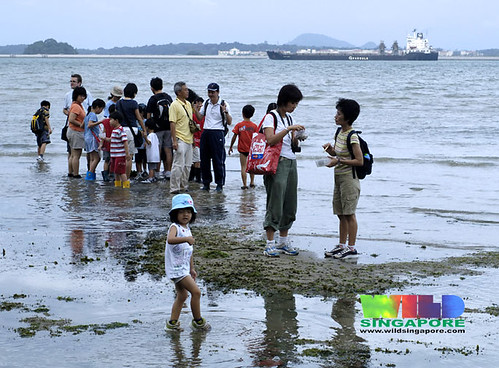
For all ages at Changi.Communing with wildlife on Chek Jawa.

To learn more about our shores, come for my public talk on 7 Jun (Sat) 3pm at the National Library Victoria Street. I promise to share hundreds of photos of our living shores and some of the issues affecting them. More details of the talk on the wildsingapore happenings blog.


Links to media articles on the Master Plan
From the Straits Times 24 May 08
To give your views on the redevelopment plans, visit the Draft Master Plan 2008 exhibition at The URA Centre, 45 Maxwell Road from now till June 20.

Opening hours are 9am to 7pm (Monday to Friday), and till 1pm on Saturday.

Those who object to the proposals should write in to the Permanent Secretary, Ministry of National Development, 5 Maxwell Road, Singapore 069110 - with supporting reasons - before June 20.

Master Plan 2008: our Southern Islands

The cluster of Southern Islands near Sentosa seem very well in the focus of the planners. From the URA website, the map includes the major submerged reefs in the vicinity. But the map above is wrongly labelled. This is the correct names for the islands and reefs. (Higher resolutions of this same map on the website, however, had the correct names).The designated land uses are light green for "sports and recreation", olive green for "open space", purple for "hotel" or "business", light pink "residential" and dark pink "residential with commercial first storey", light blue "water body".

Most of the commercial and residential uses are concentrated on Seringat-Kias.This area was created by burying two submerged reefs: Seringat and Kias. This is what the two reefs looked like, from the Southern Islands Development Guide Plan (DGP) 1996 by the URA.The plans for Kusu Island are light green for "sports and recreation" with red areas marking "places of worship".
While the plans for the Sisters Islands are all light green for "sports and recreation".In the Parks and Waterbodies Plan, a chunk of St. John's Island is designated a Nature Area, while the Sisters Island and the water around them is designated a Marine Nature Area.
What does this mean?As for the other Southern Islands with natural shores, they are completely blank. Pulau Hantu isn't even labelled on the map, and Cyrene Reef doesn't appear on the map at all.
Here are the locations properly labelled.Pulau Semakau is the original island. The Semakau Landfill was created by building a seawall that eliminated Pulau Sakeng and the Eastern half of the original Pulau Semakau.

As for the landuse plan, the area is mostly maroon "business" and grey "transport facilities".
With olive green for "open space" assigned to the live firing islands and the natural part of Pulau Semakau.

Ominously, Pulau Hantu is beige, for "reserve site".

Significantly, Pulau Hantu was not featured in the exhibition in any other way. For example, no photos of people enjoying the island for fishing, diving or other water sports.

At the exhibition, under "Magnet for Business", the business plans for these islands are indicated.With dark blue for existing developments and maroon for projected developments. More about petrochemical industries and our southern islands.

Master Plan 2008: Pulau Ubin, Chek Jawa and our northern shores

Is Chek Jawa safe from reclamation?

The panel at the exhibition on Nature features Chek Jawa.As part of the effort to 'protect key areas of ecological signficance' and an example of 'some nature areas that have been selectively and sensitively integrated within parks so that it is easier to commune with nature'. Perhaps significantly, what is featured is just the more terrestrial Chek Jawa boardwalk and Visitor Centre.From the URA website, the bulk of Pulau Ubin is designated as Nature Area (NA). Although this designation does not extend to the Chek Jawa intertidal zone.What is additionally unsettling is that the outline in the Master Plan for Ubin at Chek Jawa extends to the low water mark...suspiciously like a reclaimed land boundary. The google map below shows the terrestrial and intertidal areas at Chek Jawa.
In fact, the outlines for Pulau Tekong on the URA website (and exhibition panels) ... .. match the reclaimed area on Pulau Tekong as can be seen from the google map.
In 1990, in the book "The Next Lap" this was the plan for Pulau Ubin, Chek Jawa and Pulau Tekong.
Back to today's Master Plan 2008, a closer look shows a Nature Area designated on Pulau Tekong.As for the land use plan, the olive green colour onPulau Ubin and Pulau Tekong indicates "open space", the light blue "water body"and beige "reserve site". The beige portions of Pulau Tekong includes the currently reclaimed areas.
With a designated conservation area (marked with a dotted line with "C" in the centre) located at House No. 1, the Visitor Centre of Chek Jawa.
Pulau Ubin is NOT included as part of the grand plan for Leisure in Singapore.Although existing leisure features on Pulau Ubin are indicated, including a 'sea star' for Chek Jawa, located on the intertidal.Changi is a part of the leisure plan. There doesn't appear to be any new shore development plans for Changi. Although other leisure activities are planned for the area.Further along the northern coastline, there are plans to open up Coney Island.and to develop facilities on the Punggol shore.And even further up, there are plans to develop the Sembawang shoreline.As well as the Woodlands coast next to Admiralty Park.

Master Plan 2008: Labrador

Labrador is one of the four designated Nature Reserves in Singapore.
But exactly what is the outline of Labrador Nature Reserve? In particular...

Is Labrador shore part of the Labrador Nature Reserve?

From the URA website, under the Parks and Waterbodies Plan, only the terrestrial forested part of Labrador is a delineated as a Nature Reserve:This was also reflected on the panels at the exhibition.But on another panel at the exhibition, the Nature Reserve encompassed all of Labrador, but doesn't include the shore.This panel also showed plans to develop Bukit Chermin, which is next to Labrador and at the mouth of Berlayar Creek.On yet another panel, Labrador shore is featured as one of the 4 Nature Reserves and 18 Nature Areas 'safeguarded'.With a photo of Labrador Beach to illustrate this.Ironically, the photo has the cofferdam in the background. More about the cofferdam and the impact it had on this last natural rocky shore and reef on mainland Singapore.

Although all the maps at the exhibit did not show the impending works on the extension of Pasir Panjang Container Terminal, the big table top model clearly showed the size of this extension.The model clearly shows the scale and size of this development. And its possible impact on the surrounding shores at Labrador, Sentosa and Cyrene Reefs.

Here's some of the latest on-going works for and related to the Pasir Panjang Terminal extension.
Rock filling near Cyrene with holding area off Labrador Nature Reserve, works to happen from 28 May 08 to 15 July 08.

Sand mining and sand dumping next to Labrador and near Cyrene Reef and Sentosa, works to happen from 16 May 08 to 15 Nov 08.

There are already signs of coral bleaching at Sentosa.

Is saving our reefs... A LOST CAUSE?

With 88% of region's coral reefs under threat, greater effort must be made to protect them
Chou Loke Ming, Straits Times 31 May 08;

Reefs of islands used by the Singapore military in live-firing exercises are among some of the healthier ones in the country.

MENTION 'coral reef' and the aquamarine expanses of Australia's Great Barrier Reef come to mind.

Less known is that one-third of the world's coral reefs are in South-east Asia, concentrated in seas covering a mere 2.5per cent of the earth's ocean surface.

All groups of reef plants and animals are present, in a wealth of bio-diversity seen nowhere else, which reinforces the region's status as the global centre of coral reefs.

But the great natural heritage of the region has been badly hit by economic development.

While damage has been ramped up since the boom of the 1970s, the regional alarm bell was sounded for the first time in 1993.

Of 49 reefs monitored in Indonesia, Malaysia, the Philippines, Singapore and Thailand, experts found less than one-fifth in good condition, based on live coral cover.

The assessment was the first based on monitoring of coral reefs, a capacity developed through the Asean-Australia Living Coastal Resources Project. It was estimated that degraded reefs had risen by 70 per cent in the preceding 50 years.

The Global Coral Reef Monitoring Network of the International Coral Reef Initiative established an informal network of reef scientists in 1998, making regional assessments possible every two years.

It found that 88 per cent of what remains of South-east Asian reefs are under threat by human activities.

Human impact on coral reefs is varied, including coastal development, marine pollution, overfishing and destructive fishing. During the 1960s and 1970s, coastal development and pollution caused extensive loss and degradation.

By the 1980s, destructive fishing (mainly blast-fishing using explosives) became rampant, destroying large tracts of reefs, including those in remote areas that were once thought of as 'safe'.

Techniques soon evolved into another form of destructive fishing - poison fishing, where fish hiding in reef crevices are stunned by a cyanide solution squirted into the tight confines. The poison silently kills corals and smaller reef organisms that form the reef's ecological fabric.

As the world's appetite for fish increases amid the collapse of international stocks, destructive fishing practices are on the rise, making sustainable use of reef resources seem an almost impossible mission.

Protecting our reefs

ONE of the most common ways to safeguard reefs is to establish Marine Protected Areas. But while the figures sound good on paper - more than 430 areas have been declared - the truth is that they comprise only 8per cent of the region's reefs.

What is worse, only 10 per cent of protected areas are effectively managed by surveillance, for example, to ensure there is no illegal fishing.

Because our reefs are an important food and climate regulation source, their destruction means a loss of what was once considered an infinite food supply, as well as ecological services such as coastal protection, carbon fixation to use up global-warming gases and environmental quality regulation.

Reefs provide for free, services which would cost millions of dollars annually to run. As they degrade, human engineering is necessary to replace some of the lost services.

An example is the construction of sea walls for coastal protection. During the 2004 Asian tsunami, reefs in good condition gave better coastal protection from the force of the tidal waves than damaged ones.

The demise of reefs also means a significant decline of food supplies critical to coastal communities.

Then, there are the recreational benefits. Divers are always in search of pristine reefs and a well-protected reef attracts considerable tourist dollars. A healthy and well-managed reef is worth a lot of money. In fact, the annual economic gain from healthy reefs is estimated at $500,000 per square kilometre. Why then, are reefs constantly under threat?

One can only attribute it to ignorance or opportunistic short-term plundering. Long-term sustainable use is something myopic management fails to recognise because benefits are to be shared with future generations. To them, long-term sustainability is irrelevant to their limited term of governance.

Amid this dismal outlook, is there any hope of saving South-east Asia's reefs?

There are a few cases of effective management, which can and should be replicated to reverse the reef-degradation trend.

One of the best-known cases of a coastal community transforming a degraded reef that had been severely damaged by blast-fishing and overfishing to one that supports sustainable fisheries is that of Apo Island in the Philippines.

The 800 inhabitants of this small island realised in 1982 they had damaged the surrounding reef by overfishing. On the advice of reef scientists, the villagers stopped destructive fishing and set aside a quarter of the reef as a marine sanctuary.

The sanctuary is a protected zone operating as a 'no-take' area.

No one is allowed to fish or extract anything from this zone and even scientific investigations are limited to non-destructive methods.

The sanctuary replenishes the remaining reef, so much so that the entire community has been able to fish at a sustainable level since.

The reef now supports 650 reef fish species and 400 coral species. It now attracts coastal tourists and generates additional income.

The success of this community-organised sanctuary demonstrates the effective role of local communities.

In the Philippines, community-based management is now widely implemented, with mayors of some local districts supporting moves to galvanise the community to halt reef destruction.

Transferring this management capacity across countries is the next step in the battle.

The small village of Blongko, in Indonesia's North Sulawesi, has a 1,200-strong population largely dependent on fishing.

It learnt from the Apo Island marine sanctuary, and went on to establish the community-managed Blongko marine sanctuary 10 years ago.

Other forms of reef management have emerged in the region.

Resort operators with buildings close to good reefs, for example, acknowledge the importance of maintaining reef health as the beautiful corals and fish attract guests.

Some operators even provide resources to cash-strapped government agencies and help pay for boats and fuel for surveillance.

Unintentional protection

UNINTENDED reef management is seen in areas that prohibit visitor access because of security concerns or private-lease arrangements.

Reefs of islands used by the Singapore military in live-firing exercises are among some of the healthier ones in the country.

In Sattaheep, south of Pattaya, Thailand, the reefs are in excellent condition as they lie within a naval base that is off-limits to the public.

A good example of effective management in a region where enforcement is, for the most part, weak or symbolic is the strong protection given to reefs surrounding small islands that attract swiftlets to nest.

The birds roost in caves of these islands and their nests are harvested to produce bird's nest which can fetch up to $5,000 per kilo.

In the Gulf of Thailand, operators paying to harvest the nests take measures to ensure no one goes near the island. Some even hire guards armed with machine guns.

As no one ventures near the islands, the reefs are completely protected and in the best of health.

These different modes of reef protection show that positive action can be taken to prevent the habitat going to waste.

At national levels, more committed policies are needed to conserve reef resources.

Management effectiveness of Marine Protected Areas needs strengthening and review to target larger areas of coral reefs as only 8 per cent of the region's reefs lie within them.

But, as the success stories have shown, the picture is not totally dismal, and much can be done to save our watery treasure troves.

The writer is a professor at the National University of Singapore's Department of Biological Sciences, and has been involved with coral reef management research throughout South-east Asia. He has been a member of the scientific and technical advisory committee of the Global Coral Reef Monitoring Network since its formation in 1996, serving as chairman from 2003 to 2005.

May 30, 2008

Sentosa Resorts World to shark's fins: "no, but..."

full media reports on wildsingapore news

Shark's fin will be off the Resorts World Sentosa menu, but ...

High rollers can still get their dish and eat it too — the Chinese delicacy will be available on request at the integrated resorts’ private gaming rooms, said Ms Krist Boo, RWS’ head of communications. For business’ sake, “we will never say no to a high roller, but we will try to educate and persuade them”, she said, adding that alternatives like scallops and lobsters would be available.
...

'We did our sums and we cannot say no to the high-rollers. But we felt at least 90 per cent of what might normally be served will be done away with if we take it off the menu,' Ms Boo said.
...

Krist Boo, Resorts World at Sentosa, said: "In the private gaming rooms, if a high roller asks for shark's fin, we will serve it and that's a business decision."
So ostensibly, shark's fins will still be served at Resorts World Sentosa and shark's fins will be stocked in their kitchen, because Resorts World Sentosa has done "their sums".

Will Resorts World Sentosa say 'no' to sharks and other marine life in their exhibits? From the Resorts World Sentosa website
With 700,000 fishes in 20 million gallons of water, the Marine Life Park will be the world’s largest oceanarium.Our first-ever oceanarium programme will let guests admire the dolphins going about their natural behavioral activities, as well as dive with and feed menacing 4-meter long tiger sharks. A wading pool for children allows close interaction with curious fishes and an introduction to the wonderful but depleting coral reefs in the oceans.
In addition, the Resorts World Sentosa website includes this statement
The acquisition of animals for the Marine Life Park will be done in full compliance with international standards which, in this case, are standards set by the Convention on International Trade in Endangered Species of Wild Fauna and Flora (CITES).
From the CITES website, whale sharks (Rhincodon typus) are listed on Appendix II. What does this mean? From How CITES works
An export permit or re-export certificate issued by the Management Authority of the State of export or re-export is required.

An export permit may be issued only if the specimen was legally obtained and if the export will not be detrimental to the survival of the species.

A re-export certificate may be issued only if the specimen was imported in accordance with the Convention.

In the case of a live animal or plant, it must be prepared and shipped to minimize any risk of injury, damage to health or cruel treatment.

No import permit is needed unless required by national law.

In the case of specimens introduced from the sea, a certificate has to be issued by the Management Authority of the State into which the specimens are being brought, for species listed in Appendix I or II.
While few dolphins are listed in CITES, Universal Studios has distanced itself from reports that it was involved in the use of live dolphins at Resorts World Sentosa. New Zealand has banned the import or capture of live dolphins, forcing realignment of purpose of at least one aquarium.

Resorts World Sentosa today launched a 'marine conservation' programme:
To boost marine research, conservation and education, RWS also launched the RWS Marine Life Fund, which will sponsor efforts of researchers, non-governmental organisations as well as students aged 10 to 18.

Entirely funded by RWS, whose parent company is Genting International, the fund will “start small” with up to $100,000 given out this year and next, said Ms Boo. When the resort opens in two years’ time, annual funding will be increased to $1 million.

A quarter of the fund will be set aside for school projects, and there is no cap on applied funding. Applications for $20,000 or less will be assessed by an RWS committee, while those seeking more than $20,000 will also be assessed by an independent reviewer, such as a conservation agency.

Groups from around the world may apply while details have not been firmed up, Ms Boo said. All factors being equal, a project closer to home would probably be given more priority.

Although RWS’ oceanarium drew objections from nature groups when announced two years ago, RWS hopes that through the Marine Life Fund, a group of young volunteers for the oceanarium can eventually be formed.
...

Together with its move to keep shark's fin off its menus, the resort has also launched a Marine Life Fund as part of its corporate social responsibility programme.

It has set aside some US$70,000 (SGD$100,000) for 2008 and 2009 to fund research and conservation efforts, and up to US$700,000 a year when the resort opens in 2010.

A quarter of the fund will be reserved for school projects with a marine conservation theme.
...

The RWS Marine Life Fund will disburse up to S$100,000 each year in 2008 and 2009, and up to S$1 million each year from 2010 when the Resort opens.

'We hope to see some good applications for the Marine Life Fund. What's exciting for us is that this fund is not reserved only for established conservation groups, but it has a pocket solely devoted to kids,' said RWS's Communications head Krist Boo.

'We hope it will encourage children to learn about the ocean, and to love it. The online application process is easy for all.'

To encourage and cultivate an interest for the oceans, besides researchers and NGOs, the Fund is also open to schoolchildren. 25 per cent of this Fund will be set aside for kids working on school projects related to marine conservation. There is no cap on the applied funding, and projects could span anything from fieldwork to classroom models. All applications will be assessed by a RWS committee which oversees the Fund, and for applications for funding above $20,000, an independent reviewer will be included in the assessment.
An aspect of Resorts World Sentosa's 'conservation efforts' highlighted in Resorts World Sentosa's press release was coral relocation:
In 2006, RWS undertook the initiative to relocate corals and other marine life around the northern coastline affected by reclamation works that were carried out as part of the Resort’s construction. To preserve a part of Singapore’s natural marine heritage, the affected corals were moved to the Southern Islands, and are now thriving in their new homes.
Let's recall that the reclamation destroyed the majority of the reef there.
Flashback to the relocation details...
Despite trying to "save as much as possible," DHI estimates some two-thirds of the corals will be sacrificed.

In the Southern Islands, the corals will be tagged, and their health and status will be monitored over 12 months. The survival rate of relocated corals in Singapore is about 80 to 90 per cent.
It's a pity Resorts World Sentosa did not consider integrating the existing reefs into their plans and thus avoid 'sacrificing' them in the first place.

Since the relocated corals are "thriving", perhaps it's time to ask for a formal update on their status?

Does the public have a right to know? On 22 Aug 07, Sentosa informed me that "On the viewing of the coral monitoring reports, as this is a private project, the reports will not be made available to the public. However, the information can be made available upon request, on a case-by-case basis."

Since Resorts World Sentosa considers the relocated corals "a part of Singapore’s natural marine heritage" can it be "a private project"?

Links to more about the reclamation for Resorts World Sentosa

May 29, 2008

Petrochemical industry and our southern shores

Some of our natural shores in the South are very close to industrial installations there.
Petrochemical plants on Pulau Bukom seen from the shores of Pulau Hantu.
The natural shores include Cyrene Reef, Pulau Hantu, Labrador Nature Reserve and Sentosa's Tanjung Rimau shore. Nearby Pulau Jong and the Sisters Islands are also home to some of our natural reefs.
Major industrial installations are located on nearby Jurong Island and Pulau Bukom.
Jurong Island seen from the vast seagrass meadows of Cyrene Reef.

Just how major are these industrial installations?

Highway on Jurong Island diverted for petrochem cracker
Charmian Kok, Business Times 28 May 08;
full article on wildsingapore news

JURONG Island will go to great lengths to accommodate the petrochemical industry - as shown by the near-$100 million Jurong Island Highway diversion project.

'One third of our manufacturing GDP comes from chemicals,' he said. 'We can safely say the bulk of that comes from Jurong Island. If it is an investment that is important to the Singapore economy and adds to the whole value chain, I don't see why we would not divert roads to accommodate it. We need to look at the bigger picture.'
Government will remove hurdles to Jurong Island's boom
ExxonMobil, Shell projects will give big edge to Singapore chemicals sector: PM
Nisha Ramchandani, Business Times 7 Nov 07;
full article on wildsingapore news
ExxonMobil Chemical Company's massive new petrochemical project here will make Jurong Island the company's biggest integrated manufacturing site worldwide and a strong endorsement of Singapore's pro-business environment.
Are there any impacts of petrochemical industries?

Dangers of Singapore as petrochemical hub
Striking a balance between the economy and the environment
Letter from Felix Ang Kok Hou, Straits Times Forum 31 Dec 07
full article on wildsingapore news
A quick search on Google and Wikipedia revealed some startling statistics. Singapore has oil refining capacity of about 1.3 million barrels per day. Malaysia has about 0.5m bpd and Indonesia 1.05m bpd. The US, with the world's largest refining capacity, has 16.7m bpd while Saudi Arabia, the world's largest oil producer, has 2.08m bpd.

If we look at the per capita numbers, Singapore would be at 0.295 bpd, Malaysia 0.018 bpd, Indonesia 0.0046 bpd, the US 0.055 bpd and Saudi Arabia 0.084 bpd. What this means is that each Singapore resident is bearing more risks of oil refining than probably the rest of the world.
Two groups fear new Shell plant will endanger marine life
Pulau Hantu one of Singapore's last marine beauty spots
Radha Basu The Straits Times, 4 Jul 05
full article on the wildsingapore website
TWO local marine conservation groups have written to oil giant Shell to raise concerns over its plans to build a petrochemical plant on reclaimed land near Pulau Hantu, one of Singapore's last remaining sites teeming with marine life.

The Blue Water Volunteers and Hantu Bloggers fear the colourful sea creatures and age-old coral in the area will die if the reclamation proceeds without proper environmental safeguards.
What are current plans for petrochemicals in the area?

Another major Shell plant on the cards for Singapore
Decision soon on whether US$500m SMPO plant will be sited in Singapore
Ronnie Lim, Business Times 29 May 08;
full article on wildsingapore news
(SINGAPORE) Shell Chemicals is considering Singapore as a possible site for a significant new styrene monomer/propylene oxide (SMPO) plant investment - expected to cost at least US$500 million. This comes even as it is building a US$3 billion-plus petrochemical complex here from which the plant can get its feedstock.
Synthetic rubber plant set up to use Bukom petrochemicals
Synthetic rubber plant gives Singapore more bounce
Lanxess's $834m facility will supply to tyre makers in Asia
Ronnie Lim, Business Times 27 Feb 08;
full article on wildsingapore news
(SINGAPORE) Singapore has landed the world's first entirely-new butyl or synthetic rubber plant investment since 2000.
Singapore gearing up for more oil refineries
Ronnie Lim, Business Times 11 Feb 08
full article on wildsingapore news
The EDB edge: Gearing up for more oil refineries, biomed projects
EDB also hoping to tap new growth area of health, wellness and ageing

(SINGAPORE) From more oil refineries and planning for a third biomedical park in Tuas for drug-makers, to securing lifestyle projects like big-name, international wellness centres - that's what EDB assistant managing director Aw Kah Peng and her team of 70 are working on this year.
Soxal to build $250m hydrogen plant on Jurong Island
Matthew Phan Business Times 16 Jan 08;
full article on wildsingapore news
At a joint press conference yesterday, Singapore Oxygen Air Liquide (Soxal), a subsidiary of French- owned Air Liquide, said it would invest $250 million to build Singapore's first world-class hydrogen facility on Jurong Island to support Neste, as well as other refiners in the area.
Invista builds nitric acid plant on Jurong Island
Matthew Phan, Business Times 14 Nov 07;
full article on wildsingapore news
INVISTA, a US manufacturer of fibres and polymers, is building a US$100 million plant on Jurong Island to make nitric acid, it said at the plant's groundbreaking yesterday.

Nitric acid is a feedstock for adipic acid, which is widely used as an intermediate chemical in many applications, from solvents and lubricants to electronics and cleaning aids.

May 27, 2008

Rock filling near Cyrene with holding area off Labrador Nature Reserve

A) ROCK-FILLING OPERATIONS IN WEST KEPPEL FAIRWAY – SSD5A and SSD5B
B) TEMPORARY HOLDING AREA IN WORKING AREA “A” (OFF LABRADOR PARK)
from PORT MARINE NOTICE No. 108 of 2008 26 May 2008

The existing Port Marine Notice No. 84 of 2008 is superseded by this Port Marine Notice.

With effect from 28 May 08 to 15 July 08, at West Keppel Fairway, Jong Fairway and approaches to Cruise Bay.

Rock-filling works on area SSD-5A will be carried out 24 hours daily, including Sundays, within the shaded areas of SSD-5A (bounded by Point G, I, J, K, L and H).

Rock-filling works on area SSD-5B will be carried out during daylight hours only, including Sundays, within the shaded areas of SSD-5B (bounded by Point G, F, D, E and H).

Working area “A”, within the shaded areas of “A” (bounded by Point 1 to Point 8) in the vicinity of Labrador Park, has been identified as the temporary holding area for the rock-filling works.

Rock-filling work will be carried out by the Tremie barge at Working Area “SSD-5A” and “SSD-5B”. There will be only one (1) barge carrying out rock-filling works in the working Area “SSD-5A” or “SSD-5B”. The Tremie barge will be held in position by 4-point anchor mooring system. A safety working zone of 200-metre radius is centred at the Tremie barge. Safety boats will be stationed in the immediate vicinity to warn other craft of the project work. Emergency safety tug will be stationed at all times to assist during emergency. The Tremie barge will be required to shift to Working area ‘A’ where necessary.

Further enquiries relating to this operation can be directed to Mr Emir Himzari, the project co-ordinator at Tel. 9125 5998, e-mail: emir@eastmarine.com.sg.

wildfilms note: this is the current working area ...

Compared to the last working area ...

The working area has moved away from Cyrene Reef ...


Towards Labrador Nature Reserve (MPA should stop calling it Labrador Park). This area is also just off Sentosa's natural shores at Tanjung Rimau.

Not forgetting that at the same time, there is massive sand dumping going on in the same area at the same time ...

Dredging and construction at Sungei Serangoon opposite Pulau Ubin

DREDGING AND MARINE CONSTRUCTION WORKS AT SUNGEI SERANGOON
from PORT MARINE NOTICE NO. 107 of 2008 26 May 2008

With effect from 26 May 08 to 25 Nov 08, at Sungei Serangoon, within a working area bounded by the following coordinates (see attached plan):

Dredging works will be carried out by grab dredgers. The grab dredgers will be held by 4-point anchoring system and each anchor position will be marked by a yellow buoy, Fl Y 3s.

Installation of temporary cofferdam; and construction of gate house, spillway and dam will be carried out within the working area.

Further enquiries relating to the project can be directed to Mr Mok Chin Ket, the project director, at Tel. 9628 7370, email: mokck@koon.com.sg.

Singapore pleasure craft rules changed

Wow! Can we look forward to bringing more people to our shores?

Singapore pleasure craft rules changed
Oh Boon Ping, Business Times 27 May 08;

IT USED to be that pleasure craft operating in port waters could carry no more than 12 passengers unless registered as a passenger ship that complied with the safety requirements of the Merchant Shipping Act. Not any more.

The change came after boat dealership Peninsula Boating appealed to the Pro-Enterprise Panel (PEP) for a change in the rules. The company's founder James Purves felt the legislation needed to be updated. In his application, he said: 'Normally, a pleasure craft is designed to carry between eight and 24 people, depending on its size. Those restrictions on the number of people on a boat prevents charter operators from realising the economies of scale by purchasing bigger boats.'

Mr Purves suggested the rules be changed to 'allow a vessel to carry the number of persons it is designed to carry, as this flexibility means that operators/users can make commercial economies of scale and their expensive vessels will be more marketable.'

The Maritime and Port Authority of Singapore (MPA) assessed the situation and revised the regulation so pleasure craft carrying more than 12 passengers need no longer be considered passenger ships under the Merchant Shipping Act.

'With this amendment there is no compromise on safety, as all pleasure craft are still subject to annual inspection and certification requirements,' the MPA said in a statement. For example: 'The pleasure craft must obtain a licence issued by MPA to indicate the number of passengers it can carry.'

Before a licence is issued, a craft is inspected to ensure it is seaworthy and that life-saving appliances are sufficient for the number of passengers it can carry. The craft must also be inspected once a year to maintain the validity of the licence. The number of passengers it can carry will depend on boat size, provided the craft is used solely for pleasure purposes.

Businesses that wish to make a suggestion to the PEP on how to cut red tape can do so at www.pep.gov.sg. The panel was set up in 2000 to solicit feedback from businesses on how government rules and regulations can be improved to create a more pro-enterprise environment. The PEP is chaired by Civil Service Head Peter Ho and comprises mainly private sector business leaders.

The Pro-Enterprise Panel (PEP) was established in 2000 to actively solicit feedback from businesses on how government rules and regulations can be improved to create a more pro-enterprise environment in Singapore. The PEP is chaired by the Head of Civil Service, Peter Ho, and comprises mainly business leaders from the private sector.

May 25, 2008

New fad: exotic marine aquarium pets

Today, there is an article highlighting the fad for exotic marine creatures in home aquariums.

Aqua wonders
They suck, they sting, they even bite, but people are filling their aquariums with these exotic marine creatures
Tan Yi Hui, Straits Times 25 May 08;
full article on wildsingapore news

Some fish collectors are now hooked on more exotic marine creatures - the type you would more usually see on your dinner plate than bobbing around your neighbour's aquarium.

Hermit crabs, seahorses and shrimps are some of the novelty creatures now making a splash as pets.

A few fish fanatics have even taken the plunge and are pampering stingrays.

...

Mr Conrad Chua, 37, founder of the Singapore Reef Club - a popular 11,000-member online forum for marine aquarium enthusiasts - says keeping exotic marine species 'is a rising trend', although it's still a niche group.

...

Jireh sells seahorses from 8 to 10cm in size for $35 each, and has about a dozen buyers in a week. This is up from only one a month, half a year ago. Their seahorses are tank-raised, not caught at sea.

...

Student Phuah Chee Chong, 19, used to keep cuttlefish and octopuses, but they either died because of his inexperience in tending them, or because of short life-spans - cuttlefish live for only about a year.

After lengthy coverage of the fads, there is brief mention of the possible negative impacts
But if you're thinking of taking the plunge into exotic water wonders, owners such as Ms Yap caution: 'You have to realise that there is a lot of research to do. It's for people who are more patient. It's not like fish where a lot of information is readily available.'

Mr Henry Ko, 55, owner of aquarium shop MarineLife at Hong Leong Garden Shopping Centre, sums it up: 'Don't buy on impulse. Such organisms are hard to get.

'When you bring them back and can't sustain them, it's a shame.'

...

Mr Goh and Mr Poon buy their rays from fellow hobbyists. The sale of rays in shops is banned, but not among private enthusiasts, even though industry regulator the Agri-Food and Veterinary Authority of Singapore (AVA) discourages it.

Some ray-keepers sell surplus pets to others, rather than throw them back to nature. Athough rays are a foreign species, they are capable of adapting and breeding here. Indeed, The Straits Times reported last year that rays have been found in Singapore reservoirs.

Releasing animals into the wild is illegal and offenders can be fined up to $50,000, jailed up to six months, or both.

There is also a list of what to do to keep these animals in home aquariums: rays, freshwater shrimps, seahorses, octopus and cuttlefish, hermit crabs.

Having seen these marvellous creatures living free and naturally on our living shores, I am quite disturbed to think of them kept in a tank simply for personal pleasure without benefit to the environment or science.

Some issues raised by this fad:

How were the specimens captured? Many marine creatures are caught with cyanide which not only leads to mortality rate of the targeted specimens but also death of untargeted marine life and hard corals. Over-collection of marine creatures to support fads can wipe out the targeted species in the wild.

Is there such a thing as captive-bred seahorses? Some so-called captive bred seahorses are actually derived from wild-caught pregnant fathers. Seahorses are threatened by over-collection for the traditional medicine trade and the live aquarium trade.

Impact of releasing aquatic life? Released pets may die a painful death. Especially if uninformed people release them into the wrong habitat (freshwater creatures in the sea and visa versa). Released exotics in our freshwater habitats puts severe pressure on our native wildlife. This is why there are AVA rules on exotics. Release to the marine habitat may have similar effects. Here's a more detailed recent discussion of the issues on the lazy lizard blog.

I am sure readers will have other issues to highlight on this matter.

Ubin's other shores

Whilst everyone else headed for the Chek Jawa public walk this morning, Ivan, Andy and I decided to check out some other shores on Ubin.This tiny patch of seagrass meadows was thick with the large Spoon seagrasses (Halophila ovalis) that we generally see only on Chek Jawa and Changi.The small area was studded with many large Carpet anemones (Stichodactyla sp.)In the sandier patch, there was an anemone which we have yet to identify.There were also swimming anemones, and a few peacock anemones completely withdrawn into their tubes.

I saw a mantis shrimp before it disappeared into the murky water, and there were several large Geographic sea hares (Syphonota geographica) and lots of their pink strings of egg masses.We chanced upon this tiny spider crab (Family Majidae) decorated with bits of seaweeds and encrusted with stuff.

There were also colourful blobs among the seagrasses.These are probably ascidians, which are tiny animals that live together in a colony.Each little hole indicates the tiny animal.

The narrow rocky seawall shore was also decorated with colorful blobs.I'm not really sure whether these are sponges or ascidians.They sure come in a wide range of colours!

These, however, are definitely sponges. They are also commonly seen on our other Northern shores.There was even a tiny patch of hard coral starting to grow on a big stone.The stones were crawling with very VERY large Onchidium slugs. As well as commonly encountered snails such as nerites and turban snails.

Ivan found a Rock star as well as a Cake sea star!

Alas, there were only a few dead or dying sea fans.

Just next to this small seagrass meadow is what appears to be a dumping area.An enormous about of trash spills out from this area onto the shore. We'll no doubt hear more about the situation there when Andy blogs about it.

We also explored the area under the Ubin Jetty and I spent a lot of time with the fiddler crabs there.

Ubin was very cheerful today with flags out for the Vesak Day celebrations. The flags and lanterns stretched all along the jetty and into Ubin Town!Here's more about the celebrations on the Pulau Ubin Tour with Justin blog

Fiddler crabs

Fiddler crabs are among the most engaging and amusing animals to be encountered at low tide during daylight.

There are particularly large Orange fiddler crabs (Uca vocans) under the Ubin Jetty.Fiddler crabs are identified by the shape of the enlarged pincer of the male crab. In the Orange fiddle crab, the enlarged pincer has a bumpy or pimply outer face. The tips of the claws are flattened and sabre-like. The immobile lower finger is orange or yellow and has a long groove on the outside.

There is a row of bumps on the innder surface of the enlarged pincer too.Only the male fiddler crab has this huge single claw that may be as large and as heavy as the rest of the crab's body!
This enormous claw is not used to hunt or crush food. It is too small to effectively fend off most predators. Instead, it is used to attract females and to intimidate rival males. The male waves his large claw in a style and rhythm unique to his species in order to attract the ladies. Fiddler crabs got their name for this behaviour, which resembles a musician playing on his fiddle.

Is the enlarged claw on the left or on the right?
As this photo shows, it can be on either side.

The huge claw of the male fiddler crab is so big it misses his mouth! So he cannot feed with his huge claw and has a much smaller feeding claw.Females, however, have two feeding claws and can thus feed much faster. What do they eat? Fiddler crabs eat the thin coating of detritus on sand grains. They scoop sand to their mouthparts with the feeding claws that are spoon shaped and fringed with hairs. The bristle-like mouthparts scrape the sand grains clean of any edible titbits.
The body and legs of the Orange fiddle crab can be of different colours and patterns.In fact, it is said that fiddler crabs can change colours. Sometimes, they appear different at night and during the day. In some species, the males brighten up during mating season. This makes it challenging to identify the different species of fiddler crabs by their colours alone. The species are generally distinguished by the structure of their claws rather than by colours alone.

Fiddler crabs belong to Family Ocypodidae. Another member of this family commonly encountered are the Sand bubbler crabs (Scopimera sp.).This tiny ball-shaped crab resembles the little sand balls that it creates all over the shore at low tide. It has a somewhat spherical body with pincers that are long, flattened and downward-pointing.Like the Fiddler crabs, the Sand bubbler crab eats the thin coating of detritus on sand grains. Sand grains are scraped up with the downward pointing pincers and brought to the mouthparts that then sift out any tiny food particles. The shifted sand is then discarded in a little ball.

As it eats, a little path is scraped out on the sand from the burrow entrance. Little balls of sifted sand is piled up on either side of this path. As a result, there is often a 'path' among the piles of sand grains leading from the burrow entrance.

The Fiddler crabs and Sand bubbler crabs disappear into their burrows when they sense footsteps. So while you may not see them, they are in the soft sand and mud. So please watch your step and don't squash them!

Other blog posts about these crabs

May 24, 2008

Sentosa stroll

At daybreak, I joined the Naked Hermit Crabs and friends of the Crabs on a slow stroll of Sentosa.We checked out the shore near the cable car tower where reclamation is on going. Alas, the nemo is still not sighted in the anemone there.

But the soft shores there were still alive. We saw the carpet anemones with their anemone shrimps. And under a stone, there was this crab (Leptodius sp.).It has spoon-shaped tips on its pincers. These are probably used to scrape off algae or other edible stuff.The crab is a member of the Family Xanthidae which includes some of the most poisonous crabs on our shores. These crabs should not be eaten.

Besides the usual branching corals other marine life in the pools there, James found a dead sting ray. Ivan took the opportunity to explain the underside of this intriguing fish. Something that we can't do with a living fish.And Bian found an egg-case, possibly of a shark. It was light and empty. Hopefully the baby hatched safely.We then moved on along the rocky shore beneath the towering natural cliffs cloaked in plants. We saw a few people fishing on this shore. Leykun and Ivan shared about the snails found there.Bian, the botanical expert, was with us and shared about the plants. There was a huge natural Angsana there, planted by nature and not an "instant tree" like our roadside trees. We also spotted a Tailorbird!

We soon approached the more forbidding portion at the Tanjung Rimau point.Here there are rock pools filled with little fishes, small corals and other marine life. Unfortunately, there was some signs of coral bleaching here.

The Tanjung Rimau beacon was still being repaired.It's a big job.With quite a bit of a mess around it.By the time we rounded the bend, the tide was incoming. We had some glimpses of hard and soft corals and lots of small corals growing on the encrusted coral rubble shore. The seagrasses were doing well too.

James spots a ball of Lined eel-tail catfishes. And finds a tiny flatworm!Bian points out the figging fig tree.But we're not really sure what kind of fig it is.Bian says these figs are figging everywhere. And Ivan and I suddenly recalled seeing these small orange fruits on Changi earlier this week as well.

Since Bian is with us, we ask about the Tongkat ali and whether those bright red fruits belong to the plant.And he confirmed that indeed, those are the fruits of the Tongkat ali.

Bian also tells us more about the Sea teak (Podocarpus polystachyus). Apparently the red portion is not really the fruit but just an attractive bit to encourage animals to disperse the seed. The seed is the green bit on top of the red fleshy part. Wow!

We learn so much everytime we visit our shores.

May 23, 2008

Fishy Day at Cyrene

Though it was early and wasn't really very low, a determined group of shore explorers head out to Cyrene.This time, we are focusing on learning more about the fishes on Cyrene Reef. Collin has brought a seine net and together with Jeffrey, they carefully and gently check out the fishes in a deep pool in the middle of the reef.

The fishes are carefully scooped in the net and observations and identification quickly made and the fishes immediately released. These photos were taken after the fishes were released.

There were several of these strange fat pipefishes!It really does look like the seagrasses where it lives! It is called the Alligator pipefish (Syngnathoides biaculeatus). Also sometimes called the Double-ended pipefish because it's not immediately obvious which end is the front end.Here is the front end of the fish, with a long narrow snout and a pair of eyes.

It has short transparent fins on the sides of the head, and on the top of the body.You can see this one swimming with its dorsal fins. It doesn't have a tail fin and it is said that its tail is prehensile.

This fat pipefish come in various colours and patterns.
They belong to the same family as seahorses, Family Syngnathidae. And like seahorses, it is the papa pipefish that carries the eggs!The eggs are found on his underbelly.Some of the pipefishes, however, didn't have any eggs on the underbelly. Here we are taking a very gentle look at the underside.There were also small razorfishes!These fishes are often seen hanging vertically head down over hard corals. They are also known to be found among the spines of large sea urchins such as the Long-spined black sea urchins (Diadema sp). And now we know they are also found among seagrasses!
These fishes have a long sharp dorsal spine that is located at the end of the body. Those with a hinged dorsal spine (like this one) belong to the genus Aoeliscus. These fishes also swim horizontally, as we discovered.

There were lots of filefishes in the pool!There are three different coloured filefishes in this photo, can you see them? The bright green one with the white smiley mark is probably the Seagrass filefish (Acreichthys tomentosus), while the darker one on the lower bottom of the photo is probably the commonly encountered Fan-bellied filefish (Monacanthus chinensis).

This one is probably the Strapweed filefish (Pseudomonacanthus macrurus).Filefishes belong to Family Monacanthidae and get their common name because they have a rough skin that has the texture of a file. They are also sometimes called Leatherjackets for their tough skin.

The wonderful surprise of the day was this really strange fish with a 'beard'.Here is a closer look at its face. It is holding up the 'beard' into a point under the tiny upturned mouth.It has a long broad tail.At first we thought it might be a pipefish. But some checking after we got back and we now know it is a filefish! It is the Bearded filefish (Anacanthus barbatus). This is the first time I've seen this fish! Wow.

We also encountered several of these well camouflaged blennies (Family Blennidae).Other fishes encountered in the pool included several large flatheads (Family Platycephalidae), small rabbitfishes (Family Siganidae), lots of tiny cardinalfishes (Family Apogonidae) and one large fat pufferfish.
We also saw some very VERY tiny seahorses, that looked like mosquito larvae!

Besides the fishes, there was also this tiny little squid!
Thank you Rudie Kuiter and Jeffrey Low for the fish ids!

The rest of the team, meanwhile, had gone on to explore on their own.YC as usual, goes to all lengths to find and take photos of the marine critters.Here's the happy team at the end of this short, not so low trip to Cyrene.And the special guest on this trip is Gloria! She submitted an excellent blog entry about Cyrene for the blogging contest as part of the "I want to go Cyrene" facebook group. Congratulations Gloria for being the first outside the working group to say "I've been to Cyrene!". And thank you for supporting our effort!

If you would like to join us to Cyrene, join the blogging contest for the next trip scheduled on 23 Jun (Mon) 0700-1000hrs. Send in your entry by 15 Jun (Sun) to cyrenereef@gmail.com

As we depart Cyrene, we take nothing but memories. And leave nothing but footprints (and as few of those as possible too).

Other blog entries about this trip

May 22, 2008

'Leisure Island' and our shores

The "Singapore: Leisure Island" concept was unveiled today.
Full articles on the wildsingapore news blog

On Changi, there will be "longer coastal boardwalks closer to the water's edge", as well as a new hotel at the Old Command HQ and a motor racing circuit. In the South, there will be coastal boardwalks at Labrador (more articles about this on the wildsingapore news blog) . And for some reason, the Sentosa IR falls under the label "Going Green"...hmmm.
At Kranji, new walking trails at Kranji Marshes and new park land.

Pulau Ubin was not listed in this plan although there the Ketam Bike Park was recently launched as a leisure element (articles on this on the wildsingapore news blog).

We should go down and have a look at the Draft Master Plan 2008 exhibition, which will be launched tomorrow for the public to give feedback.

Seagrasses on the East Coast?

This early morning trip, just me and Ivan were off to check out the East Coast.

Oops!
Since we weren't swimming, we thought it was alright to go ahead.

I wonder why the beach is closed? There was a lot of loose sand piled high on the beach above the high water mark. And we noticed on the shore itself, there seemed to be some loss of sand, e.g., the slipway into the beach was a lot more exposed than usual.

Alas, as Kok Sheng did warn, the tide was a tad too high to see the wonderful sea fans and other marine creatures he shared on his wonderful creations blog earlier this month.

We did come across some interesting higher tide creatures such as this rather large Gold-spotted mudskipper (Periophthalmus chrysospilos), which obligingly posed for us as it was still dark.And a pretty swimming crab with banded legs that I've only seen regularly at Labrador and this part of the East Coast. This crab is possibly Charybdis annulata.Ivan saw lots of other stuff which he SAYS he is going to blog, and we await patiently for the eventual public launch of his blog (nudge nudge). And here is his entry on the lazy lizard blog!

We did get a glimpse of one of the sea fans in the rather murky water, and decided not to move any deeper in case we stomp on them. We hope any work on the beach will not kill off the seafans and other animals found there.

Floating in the water, I saw a very large clump of Tape seagrass (Enhalus acoroides), including part of its root. Where did it come from? Why was it uprooted?As there really wasn't much more to see on this shore, we zoomed down a little further to another stretch of the shore.

And as we wandered in the pre-dawn, washed up on the shore, we came across several large entangled clumps of Tape seagrass again!You can see the in-rolled edges that distinguish this long seagrass.I tried to take more photos and wanted to take a closer look at it, but the cleaner that was working hard on the beach was really nearby. He seemed nervous that I was taking photos and paying attention to his work and started to vigorously clean up the piles.

We move further down the beach and quickly had a look at the debris there before the cleaner could catch up. And found bits of another kind of seagrass.It has a smooth rounded tip, some cross-hatching on the veins, the blade is rather thin and flexible. They could be Thalassia hemprichi or Cymodocea rotundata. Either way both species of seagrasses are rather rare in Singapore. Some of the bits of seagrasses had black stuff on them.

Where did the seagrasses come from? Are there seagrass meadows in deeper waters off the East Coast? What's the black stuff on them? Why are there clumps on the shore? Did they get uprooted? Does this happen regularly? Is it seasonal or does this mean something has changed somewhere nearby?

The short shore was also littered with lots of dead flat clams .They look like the Leaf oyster (Isognomon sp.) that is usually found attached to mangrove roots. How did these end up here in such numbers?

On the high shore, Ivan notices lots of dead Button shells (Umbonium vestiarum) which were also previously seen in large numbers at Tanah Merah. Are they somewhere near the East Coast too? And on the water line, a large Arabica cowrie (Cypraea arabica)!This is a rather rare cowrie that we usually only see near coral reefs.

Wow, where is all this stuff coming from? It is also possible these snails "came with" the sand that is placed on the East Coast shore. Or there might be ecosystems nearby that we don't know about, yet?

These thoughts mulled in our heads as we enjoyed a spectacular sunrise. Alas, daylight also revealed an issue that is particularly vexing on the East Coast ... Litter that even the invisible army of cleaners haven't gotten to this morning.Trash of all kinds, big and small, are found on the shore.
Plastic is particularly abundant. Plastic kills marine life and plastic lasts for a long long time in the marine ecosystem.

And where does all this trash come from? We didn't have to look very far to find one of the sources.
Yes, it's lovely having breakfast with a glorious sea view. And it doesn't take much effort to toss the breakfast remains into the dustbin just a few paces away. It boggles the mind that some people just don't make the effort.

Erosion at the East Coast also looks pretty bad.The erosion has reached the roots of these tall trees that must have been planted in the park years ago.

Meanwhile, some plants have naturally taken root at the shore.
Some like this coconut palm was probably brought in by the sea.
These was also a bunch of young Sea almonds, next to an Acacia. And a large Sea hibiscus bush. A stretch of the shore was covered with the colourful Seashore morning glory (Ipomoea pes-caprae) , truly in full glory this morning. These humble plants play an important role in binding sand on the shore (see the previous blog entry). And they are really pretty too!

Do these naturally sprouting plants help mitigate the erosion problem? Does a more natural approach to managing our shores help protect from loss of land?

There is indeed a lot still to learn and explore about our shores.

Sea morning glory

Truly a glory in the morning on the shore!
Sea morning glory (Ipomoea pes-caprae) according to Ivan Polunin, is the most important coloniser of many tropical beaches around the world. Its creeping rooting stems often form dense patches which hold down the sand and produce humus.
It belongs to the Family Convolvulaceae which includes the more commonly seen terrestrial morning glory, as well as our favourite vegetable 'Kang Kong' and sweet potato.
The leaves vary in shape, according to Hsuang Keng from oval to quadrangular to rounded. Sometimes they form two lobes that resembles a goat's or horse's hoof. The Malay name of the plant 'Tapak Kuda' means 'horse's footprint', while the scientific name 'pes-caprae' means 'goat's foot'.

According to Hsuan Keng, the flowers are usually reddish purple, rarely white.According to Wee Yeow Chin, the juice squeezed from the plant is used in Malaysia to treat fish stings. The leaves are used in Indonesia to hasten the bursting of boils; sap from the young leaves are boiled in coconut juice and used to treat sores and ulcers; and the seeds chewed with areca nut, soothe abdominal pains and cramps. In the Philippines, the boiled leaves are used to treat rheumatism. While Ivan Polunin records its use as a purgative in Malay medicine. Burkill includes the use of boiled tubers to relieve bladder problems as they have a diuretic effect.

According to Burkill, animals will eat the leaves but they will taint the milk of cows. The leaves are also fed to pigs.

References

Burkill, I. H., 1993. A Dictionary of the Economic Products of the Malay Peninsula. 3rd printing. Publication Unit, Ministry of Agriculture, Malaysia, Kuala Lumpur. Volume 1: 1-1240; volume 2: 1241-2444.

Hsuan Keng, S.C. Chin and H. T. W. Tan. 1990. The Concise Flora of Singapore: Gymnosperms and Dicotyledons. Singapore University Press. 222 pp.

Polunin, Ivan. 1987. Plants and Flowers of Singapore. Times Editions. 160pp

Tan, Leo W. H. & Ng, Peter K. L., 1988. A Guide to Seashore Life. The Singapore Science Centre. 160 pp. Online version

Wee Yeow Chin. 1992. A Guide to Medicinal Plants. The Singapore Science Centre. 160pp

May 21, 2008

Spotted seahorse of Singapore

Yesterday, I was overwhelmed to receive an email from Rudie H. Kuiter, author of "Seahorses, pipefishes and their relatives" among many other wonderful marine guides.

He shared that he was in the process of updating the CD-rom version of his Seahorse book and expanding on many of the species. He added that as the type-locality of the well known Hippocampus kuda is Singapore, he felt it is important to show the species from there.

And to my incredible awe, he decided to use my photos for this effort! Wow!

In the process, he also generously identified these seahorses that are commonly seen on our intertidal as Hippocampus kuda.

Taken on Chek Jawa, Pulau Ubin May 04

Taken on Changi, Jan 01

Taken on Labrador, Jun 05

Taken at Sisters Island, Dec 03

Taken on Changi, Dec 03

Taken on Pulau Sekudu, May 08

Thus even the 'hairy' seahorses, and seahorses with banded tails, that we often see on the intertidal are all Hippocampus kuda.

More about our Hippocampus kuda

'Kuda' is the Malay word for 'horse', so this seahorse is truly local!

The common name for this seahorse is the Spotted seahorse.

Alas, H. kuda is on the Red List of our threatened wildlife. Its status is vulnerable.

From Ng, P. K. L. & Y. C. Wee, 1994. The Singapore Red Data Book: Threatened Plants and Animals of Singapore. The Nature Society (Singapore), Singapore. 343 pp.
Habitat destruction appears to be the main threat, but it is also collected for medicinal purposes and for the aquarium trade.

The recognition and protection of seagrass areas, especially those in the north-eastern coast of Singapore is important for the survival of this species.
What are the other species of seahorses recorded for Singapore?

From Wee Y.C. and Peter K. L. Ng. 1994. A First Look at Biodiversity in Singapore. National Council on the Environment. 163pp, the species are:
Hippocampus histrix
Hippocampus kuda
Hippocampus spinosissimus
Hippocampus trimaculatus
I asked Rudie Kuiter about how to distinguish these different species and he kindly shared some valuable insights.

He has generously agreed to allow me to share this on the wildfilms blog, and in addition says "if someone has any questions on seahorse id, I will be more than happy to look at images send to my email address" rudiekuiter at optusnet dot com dot au:
"H. histrix could be in the area, but has long spines and such species nearly always live in sponge habitats and these are usually at moderate depths. Long spines would not be a good thing to have in weeds.

H. spinosissimus is a very small spiny species and the name is constantly misused. This name is used for H. arnei which occurs in the Gulf of Thailand will probably occur in your area, but it lives out on open sand flats and I dived in Singapore, doubt that you have the habitat suitable.

I have a pictures of H. comes from Bintan Island and this looks much like kuda, but slender, a bit more spiny, longer snout and has double spine below the head instead of a single one such as in H. kuda.

I still have not seen any photographs of H. trimaculatus and not sure about this species or where it originally came from.

I am sure that there are more species in your area, but I am afraid that you will look beyond the tidal zone."
What's in a name?

For those who are deeply concerned about species names, I thought it would be useful learning to share some extracts of Rudie Kuiter's introduction to the issues and difficulties with species names which he outlined in his "Seahorses, Pipefishes and their Relatives: A Comprehensive Guide to Syngnathiformes":
The taxonomy of fishes is relatively young, and there are many similar species that were only recently discovered. The nomenclature includes numerous synonyms and often wrong names are applied, even to the most common species, and only when a particular group is studied in detail, this becomes apparent.

Many problems came about when similar species were treated under the same name and later were recognised as being different, but then applying the name to the wrong one.

A popular way of determining a species in similar groups is by providing a key that is based on the characteristics that separates one species from the other. However, this can also be a trap as such a key many not cover all the species and an unknown or new species may fit the key. Wrong names often result from the use of keys to determine a species when used in different geographical zones that often share closely related species.

In many cases confusion remains about the identity of species that were named a long time ago. Descriptions and illustrations were excellent by many authors and with diagnostic features presented leaving no doubt to their identity, but others were basic and poor, and could apply to several species.

Type-materials that represents particular species may be lost, was destroyed in wars or natural disasters, or in some cases specimens were substituted with others that may not represent the true species.

Where there is a problem with the identity of a species, all these factors must be considered.

As many species have a restricted distribution, the type locality can play an important role to determine the true identity of a species.

Confusion is caused when the same species is described several times by different people, different forms of the same species received separate names, or the same name is used for different species.

Many species were described over 100 years ago and it is difficult to know at the time, if a species was already named by somebody else. This often resulted in common widespread species having multiple names.
References

Kuiter, Rudie H., 2000 (English edition). Seahorses, Pipefishes and their Relatives: A Comprehensive Guide to Syngnathiformes. TMC Publishing, UK. 240 pp

Wee Y.C. and Peter K. L. Ng. 1994.
A First Look at Biodiversity in Singapore. National Council on the Environment. 163pp.

Ng, P. K. L. & Y. C. Wee, 1994.
The Singapore Red Data Book: Threatened Plants and Animals of Singapore. The Nature Society (Singapore), Singapore. 343 pp.

Changi Returns

In the cool predawn, we visited a stretch of Changi that we haven't looked at for about a year.What a delightful surprise to be greeted by an abundance of life! This stretch is possibly the last natural rocky shore on Changi. The hard surface provides lots of real estate for beautiful hydroids, sponges and the many animals that live with them.

Such as nudibranchs!We saw four of these pretty little slugs! It is possibly Hypselodoris infucata (and not H. kanga because it doesn't have the spots on the edges of the feathery gills). But there are many nudi species that look similar so we can't really be sure.
This is particularly momentous for me, because I saw this very kind of slug the first time I visited this shore. And have not seen it since. That first visit years ago this shore was exploding with life. It had suffered since, but looks like it's making a comeback.

Kok Sheng also spotted this spotted nudi. We don't really know what it is. Chay Hoon found something similar a while back at Tuas. We decided to call it the "cow nudi" because of the cow-like patches.It was placed in the container for a clear water pot shot because the water here is very murky. Of course, we put it back where it was found after that. It is very important to do this, because nudibranchs generally have a very specialised diet and they may starve if they are moved far away from their food.

Rocks provide a hard surface to cling to, so many animals are found here. You will have to look carefully though, as some are very well camouflaged. Such as this large crab.And these often overlooked sea stars, which we call the Rock star (Asterina coronata).
We saw a few of the black short-spined sea urchins (Temnopleurus sp.) clinging to the rocks.And under stones were cowries, porcelain crabs, all kinds of encrusting worms and sponges, and this strange limpet with an oversized body.You can see the shell in the middle of the fleshy body. It is called the Hoof-shield limpet (Scutus sp.). I saw them often in the past, but for a while they were not so commonly encountered. So it was good to see several during our short trip.

Under stones that are encrusted with sponges, are tiny snapping shrimps!Here is a pair, possibly the bigger is Mama (with the pink thing that looks like eggs) and the smaller Papa. These snapping shrimps too were a common sighting in the past but missing for a while when the sponges disappeared. Great to see them again!

We always look under stones very carefully so as not to hurt plants and animals when turning the stone over. And we always turn the stones back exactly the way they were found. Because animals that live in burrows in the ground also use the stone as protection.

Another old friend to welcome back is this large orange sea cucumber with dark stripes.It has really long tube feet and was seen clinging to hydroids and on stones. These used to be commonly seen. Then they were missing for a while.

A hard surface is also a great place for hard corals.The Zebra coral (Oulastrea crispata) is quite often seen on Changi, although the colonies are small. This coral has a black-and-white skeleton that retains this colouration even after the animals die.

For the first time, however, we noticed these tiny little things that look like individual hard coral polyps all over the rocks in a covered area.They were growing quite apart from one another. Here's a closer look at the skeleton.And the living polyp.Could these be Cave corals (Tubastrea sp.)? Cave corals grow where it is dark because they do not have the symbiotic algae that depend on sunlight for photosynthesis.

The shores are teeming with what seems to be blobs, but turn out to be little sea anemones.They may look boring, but a closer look reveals their beauty.We miss Dr Daphne when we see all these blobs. We should bring her here the next time she visits us. Because the rocks are just covered with these anemones.

The Zoanthids Have Returned!One stretch of this rocky shore used to be literally carpeted with these colonial anemones with pink centres. It was impossible to walk there. Then they all disappeared. But today, we saw good clumps of them back on the shore!

And some clumps were really LARGE!Zoanthids look like tiny sea anemones with a circle of tentacles on top of a tube-like body column. The little animals are connected to one another and thus colonial. When out of water, they tuck their tentacles into their bodies and look like tiny sausages.

Still Missing In Action: We didn't see a single living sea fan. I saw two dead ones still stuck to a rock. There used to be a lot of sea fans at this location. There were also no flowery soft corals.

On the way back, we came across lots of fireworms washed ashore. They were being attacked by tiny bluish springtails!

When we put some back into the water, they began to swim vigorously.
Some of the returned worms, however, were immediately attacked by little swimming crabs! Kok Sheng has photos of the crabs in action on his wonderful creations blog.

All too soon, it was sunrise and the tide came in.What a beautiful beginning for the day,
And dawn of returning life on this rare Changi rocky shore.

Alas, as usual, people continue to leave an impact on this shore.Ivan noticed lots of dead mud crabs. A strange thing to see as these crabs are not usually found in the habitats on this stretch of Changi. He shares his thoughts on the possibility that they were released as part of Vesak Day celebrations, on his lazy lizard blog.

Along the boardwalk, there appears to be accumulations of rubbish.Some people don't seem to take care even of the man-made structures provided for their enjoyment.This lovely shelter was marred by huge burn marks on the wooden floor and wooden benches.To continue to enjoy common property, both man-made and natural, responsible behaviour is necessary. There is indeed still much to be done by way of raising awareness.

Other blog entries about this trip

May 20, 2008

What happens when a river is dammed up?

The Singapore River now no longer flows to the sea with the construction of the Marina Barrrage. Is this recent development one of the possible consequences?

Robertson Quay restaurants raise a stink
Stench from river affecting business, they claim
Jinny Koh, Today Online 20 May 08;
full article also on wildsingapore news

YOU are dining al fresco by the river, tourists at the next table are taking in the tropical night scene, a gentle breeze blows — and suddenly, there is a smell from the river.

It is pungent and will not go away; and the night is ruined.

In February, Robertson Quay's management notified the Public Utilities Board (PUB) of the smell.

The agency in charge of Singapore's waterways investigated and found the stench occurred when water levels were low, exposing years of deposits and sediment accumulated along the riverbank.

A PUB contractor has carried out works to remove the deposits and sediment at the heavily-silted areas and is monitoring the situation closely. Still, there is a lingering smell; a second round of dredging starts this week, to be completed by the month's end.

The PUB has also tried to maintain a high water level whenever possible to avoid exposure of the sediment bed for prolonged periods of time.

The 15 or so Robertson Quay pubs and restaurants located along the river, the hardest-hit, could potentially play a part to improve the situation if they work with Waterways Watch, a non-governmental organisation that seeks to keep Singapore's waterways clean and free from pollution through patrols and public education.

It runs a programme called Friends of the Marina Association, in which participants contribute $120 a year as a form of financial support as well as display the organisation's pamphlets and posters at their premises.

But response has been dismal, said Waterways Watch chairman Eugene Heng, 59. "We visited them, sent letters to them, but they were not interested," he said.

There are only four Friends of the Marina despite efforts to reach out to about 200 businesses. Only one, Japanese restaurant Sangokushi Ryoriya, is on Robertson Quay.
Meanwhile, this doesn't stop further developments along the riverside...

Waterfront cluster with high-end appeal
New Fullerton Heritage zone has luxury retail and dining outlets to draw the well-heeled
Michelle Tay, Straits Times 20 May 08;
full article also on wildsingapore news

RAFFLES Place may be best known as the arena where high-flying bankers and corporate executives slog away for handsome salaries. But a small patch of it is set to become a luxury retail haven where they can spend their hard-earned cash on art, jewellery and fine dining.

The waterfront strip around the historic Collyer Quay is being transformed into a playground for well-heeled locals and tourists, as developers of the Fullerton Heritage zone seek to lure these big spenders away from Orchard Road.

Appetites will be catered for with One Fullerton set for an August relaunch with four new eateries.

And Aqua, famed in Hong Kong for its ultra-stylish harbourfront restaurant in Kowloon, will unveil its plans for its 'Chinese fine-dining' restaurant in Clifford Pier later this year.

May 19, 2008

High on Sisters

The tide wasn't very low today but it was a public holiday so we headed out for Sisters Island for a sloshy trip in the wee hours of 3am.
At the high water mark, as we waited for the tide to go down, there were lots of beautiful Pechia anemones (Peachia sp.). YC and I start to miss Dr Daphne as we encounter the nems.This small anemone has only one ring of about 16 tentacles. Often seen is a structure of 3-5 bumps in the middle of the mouth that protrudes out of the mouth. This sea anemone is more often sighted at our Northern shores, although possibly we just never take the time to look for them on our Southern shores.

When the tide is high, it's a great chance to look for fishes. And they are generally less shy at night.

The shores are teeming with little gobies.
The Shadow goby (Acentrogobius nebulosus) is commonly seen in shallow pools. It has three large dark brown blotches on the sides of the body (not easily seen from the top). It is poisonous to eat as it contains tetrodotoxin (the same toxin found in pufferfishes) in its flesh and internal organs. In some places, it is called the Poisonous goby. This is probably why the fish is not as shy as other gobies.

The larger Ornate lagoon-goby (Istigobius ornatus) is another goby commonly seen on many of our shores. It has a bulbous snout that overhangs the mouth, with two rows of deep blue spots on the lower sides (not easily seen from the top).There are lots of other pretty little gobies, like this one. I have no idea what it is.
The beautiful Head-stripe goby (Amblygobius stethophthalmus) is generally only seen near reefs and I saw one in a quiet pool near the corals as the tide went down. There is a dark stripe edged with pale blue on the side of the body through the eye to just past the gill cover (not easily seen when viewing the fish from above). There are bright spots and markings on its head. It makes its burrow under solid objects.
Blending in with the coral rubble was this little filefish (Family Monacanthidae) with a frilly long dorsal spine at the top of its head, and bristles near the tail. The single stiff dorsal spine gives this family of fishes its scientific name: 'mono' means 'one' and 'canthus' means 'thorn'. The common name comes from the texture of its skin. The scales are small and have prickles on them. So the skin feels leathery and rough, like sandpaper.The shore was also teeming with Whitings (Sillago sp., Family Sillaginidae). These long, slender silvery fishes have a torpedo-shaped body, large eyes and small mouth on a conical, sharp snout. In Singapore, this fish is also called 'pasir', which means 'sand' in Malay. The species are difficult to tell apart in the field.
Lurking among the rubble was this colourful fish that disappeared as soon as I took a photo. I have no idea what it is, it might possibly be some sort of grouper.In the calm shallow lagoon of Sisters, we almost always see the Fringe-eyed flathead (Cymbacephalus nematophthalmus). It is superbly camouflaged and I nearly stepped on him! It has bony ridges on the head with spines, 7-8 dusky bars on the back and sides and its fins has variegated patterns.But it's most endearing feature is those golden lashes! What girl wouldn't want to have those. These fringes are 6-9 skin tentacles over the eye. This predator feeds on creatures that live on the sea bottom.

Sisters has among our best reefs that are easily accessible to the public. The swimming lagoon in some parts are crowded with all kinds of animals. Here, two hard corals (purple and brown) and a soft coral (green).The brown hard coral (possibly Porites sp.) had a tiny fan worm living in it! The green feathery animals are probably soft corals because they have branched tentacles. But I have no idea what it is.

At night, our corals expand their polyps and no longer look like lumps of rock!Each hard coral is a colony of tiny animals called polyps. Each polyp creates a hard skeleton for itself. With the tentacles of the polyps extended, the colony takes on amazing colours and textures.
The polyps look like tiny sea anemones, with a ring of tentacles around a central mouth.As corals are identified by the skeleton structure, it's hard to identify the species of a living coral especially when the skeleton is hidden by thick tissue and 'blooming' polyps. I don't know why some of the polyps on this hard skeleton had white parts.Here are the very tiny polyps of a branching coral (possibly Montipora sp.).The branching Acropora corals (Acropora sp.) are always a special find as they are rather rarely seen on our accessible reefs. Acropora hard coral have a large corallite at the tip of each branch called the axial corallite. New corallites (called secondary or radial corallites) bud off along the sides while the axial corallite continues to grow upwards on the tip of the branch.Branching corals are a great hiding place for small animals. This particular coral had tiny crabs and little clams tucked among its branches.

Sponges are a great place to hide away too.All regular shore explorers know this commonly encountered brown sponge is usually riddled with tiny brittlestars, each only sticking out its little arms from the holes in the sponge.If you take a closer look though, you might spot other little fan-like things sticking out of some of the holes (photo on the right). I have no idea what they are. Seems a little too fine for fan worms. Could these be the feeding tentacles of barnacles? Hmm.I also chanced upon a beautiful pink version of this sea anemone. Bluish ones are more commonly seen. We still don't know what this sea anemone is. Some field guidebooks call anemones that look like this Condylactis, but Dr Daphne says they are not. Thus we usually call it Condylactis-NOT. The sea anemone has one ring of about 20 tentacles. Most of the tentacles are usually held flat against the surface, arranged in pairs or sets of three. Often, 5 of the tentacles are held upright forming a 'tent' over the mouth. The mouth is often seen upturned.

Chay Hoon of course shares the fabulous find of the day.A beautiful moon snail with a delightful shell pattern that reminds me of the patterns on coffee-cake! The front part of the body is brown with three white stripes.She found two of them on coral rubble. They were quite tiny, the shell about 1-2cm. But I have seen a larger one on St. John's in the past. These moon snails move very fast.The 'door' of the shell (called operculum) is white and made of shell (and not a brown horn-like material like the more common Polinices sp. moonsnails). I don't know that these moon snails are as they don't appear in any of the guidebooks that I have.We also observed that BOTH snails had a little snail shell on its butt! Is it excreting the shell after eating the snail? Wow. So much more to learn about our shores.

I didn't venture out as far into the deeper waters as it's hard to take good photos in deep water. And the wind kept the water surface ruffled. But the rest made the brave foray and encountered more wonderful fishes, octopus, flatworms, rare crabs and saw a lovely giant clam. Read more about their finds in the links to their blogs below.

As the moon set and dawn broke, the tide came in. The ravenous team swarmed over breakfast in a blur of furious feeding.Well fed and ready to go home, the sun finally peeked over St. John's, prompting lots of photo-taking.Sisters Island is open for camping (with a permit from Sentosa). Since it was a long holiday weekend, we weren't surprised to see campers on the island.There was a family with kids and two dogs in their tents facing the big lagoon.And another group of fishing folks near the jetty.As we left, they had already set up their fishing for the day.Sisters Island also has wild Long-tailed macaques (Macaca fascicularis). They used to be only found on Big Sisters Island, but recently some are also found on Little Sisters Island.The combination of people and monkey is seldom good. Alas, the trash bins at Sisters cannot keep the monkeys out. And all the contents are strewn all over the beach. Including dangerous marine litter such as plastic bags and styrofoam that can choke and kill marine life such as sea turtles.

Perhaps visitors to Sisters Island should take back their trash? This is what we always do on all our trips.

Here's a few of the happy team as we head home away from the pair of Islands. Kok Sheng is still hard at work taking photos. Jerald seems to have enjoyed his maiden trip to Sisters. While the Evelyn the Weather Witch seems to have lost her magic over the clouds. We were blessed with fine weather today. But still, we are wary when she joins us for our trips.

More blog entries about this trip
Sleepy human, lively Sisters on Kok Sheng's wonderful creations blog: lots more sightings in the not so low tide at Sisters.
Swinging by the Sisters on Marcus' budak blog, a poetic rendition of the trip with fabulous photos.

May 18, 2008

Upcoming Chek Jawa specials this week

This week, get a glimpse of work done for Chek Jawa, before deferment, and just last year! Want to see Chek Jawa for yourself now? Join the free guided walk on the Chek Jawa Boardwalk by the Naked Hermit Crabs this coming weekend!

19 May and 26 May: Screening of "Remember Chek Jawa"

“Remember Chek Jawa” is an independent documentary by Eric Lim. It chronicles the efforts of individuals who volunteered to help out with Joseph Lai’s biodiversity survey of Chek Jawa, one of several efforts that would provide feedback to government.

Many efforts and factors eventually contributed to the deferment of reclamation at Chek Jawa. Eric Lim was particularly inspired by one element that he witnessed - the efforts of the ordinary, urban Singaporean’s efforts to help out a tiring, muddy and incomprehensible biodiversity survey, at a time when all hope had been lost.

The video shoot was sporadic and conducted between July 2001 - 2004. Post-production was an ongoing process from 2001-07 whenever my schedule allowed. It was finally completed in March 2007. The film was first unveiled at Wildlife Asia on 13 Mar 2007.

More about the film on the Remember Chek Jawa website.

Time: 9.30-10.30pm
Venue: Sinema Old School, 11B Mount Sophia, #B1-1.
Cost: $5/$4 student concession
Contact: 6336 9707 or oldschool@sinema.sg


24 May (Sat): A talk on "Life and death at Chek Jawa"

Mr. Loh Kok Sheng will talk about "Life and death at Chek Jawa: a UROPs research experience in Life Sciences"

Mr. Loh graduated from Serangoon Junior College and joined NUS in 2005, majoring in life Sciences with specialization in Biology. In July 2007, he received the MOE Teaching Award. Mr. Loh has great interests in ecological work and did an UROPS project under the supervision of N. Sivasothi, Peter Todd and Dan Rittschof. His project aimed to study the mass mortality and recruitment of macrofauna at Chek Jawa in Pulau Ubin. Since the project has application value in understanding and conserving the Singapore macrofauna at Chek Jawa, Mr. Loh’s achievement has been featured in Embracing passion, NUS Advertorial and The Straits Time (March 25 2008). In this talk, Mr. Loh will share with the audience his experience in project work (UROPS) in Life Sciences and highlight those qualities that he has developed through this project as a junior scientist.

More about the project and talk on the Chek Jawa Mortality and Recruitment Project blog

Time: 2-3.30pm
Venue: LT27, Department of Biological Sciences, the University of Singapore


25 May (Sun): Free Chek Jawa Boardwalk tour with the Naked Hermit Crabs

photo by Andy DineshThe Naked Hermit Crabs introduce you to Chek Jawa without getting your feet wet. Enjoy the great view and find out more about rare coastal plants, cute fiddler crabs, aggressive mudskippers, sturdy mangrove trees, interesting bugs and more!

The free walk will be held every the last Sunday of the month. You don’t even have to sign up. On each public walk day, a few of the volunteer guides will be stationed at the Chek Jawa Info Kiosk in front of House No. 1 at Chek Jawa. The Crabs will trial this format for 4 months and then review it after that.

Group size? Come in small friends and family groups of around 6 people or fewer. We expect to have a few guides volunteering each time, but cannot guarantee that we will have a lot of guides. Please …. don’t organize a huge company group and show up at our free walk-in tours. We will be overwhelmed and you will go away very disappointed.

Time: 3 pm meet at the Chek Jawa Info Kiosk
Duration: Two hours
Cost: no charge for now, but donations accepted.
Website: http://nakedhermitcrabs.blogspot.com/
Contact: nakedhermitcrabs@gmail.com

May 16, 2008

Another run away idea for Changi

A few days ago, Syu Ying Kwok again wrote to the Straits Times with another engineering proposal for Changi's shores. This time to propose a Changi 4th runway float on the sea (Straits Times Forum 12 May 08).

Putting aside the issues of whether floating platforms are feasible or applicable, is there really such a dire need for land for Changi Airport?

One of the writer's points is that "For Singapore to become the major aviation hub in Asia and South-east Asia, we need a massive amount of land to cater to the industry's growing needs. The Changi cargo and aircraft maintenance area is bursting at the seams."

Let's have a look at the availability of land near Changi airport...
Hmm... I'm not sure what the writer sees, but to me it looks like there's quite a bit of unused land right next to the existing airport runways.

The writer doesn't exactly say where this "floating platform" will be placed, but let's have a look at the marine area near Changi Airport.On the google map, uses of our waters are not as obvious as terrestrial uses.

So let's look at a navigational map extract from an MPA notice about works at sea.Firstly, the channel between Changi and Tekong is a major shipping lane.

In fact, in PUB's reply (Straits Times Forum 22 Apr 08) to the writer's earlier proposal a Tekong-Ubin reservoir (Straits Times Forum 18 Apr 08), PUB stated that "The waterway between Pulau Ubin, Pulau Tekong and the mainland is a major shipping lane".

Where does this shipping lane lead to?

Sembawang Shipyards is one of locations accessed by this shipping lane. From the Sembawang Shipyard website: " Sembawang Shipyard is Singapore’s leading ship repair facility. We repair some 220 vessels from more than 35 countries annually. We are a recognised specialist in highly sophisticated markets of LNG carriers, passenger ships, chemical tankers, liquefied gas carriers, navy ships repairs, life extensions of VLCCs and damage repairs."

These are very large vessels.


Secondly, areas in Singapore's waters are designated for a wide range of uses that support Singapore's position as a world-class port (which is why MPA has to issue a notice when there is works in the area, to warn the MANY users of our waters).

It may surprise the writer to know that Singapore's shores and seas have economic value just as our land does.

And just as Changi Airport is the hub for air travel, Singapore's port is also a major hub for international movement of cargo.

From PSA's website "PSA Singapore Terminals handles about one-fifth of the world's total container transhipment throughput. In 2007, PSA Singapore Terminals handled 27.1 million twenty-foot equivalent units (TEUS) of containers. PSA operates 4 container terminals and 2 multi-purpose terminals in Singapore, and links shippers to an excellent network of 200 shipping lines with connections to 600 ports in 123 countries.

I dare say the bulk of our cargo comes by sea rather than by air.

Here's a closer look at some of the designated uses of the marine area near Changi.
Not forgetting that this shore area is also the location of the Changi Naval Base.In commenting on why the Tekong-Ubin reservoir proposal is not practical (Straits Times Forum 22 Apr 08), Ivan Kwan Wei Ming noted, among others,

When reclamation at Pulau Tekong has already become the subject of territorial disputes with Malaysia, and when the issue of Pedra Branca has yet to be resolved, proposing to build such a reservoir so close to international boundaries will surely not sit easily with our neighbours.

The Malaysian authorities will be unhappy for another reason: Mr Syu failed to take into account the fact that the proposed reservoir would destroy an internationally important shipping lane. Ships travelling between Pasir Gudang, Sembawang Shipyard, and the rest of the world stand to lose an essential route if the area was dammed up. Are the economic and political risks worth it?
These issues remain relevant to any ideas of placing large offshore objects in the area. Surely the writer realises that?

Among the comments left on the issue by readers were
"Mr. Syu also seems to advocating for the mass-destruction of coastal and island ecological systems of Pulau Ubin, Pulau Tekong and Changi."

"Forum writers really should do basic information-gathering before launching into such fantastical spiels. How the writer got the idea, I really don't know. But a logical think-through would quickly result in the idea being shot down."
Indeed I wonder about the writer's seeming obsession with 'doing something' with the shores and water around Changi? These areas are NOT 'unused' or 'underutilised'. They are in fact used for critical elements of Singapore's national and economic needs.

The writer's continuing disregard for basic realities of the area is also rather puzzling. Particularly since these have been highlighted earlier.

May 15, 2008

Sharing about our shores with MUIS

Today I gave the Secret Shores talk to a delightful group at MUIS.The talk was made possible by the patience of Fa'izah Ahmad, who put up with my grumpiness during low spring and my impossible schedule.

We shared about Cyrene Reef as well as our many marvellous shores, and some of the threats to them. There were many interesting questions including a discussion of the value of relocation of corals, and how to raise awareness about our shores on a wider level.

The room was crowded with 40 people! I couldn't take a photo of all of them with my tiny camera.The President graced the occasion, as well as the ladies of course. Who very sportingly gave a wave for the photo.

I was really touched that they invited me to join them for lunch too!What a warm and welcoming group! I hope we meet again on some shore of ours.

To have this or other shores talks at your office or community group, visit the singapore celebrates our reefs blog for more details.

New Nature Walkway at Labrador, Berlayar Creek

Just announced today, plans to build "a garden trail at the Alexandra Arch where more shrubs will be planted, and cycling paths and more footpaths built.

The path will wend towards the Berlayer Creek mangrove swamps, which are now inaccessible. Besides a boardwalk, plaques about the plants and animal life will also be put up.

The boardwalk will take the trekker by the sea and link Labrador Park to the future promenade fronting the Reflections at Keppel Bay condominium."Another description: "After crossing Telok Blangah Road, a visitor would reach the 960-metre Berlayer Creek Mangrove Trail, which will feature an entrance plaza with an information gallery about the mangroves, as well as a rest area. The proposed trail will have lookout points with storyboards about the flora and fauna.At the end of the Creek would be the 330-metre Bukit Chermin Harbour View Walk, which will have an elevated walkway providing scenic waterfront views of Keppel Harbour and Sentosa, in an area that was once exclusive to members of the Keppel Club."

There is also a promise that "construction work, scheduled to start next year, would be carried out carefully to ensure that the ecosystem would not be affected".

and "The trail will run parallel to a previously inaccessible mangrove habitat, with several boardwalks puncturing the mangrove at strategic points to both allow visitors a glimpse into its rich biodiversity and minimise any impact on the local ecosystem".

Additional information includes: "The nature and coastal walk is scheduled to be completed in tandem with the opening of the Labrador Park MRT station along the Circle Line".

Full articles on wildsingapore news.

What's at Berlayar Creek?

Unfortunately, the last time few times we visited, it was to remove an enormous amount of drift nets.

On the first trip, a small team struggled with the mess.On the second trip, a bigger team hauled even more out.Meanwhile, leisure fishing goes on at this shore, while huge fishtraps are laid just off the shore.

Links to more about Berlayar Creek

May 14, 2008

"Let's go to Cyrene Reef!" Blogging Contest

Want to go to Cyrene Reef? Now is your chance!

The Naked Hermit Crabs (http://nakedhermitcrabs.blogspot.com) will be organizing several working trips to Cyrene Reef in the coming months and 2 lucky persons will get a chance to join us on these trips.

All you need to do is to write a blog post on why you want to go to Cyrene Reef and the 2 best essays each month will be given the opportunity to join the trips to Cyrene.


Be warned that going to Cyrene Reef is no easy feat. There is no jetty and amphibious landing is required. That means that you will actually get your feet (and legs!) wet.
The walk is long and may be strenuous to some. The boat to Cyrene cost $800 per trip and can only take up to 14 persons each time. Space is precious and highly coveted. The subsidized cost for each passenger is $46/pax. If you think you deserve to visit Cyrene free of charge, convince us! Let us know how you would like to contribute to Cyrene and we might just sponsor your trip for free.

But first of all, convince us that you deserve one of the coveted spots on the boat to Cyrene. This is what you need to do:

1) WRITE (or any other forms of creative expression) about Cyrene Reef and/or why you want to go to Cyrene Reef. If you wish to have your trip fully subsidized, remember to convince us in your submission.
2) PUBLISH your masterpiece on any means of publication online
3) SUBMIT your entry to us at cyrenereef@gmail.com
4) Remember to include in your email:
a. Name
b. Email
c. Contact Number
d. Website URL of where we can view your submission
e. Whether you are available on 23 May 2008, 6am
f. Please indicate if you are above 21 years of age, are able bodied, fit and used to being outdoors, e.g., you have hiked, biked, done long nature walks.

Winners will be decided loosely based on the following criteria:
1) Creativity
2) Persuasiveness
3) Contribution to Cyrene Reef
4) Audience size
5) Ability to actually attend the trip!

For those who worry that they cannot write well, feel free to convince us by how you can contribute / help / act for Cyrene Reef.

Submissions are now open for the trip to Cyrene on 23 May 2008. If you think you can wake up at the wee hours of the morning at 6am, join us! Write in now!

Closing date: 18 May 2008, Sunday, 2359hrs
Winners will be announced on 19 May 2008, Monday, 1500hrs

May 13, 2008

Sand mining and sand dumping next to Labrador and near Cyrene Reef and Sentosa

SAND MINING AT AREA 1 AND DUMPING AT (i) JURONG ISLAND LNG PROJECT AND (ii) PASIR PANJANG TERMINAL PROJECT WORKING AREAS
from PORT MARINE NOTICE NO. 106 OF 2008 13 May 2008

The existing Port Marine Notice No. 78 of 2008 is superseded by this Port Marine Notice.

With effect from 16 May 08 to 15 Nov 08, 24 hours daily including Sundays and Public Holidays.

The reclamation works will involve dredging by Trailer-Suction-Hopper-Dredger (TSHD) at Area 1. Area 1 extends from the Singapore Port Limit into the westbound lane of the Traffic Separation Scheme (TSS) within the Singapore Strait.

All dredged materials will be dumped at Jurong Island project (See Working Area A and B of plan Attached-1) and Jurong Island LNG project (See Working Area C of plan Attached-1)
and Pasir Panjang Terminal project (See Working Area of plan Attached-2)
Further enquiries relating to the project can be directed to the following Project Co-ordinators:
Jurong Island project and Jurong Island LNG project: Mr. A. Muhaimin at Tel No: 98178572, email: muhaimin@pkdbh.com.sg; and Pasir Panjang Terminal project: Mr. Y. Abe at Tel No: 9664 8810, email: y.abe@mypenta.net.

wildfilms note: the dumping area is large and is next to Labrador Nature Reserve, the natural shores of Sentosa at Tanjung Rimau and near Cyrene Reefs.

May 11, 2008

The perils of morphology and taxonomy

Now that im actually free from the clutches of undergraduatedom, i've got a few things i've really been wanting to say for the long spitfire comment thread on 25th April. I'd only dare comment on this as i've been on a bloody year long project reconstructing the phylogeny (family tree) of a whole family of 30 flies primarily based on morphology, and i've found out that using morphological characters isn't as straightforward as it seems.

To elaborate on Ria’s point, our definition of ‘species’ is exists only as a human construct, an arbitrary term for a certain population of organisms ‘delimited’ by features which we define. Traditionally, these features are derived from morphology – i.e., physical features which we can see, such as spikes or bumps, or even color. The best kind of feature (morphological character) would be one that is discreet: They can clearly be defined as one state or another, usually as ‘absent’ or ‘present’, or ‘3 spines’, ‘5 spines’.

Unfortunately, a majority of characters are not discreet, but rather, continuous: there is a spectrum of states with no clear distinction between the states. These can be like the ‘hairiness’ or length of a body part. Even seemingly discreet characters can become continuous – should a medium sized protrusion be considered a large bump or a short spike? Such characters can also be at the mercy of other factors. Some color characters observed in the field cannot be strictly considered as discreet – color is the result of pigments generated by the organism, itself subject to a whole range of other factors. Diet, or the lack of, can contribute to a dull color due to malnutrition. Otherwise, the organism may be feeding on a food source that may make it allocate certain pigments – like us humans turning slightly orange when we drink far too much carrot juice. The environment itself plays a huge role; look at a fair person who sees no sun compared with one who spends all his time in the sun – are these two people different species then?

Another important issue is called ‘homoplasy’, where characters may have different evolutionary origins but arrive at the same character state. For example, both sharks and dolphins have dorsal fins, but the genetic makeup and structural origins are totally different.

In the case of the Cyrene urchin, it was alleged to be a Diadema savignyi due to its shorter spines, while the orange periproct suggested it to be otherwise. In this case, these two characters alone are probably by no means adequate for an absolute confirmation. In fact, even morphological characters alone may not be able to solve this issue to a 100% conclusion. Historical context, genetic data, reproductive isolation may have to be invoked. Each however has their own problems. It may be hard to reconstruct the urchin’s historical and geographical context, since there are few prior records in this region and the movement of larvae is hard to determine as well.

Genetic data often comes with problems of its own: It is highly subjective to different analytical methods, and even then, genetic evidence for species difference exists as a predictor – as long as genetic sequences are over x% different, they are considered different species. This x% is arbitrary and may be different for different groups of animals. The sampling of DNA data is also usually a minute percentage of an organism’s entire genetic data; usually 1-2 genes out of a total of thousands of genes are used in a genetic analysis.

As for reproductive isolation, different species are determined by not being able to interbreed with each other. This is not a satisfactory solution either, as both tigers and lions can interbreed – are they the same species then? Same goes for urchins – the papers i’ve read suggest that a number of species can interbreed.

As you can see, plenty of ways exist for us to define what a species is, and none of them are failsafe methods. Even amongst academic circles, there is intense debate on species delimitations, which methods are better, and in fact, at least five camps who define species in five different ways. I wont even try to go into cryptic species complexes! Thus, it is very dangerous for us to just use just one or two characters from a type of data (morphological) to absolutely ascertain a claim. In exaggerating, it is akin to feeling the tail of an elephant and claiming it to be a thin snake.

*******

One more thing. I did read through the paper on the taxonomy of the Diadema urchins, and found a few odd things. For one, the authors utilized a large number of continuous characters (usu lengths, percentages that were in a range), often which overlapped each other. As mentioned earlier such characters should be avoided in a rigorous morphological study. Secondly, while i'm not familiar with the form of analysis they performed on their data, i do know that cluster analysis does not take into account evolutionary history – it basically compares similarities between species, does not trace the evolution of that character itself. I am surprised that they didn’t use other analysis methods as parsimony, likelihood etc, which would take into account such things. Hence the paper while extensive in its morphological scope, does not seem to provide a robust analysis. This, of course, is just my view, i may be missing out on some of their arguments, or maybe their focus is elsewhere. Anyone with a better idea please enlighten me. Then again i am a systematist by nature; i just feel it would make more sense if it included other analytical methods.

I also did a check on the paper – it's from the journal Zoosystema, of impact factor (IF) 0.714. This means that an average it has an average of 0.714 citations per paper per year. It isnt very high at all. Of course, IFs exists as a proxy gauge for the academic world to approximate its importance, and may be prone to some statistical problems, but it still exists as a useful gauge. More info can be found at wiki. Anyway, the paper itself is only cited twice since 2006, but of course this is dependent on the field of interest as well.

Coral bleaching at Sentosa

This morning, I joined the Naked Hermit Crabs in a recce of Sentosa's natural shores in preparation for public walks there in June.

It was heart-breaking to see the shore being impacted by the reclamation works for the IR.Just last year, we discovered large living corals under the cable car tower where the massive construction is now on going.

I check up on the little 'Nemo' in his anemone home.
Alas, although the anemone was still there, I didn't see him. He was sighted last month on the lekowala blog. The seagrass meadows there are also getting very thin.

The small team of Ley Kun, Vyna, Terry and Jane moved on to the shores just behind Underwater World where we saw lots of carpet anemones! And there were at least four little anemone shrimps!We saw some branching corals and the shell of a dead heart urchin. So there is still some life on this shore.

We moved on quickly past the stunning natural cliffs towards the Tanjung Rimau beacon. We didn't want to miss the tide and wanted to see the hard corals on the Tanjung Rimau side of the natural shore.The beacon is being reconstructed!That's quite a lot of construction as the beacon is very large.

The Tanjung Rimau shore is still somewhat alive.
The coral rubble was coated in living animals of many colours and studded with Phymanthus sea anemones.
With soft corals here and there.

We also came across a large 'ball' of Lined eel-tail catfishes (Plotosus lineatus).I also stumbled upon a very long ribbon worm, while the others saw some nudibranchs and a living mushroom coral.

Unfortunately, we also came across several large hard corals that were bleaching.Hard corals have a white skeleton. The tiny animals (called polyps) that make up the hard coral contain symbiotic algae (zooxanthallae) that add colour to the living hard coral. When the polyps are stressed, they may lose their zooxanthallae. Thus their white skeleton becomes more obvious.

This is what a healthy hard coral would look like.But there were other hard corals on the shore that seemed alright, for the moment.The Sentosa shore currently bears the onslaught of much human impact.

We came across a plastic road barrier under the natural cliff.And another on the Tanjung Rimau shore that was already half buried.In addition, there are massive developments next to the Sentosa shore.

Besides the IR reclamation, reclamation for the new Pasir Panjang Terminal next to Labrador Nature Reserve will soon start.Sentosa's Tanjung Rimau lies just opposite Labrador Nature Reserve (the green hilly area on the right of the photo below).And the beautiful living shores lie just opposite the Pasir Panjang terminal.We can only hope for the best that the shores at Labrador and Sentosa survive these ongoing developments.

RECLAMATION AT PASIR PANJANG TERMINAL AND PASIR PANJANG WHARVES
from PORT MARINE NOTICE NO. 104 of 2008 9 May 08

This is a revision of Port Marine Notice No. 09 of 2008. The working area has been revised and
working period extended. With effect from 10 May 08 to 09 Nov 08. In the vicinity of Pasir Panjang Terminal and Pasir Panjang Wharves. 24 hours daily including Sundays and Public Holidays.Works will include reclamation, dredging, soil investigation, caisson construction, demolition of PW 1 and PW 2 and removal of submarine cables and pipelines.

Further general enquiries can be directed to Mr Y Abe, the project coordinator, at Tel: 9664 8810, email: y.abe@mypenta.net.

Sea teak of Sentosa

The towering natural cliffs of Sentosa are cloaked in all kinds of special plants.Among them is Sea teak (Podocarpus polystachyus). In fact, during our first seagrass transect at Sentosa, Joseph Lai our leading botanist, pronounced the Sentosa shore 'Podocarpus heaven'!

This beautiful coastal forest tree with refreshingly bright green pointed leaves is a conifer. That is, it produces seeds but no flowers. Instead, it has reproductive structures called cones or strobili.Female plants produce a highly modified cone. According to Corners, the ripe seed is a swollen part of the stalk about 1cm long. See also Joseph Lai's photo of the fruit of the tree.

Male plants produce clusters of cream-coloured cones which shed whitish, powdery pollen.From Corners, the scientific name refers to 'many (poly) ears of corn (stachys)' which is what the male cones resemble.

From Hsuan Keng, the tree is considered a species native to Singapore and found in Labrador, Kranji and other parts of the island, usually near the sea or at the back of mangroves. It was also recorded growing in gardens. Corners records it as being common on rocky and sandy coasts and in mangroves in Malaya, as well as limestone hills. He notes that it grows well on rocky places just above the high tide as well as in mangrove swamps.

Joseph Lai has recently recorded Sea teak also at Sisters Island, Lazarus Island, Pulau Jong and Pulau Sarimbun.

With the loss of our natural coastal habitats and mangroves, this once common plant is also becoming increasingly rare.

According to Burkill, the timber is small but still used for house building, carts and various other uses. Indeed, the Malay name for the tree is Jati Laut (translating to Sea teak) as well as Setada or Sentada. Burkill notes that medicinal uses possibly ascribed to it include the use of the leaves as an alternative to treat rheumatism and painful joints.

More about this special tree on Ng, Peter K. L. & N. Sivasothi, 1999. A Guide to the Mangroves of Singapore I (Plant Diversity). Singapore Science Centre; here's the online version. See also Joseph Lai's photos of the tree on his eart-h.com website and the NPark's Floraweb entry for the tree. We also had a closer look at this tree during a TeamSeagrass monitoring session at Sentosa last year.

References

Burkill, I. H., 1993. A Dictionary of the Economic Products of the Malay Peninsula. 3rd printing. Publication Unit, Ministry of Agriculture, Malaysia, Kuala Lumpur. Volume 1: 1-1240; volume 2: 1241-2444.

Corners, E. J. H., 1997. Wayside Trees of Malaya: in two volumes. Fourth edition, Malayan Nature Society, Kuala Lumpur. Volume 1: 1-476 pp, plates 1-38; volume 2: 477-861 pp., plates 139-236.

Hsuan Keng, S.C. Chin and H. T. W. Tan. 1990, The Concise Flora of Singapore: Gymnosperms and Dicotyledons. Singapore University Press. 222 pp.

Ng, Peter K. L. & N. Sivasothi, 1999. A Guide to the Mangroves of Singapore I (Plant Diversity). Singapore Science Centre. 168 pp.

May 10, 2008

Sea urchin eaten by helmet shell?

What killed this sea urchin?
A question I didn't think about until venwu225 left this comment on the wildsingapore flickr photo of this sea urchin test:

"you think this could have been killed by a helmet shell? They use muratic acid to dissolve the test of the urchin and leave these characteristic black makings, seen on the edge of the wound. I only read about this predatory relationship in literature, never had the honor of seeing it in real life. So this is speculative".

Here's a close up of the wound and the black markings on it.This is fascinating indeed! I didn't even notice this detail.

Does anyone have any other information on this?

Other information

from Family Cassidae (helmet shells) on the Sea shells of New South Wales website by Des Beechey, Senior Fellow, Australian Museum

"Most helmet shells live buried in the sand by day, coming out at night to feed on echinoderms, especially sea urchins, which they can locate by smell from at least 30 centimetre away. They immobilise the urchin, crawl onto it with the thick skin of the foot providing protection from the spines, and make a hole in the urchin shell by an acidic secretion and by rasping with the radula, and suck out the soft parts."

from Family Cassidae (helmet shells) on Gladys Archerd Shell Collection website at Washington State University Tri-Cities Natural History Museum

"This snail has a dramatic way of feeding on sea urchins. It creeps up slowly, raises its heavy shell quite high, then abruptly drops the shell in such a way that the urchin is completely engulfed. Since urchin spines contain a poison, the helmet snail releases a paralytic enzyme from its salivary gland, then it secretes sulfuric acid sufficiently strong to dissolve the sea urchin shell in about 10 minutes before consuming its meal."

Do we have helmet shells on Singapore shores?

Thanks to comments by Ivan and Mantamola, I've looked up the members of Family Cassidae listed for Singapore from Wee Y.C. and Peter K. L. Ng. 1994. A First Look at Biodiversity in Singapore. National Council on the Environment. 163pp.

Cassis glauca
Cymatium traquebaricum
Phalium glaucum

May 9, 2008

Cyrene: Stars and other strange creatures

We were out at first light, again to Cyrene Reef!
This time with a smaller team of Naked Hermit Crabs, accompanied by Chee Kong who is spearheading the Star Trackers programme (more about it soon). Collin and Kevin also joined us. Collin is looking for seahorses on Cyrene Reef. And it's Ivan's first time to Cyrene Reef! He has never seen a Knobbly before either! We are astonished!

While a bunch of us help out Chee Kong, the rest of us trooped off to try out the route Marcus suggested that would bring us to the most interesting stuff on Cyrene.

Cyrene shores are crowded with life.Here is a pretty green carpet anemone (Stichodactyla sp.) next to Tape seagrass (Enhalus acoroides) with a fruit that has just opened, leaving a flower-like structure behind.

Even before we began in earnest, we spotted a strange flatfish, another red feather star, the strange 'no panties' sea star (Nepanthia sp.), and of course lots and lots of Knobbly sea stars: so Ivan had his fill. We also take a look at the 'Nemo' there, and discovered there were TWO of these marvellous fishes in the anemone. More about these on Kok Sheng's wonderful creations blog.

We saw lots of Melibe nudibranchs too. At least four.We are so inured to them already that we don't even bother to tidy up the photo and just shoot them as they are. It is easy to see how we might have overlooked them in the past and dismissed them for brown seaweed.

We headed out to the coral rubble area after November enthused about the area after yesterday's trip. It was full of soft corals, hard corals and lots of mushroom corals. And for some unknown reason, a lot of Glossodoris atromarginata nudibranchs.The nudibranchs were everywhere. Some stranded high and dry on the rubble on this super low tide day. There were also lots of small Phyllidiella pustulosa.

Along the way, there were encounters with feathery file fish and carpet eel blenny. More about these too on Kok Sheng's wonderful creations blog. As well as TWO cushion stars which was real treat for Kok Sheng as he hasn't seen any yet. Find out more about them on his cushion star blog entry.

And for some reason, several 'sotong' as well. These were two small ones we saw.
The team found a really large half dead one as we were waiting for the boat to go home.

Among the special finds was this strange sea cucumber.The hole in the photo is its backside and it burbled a few things to us as we took pictures.It was rather large and smooth with tiny tube feet emerging all over its body.

The underside is flat also with lots of little tube feet.The mouth is on the underside, suggesting that it feeds on the surface.At first glance it does look very much like the commonly encountered Sandfish sea cucumber (Holothuria scabra). But also somewhat different. Here's a photo of the Sandfish sea cucumber on the upper side.And underside.I also saw a strange hard coral today.It looks rather boring, but a closer look suggests it's Hydnophora but with the corallites forming a maze-like pattern. Something I haven't seen yet.And the corallites look like they were secreting long white strings of some sort. I have no idea what is going on.

We also have a look at the 'blonde Knobbly' found yesterday (more on Kok Sheng's blog entry.)Chee Kong says it's possibly a Knobbly sea star (Protoreaster sp.). Indeed, when earlier I asked Dr Lane about how to identify a Knobbly, he said one of the characteristics is that their knobs appear in one row along the arms. And this is indeed the case for this sea star.Although it also has intriguing textures that the other Knobblies lack. So we are awaiting confirmation from Dr Lane on what this might exactly be.

Earlier, Chee Kong shared with us that individual Knobbly sea stars can be identified by their knob arrangement! This is exciting as it means we can track the growth and other life encounters of individual Knobblies. We look forward to more details about his fascinating project.

Just as we were ending our trip, Andy found a blob just lying on the ground among the seagrasses. When we put it in water, it expanded into a lovely sea anemone!It has lots of bumps on the body column.And pretty pink highlights on the pale tentacles. Sam dubbed the creature "Mabel".

Marcus saw a similar anemone in Oct 07 at Changi, drifting about. He asked Dr Daphne Fautin about it.

In her reply, she suggested it might be a member of family Aliciidae. She added that the distinction among genera of that family is the source of the growths from the column -- at only the base, only the middle, or all over. She also shared that she has seen them only rarely, and most in aquaria. She has seen a few in New Guinea, but very rarely. She warns that they can sting humans fairly severely.

Fortunately, it didn't sting me when I moved it into the pool of water. Phew.

Alas, we also encountered an abandoned driftnet.And more fishtraps. But these were already broken.Unfortunately too, we were unable to find any sea horses for Collin. Perhaps the next time? For we will certainly visit this fabulous reef as often as we can!

For as Vyna puts it we must indeed expect the unexpected at Cyrene.

Bravo to Melvin for taking us out despite jellyfish stings in uncomfortable places during yesterday's trip (this is why we wear long pants for amphibious landings). And to the team who came: Chee Kong, Sijie, Andy, Vyna, Kok Sheng, Sam, Kenerf, Ivan, Collin and Kevin.

Diadema of Cyrene

Cyrene Reef has lots of these large black Diadema sea urchins with long poky spines!

Here's some we saw today.

There was one perched on a bit of coral rubble with long spines (relative to the body).Here is a closer look at the upperside. You can see it has faint bands on some of the spines.Its underside was dark.There was another one with long banded spines.Here's a closer look at the upperside.The underside was pale.And in a deep pool full of seagrasses, we encountered two enormous ones! They were as big as my face.
They had shorter spines (compared to the body). Here's a closer look at the upperside.And the underside.All of them had an orange ring around the bulbous anal cone, white spots and blue lines; all these characteristics of varying boldness.

To be absolutely sure of what species they are we would need to take a specimen and have an expert examine the small features on their skeleton (see Test of Urchin).

But meanwhile, it's good to have an open mind and document all the Diadema we see, and observe their differences and similarities.

May 8, 2008

Mapping out Cyrene Reef

Early this morning, we roused poor Melvin to fetch us out to Cyrene Reef. We are very honoured today to have with us Prof Teh, Dr Raju, Joseph Lai and Andrew Tay. Prof is sitting in the back of the boat so he's not in the photo. And I realised I didn't get any photos of him during this trip...sigh.

While we waited for the boat to make a second trip to fetch the rest of us, we take photos of the glorious sunrise.And missed the ray that jumped out of the water.

Jun saw it! Right here...Prof Teh is the coastal expert of peninsular Malaysia and Singapore, and Dr Raju is a GIS expert. They are both actively involved in Chek Jawa together with Joseph Lai, and have always been there to help us map our odd and obscure reefs.

Dr Raju has brought his snazzy GIS stuff with him to help us get a better idea of Cyrene.Here he is with Siti helping out to better understand this fascinating reef.

He takes readings all over this vast reef.Here he is compared to the container ship... Meanwhile, to get GIS readings to map Cyrene Reef, November sacrifices her feeble knees and gained a few new world record bunions on her toes by literally running around the entire circumference of the reef at super low tide.Poor November. The reef is quite huge.

Prof Teh later tells us the Reef sits on the Jurong Formation, which is a kind of rock with a typical purplish colour. Dr Raju will come back again to do more mapping.

Sijie and Andy meanwhile are testing out a new project to study the Knobbly sea stars that are so abundant on Cyrene Reef.They have marked out the locations of these stars in yellow flags.There sure are a lot of Knobbly sea stars! At least 33 from this photo! In just a small area. Wow! Marcus shares a closer look at those knobs.

Meanwhile, the rest of us run off to check out the Reef according to the excellent plan developed by Kok Sheng. Armed with Kok Sheng's nicely enlarged maps and introduction on the beacons of Cyrene as landmarks, we went in search of the best of this special reef.

I hijacked the lamest section nearest the landing point. Despite which, I only managed to do a small portion with reefs and rubble before the low tide ended.The area has some amazing hard corals including really humungous brain corals (Family Mussidae).
Among the special hard corals I saw was this Hydnophora coral.It has conical corallites and this coral is not commonly encountered on our reefs.Here's another hard coral that I seldom see.I don't know what it is, but it sure is pretty.As well as lots and lots of humungous leathery soft corals!Leathery soft corals look like creatures from another planet. Some look like fried eggs, others like discarded surgical gloves, or strange half-melted pinwheels. They are actually colonial animals made up of countless tiny polyps that live together in a shared leathery tissue.

But this one soft coral that I have not seen anywhere else on our shores.It is probably a leathery coral as it has tiny polyps with branched tentacles that emerge from a common leathery tissue, quite similar to other leathery soft corals.
But very oddly, it has a wiry kind of central 'stem' that holds the branches upright. I've never seen anything like that before!

Some parts of the reef are crowded with a variety of marine life.
There were the usual variety of marine life (nudibranchs, flatworms) and fishes and octopus there.

Among the special encounters was a Melibe!Since Sijie found one on Cyrene with TeamSeagrass a few trips ago, I think most of us have got the 'search image' already. Chay Hoon and Jun found two more as well! She shares photos and a clip of it in action with its expandable hood on her colourful clouds blog

There was also a very VERY long ribbon worm (Phylum Nemertea) which are sometimes seen on our shores. Ribbon worms can be very long. This one was at least 1m long! I couldn't see the beginning or the end of the worm as it was wound among the rubble.Most ribbon worms are predatory, often specialising in a particular prey. To capture its prey, the ribbon worm has a hollow, muscular proboscis. The proboscis can shoot out with explosive force and is prehensile (can be used to grip) and retractable (can be pulled back). The proboscis is usually wound around the prey which is then hauled back toward the worm's mouth.

Alas, among some of the less happy encounters was with a huge fish trap. It was about as tall as me!It had several large butterfly fishes, and a large blue stripped fish as well as a spotted one. I couldn't take a good photo of them as they kept splashing about in panic in the shallow water. I put the cameras aside to cut open the trap and release the fishes. Later on, I learnt that Joseph Lai also found and destroyed another fish trap.

There were lots of herons and egrets feeding on the shore.
Whilst looking at them, I noticed the black smoke emitted from a ship parked at Pulau Bukom refineries in the background.

Some of the others found sea urchins! Several black long-spined sea urchins!Here's a closer look at them...I'm sure some readers will have something to say about the identity of these sea urchins...

We had so much fun we nearly forgot about the tide.Which soon rushed in leaving only slivers of Cyrene Reef above water.

The second shift for the small boat waited anxiously to be picked up as the huge waves crashed around us covering the Reef. A large cruise ship meanwhile is passing by the Reef in the background.Of course, Melvin saves us in time as usual. And we all manage to stumble, roll, collapse into the boat. Thanks to the literal leg up so kindly provided by Sijie. See Marcus' hilarious sequence LOLZCyrene on what happened to us as we tried to board the boat at high water.

The others found LOTS more interesting stuff including Nemo and another Special Star! Read all about it on Kok Sheng's wonderful creations blog, while Vyna shares thoughts about the things that money can't buy following this trip, and November shares the magical wonderland that is Cyrene, and Marcus has more insights in home on the green.

Jun shares her first time visit to Cyrene too!

See the gorgeous map of Cyrene that Dr Raju shared based on the readings he took on this trip.

Looking forward to our second trip to Cyrene again tomorrow!

May 7, 2008

Pulau Sekudu: fish traps and other encounters

Another early start this morning, just four of us were off to check up on the marine debris situation at Pulau Sekudu. And how lovely to be greeted by some of the regulars on that shore: large carpet anemones and peacock anemones were everywhere.

During our last marine debris check in Dec 07 during a moderate low tide, we found lots of abandoned driftnets on the high shore, among the mangroves and rocks there. Today, is a very low tide and we were a very small team. So we decided to head out to the low water mark and the reef edge to look for fish traps.

It didn't take very long before we came across the first one.
Lots of crabs and fishes were trapped in it. The team gently release the fishes and then remove the trap.

As we went along, we also took note of the marine life on the shore.

This is the first time we are visiting Sekudu in the early morning in nearly 10 months. Our last morning visit was in Jul 07 with Dr Daphne to look for sea anemones. We also did an evening trip in Sep 07.

Compared to those trips, some of the sponges are now more plentiful, especially the purple long branching sponges, the bright blue and pink sponges typical of that shore. And the little wine coloured sea anemones have come back!
These little sea anemones disappeared after the flood of 2007 and we had a hard time finding them when we visited with Dr Daphne.

The carpet anemones generally looked happy and healthy, and were found in a wide range of sizes. We also saw some swimming anemones (Boloceroides mcmurrichii).

And these two anemones, that were hitching a ride on a living whelk!The two anemones together are bigger than their snail 'transport'!

As usual, on our shores, you have to look out for animals on animals. Like those animals found on the many clumps of flowery soft corals (Family Nephtheide) seen today.If you look closely you may find tiny little snails that resemble their soft coral hosts!As well as lots of tiny little brittle stars!Although brightly coloured, these brittlestars are hard to spot as they match their home perfectly!There was one little sea fan making a brave new start. A sea fan is a colony of tiny animals called polyps. The tiny white polyps retract when exposed leaving these tiny bumps in the central stalk.There was a little hermit crab clinging to the sea fan.

Since Chay Hoon wasn't with us, the only nudibranchs I saw were humungous ones.

Like this rather unexciting one that blends right with its surroundings. It has a white underside with brown blotches. It is possibly Discodoris lilacina.And a huge lumpy one that looks like a dull and uninteresting sponge!! It is probably Atagema spongiosa.But the monster find for me today was this ENORMOUS Luidia sea star (Luidia maculata)! It was bigger than my foot!Oh, that was kind of scary! The poor sea star, however, had lost one of its arms, so was left with only seven. Since it is so large, it's a good opportunity to take photos of the fine features of this star.This sea star has pointed tips to its tube feet, and the upperside of its body is marvellously textured. The star was very fast moving and quite aggressive looking. No doubt striking fear into the innards of little molluscs and other echinoderms that it eats.

There were also lots of Biscuit sea stars (Goniodiscaster scaber) and some Sand stars (Astropecten sp.) and the rest of the team saw one large Knobbly sea star (Protoreaster nodosus)! This is great! Knobblies used to be very common on Pulau Sekudu. Alas, I didn't see any.

As at our Changi visit yesterday, there were lots of White sea urchins (Salmacis sp.) as well as Pencil sea urchins (Prionocidaris sp.). We saw one Sandfish sea cucumber (Holothuria scabra) but no synaptids or other sea cucumbers. More about some of the trickier echi encounters.

There were lots of fishes in the lagoon and among the rubble.

The handsome Fan-bellied filefish (Monocanthus chinesis) is particularly plentiful.
I also finally saw a somewhat large Carpet eel-blenny (Congrogadus subducens) for the first time in a long long while.And a pair of bright blue fishes sheltering in the deeper water among the rubble. I have no idea what they are.

Sheltering in a pool near the lagoon was this very pregnant papa seahorse (Hippocampus sp.) and a small rabbitfish.Small rabbitfishes (Family Siganidae) were plentiful in the pools and sheltering among the rubble.

We didn't see any stingrays. Usually, there are lots of them in the lagoon.

Still MIA?

Unfortunately, we didn't come across any living corals. Strangely, none of us also encountered octopus today. But the shore exposed was large, and it was dark, and the team was small, so we might have missed those that were there.

Fish rescue

The tide rose with the sun. By which time, the team had found a total of 8 traps at the very low water mark. Some were abandoned, some were new. Many of the traps were about to be exposed as the tide was very low. Had the team not been there, the fishes would have died.

Each trap had about 10-15 large fishes including butterflyfishes, filefishes, groupers, puffer fishes. As well as many large crabs.Most of the fishes were still alive and swam away when released.

Although access to Pulau Sekudu is now restricted, drift nets are still laid just off the island (we could see the plastic floats holding up the nets).

We hope eventually fish traps and drift netting will stop being used on and near Chek Jawa and Pulau Sekudu.

Marine debris also continues to add unneccessary colour to the shores.
As we leave the island, the team bags the trash for disposal.
Despite the small team, it was quite a big pile of trash!Bravo to Andy, KC and Vyna for checking up on Pulau Sekudu!

Vyna shares thoughts about the causes and possible solutions to people laying drift nets and fish traps on her career breaker blog.

More tricky echis

On Pulau Sekudu today, there were yet more sea urchins and other echinoderms that look similar but yet different.

There was a white sea urchin with very pink spine tips and yellow bands on its body. As well as really long tube feet! I put it next to the more commonly seen white sea urchin.The two sea urchins rapidly moved away in opposite directions!

I also took a closer look at the Pencil sea urchins that were found everywhere among the seaweeds.

There are not only differences in colours but also shape of spines, especially the small spines.Here's a closer look.Could it be that the bigger one is older? Or are they different species?

There were also LOTS of Biscuit sea stars of various sizes.Smaller ones tend to be seen on seaweeds, while bigger ones were found on coral rubble.

Here's one that looked like a biscuit sea star on the upperside, but didn't have the the typical biscuit sea star pattern on the underside.

On the upperside, both looked somewhat similar.
Even with a closer look at the upperside.On the underside, the Biscuit sea star typically has the bluish markings along the grooves under the arms, and a yellow patch in the centre.But the star in the photo on the right didn't have this typical pattern.Hmmm...Anyone has any ideas about this?

There's still much to learn and find out about our marine life!

May 6, 2008

Changi: a many splendoured shore!

The first of another series of pre-dawn super low spring tides, and an enthusiastic team were out on Changi at 4am! We were there to help Robin of NParks find strange sea cucumbers and other echinoderms (relatives of sea stars and sea cucumbers).
The shores of Changi are crowded with myriad marine life. Here's a bright orange Thorny sea cucumber (Colochirus quadrangularis) which is quite commonly seen on our northern shores. Next to a small peacock anemone (Order Ceriantharia).

It wasn't too long before we spotted our first interesting echinoderms. There are two in this photo. Can you spot them?
The pink Pencil sea urchin (Prionocidaris sp.) is pretty obvious. But can you see the sand coloured sea cucumber on the upper right corner?

This is one of the strange sea cucumbers Robin is interested in, and he found it!All along, I always thought the sea cucumber (which is regularly sighted on our northern shores) is just covered with sediments. I never really bothered to take a closer look at them. Today, we tried to 'clean' off the sediments, and what did we find out? The sea cucumber is perfectly clean already! It's body texture and colour just perfectly matched the surrounding sand!! WOW! We don't have any idea (yet) what this sea cucumber is.

Changi today was studded with ENORMOUS white sea urchins (Salmacis sp.). These sea urchins have a habit of 'carrying' seaweed, shells and other bits and pieces.This sea urchin has decided to carry the pink string-like egg masses of the many large Geographic sea hares (Syphonota geographica) that also roamed the seagrass meadows there! The egg masses do resemble 'bee hoon'. Next to it is a bright pink Warty sea cucumber (Cercodemas anceps).

I don't see the Warty sea cucumber as often as I do the Thorny sea cucumber.But today, I saw at least five of them. Amazing!

Here's a photo of the Geographic sea hare, next to yet another white sea urchin, carrying seaweeds.On our shores, animals live on animals.The carpet anemones on our Northern shores are usually home to tiny shrimps!
Even a modestly sized anemone can shelter a dozen or more of these transparent little fellows. At night, they are usually busy moving safely among the anemone's tentacles. They tend to hide during the day.

Taking a closer look always reveals delights! Here, I was at first attracted by the small scallop which was showing its brown mantle with many tiny eyes.
A closer look revealed that it was settled on top of a very large Window pane shell (Placuna sp.) which was also showing its bluish mantle!

AND there was a tiny hermit crab next to the scallop. A hermit crab that I've not seen before!Many of our sea creatures are well camouflaged and hard to spot.There are two animals in this photo. Can you see the green prawn and the tiny swimming crab? This is why we avoid stomping in murky waters and try to stick to sandy areas. The seagrasses are simply teeming with life.

Here's some of the amazing seagrass residents that we saw this morning.

Thanks to the presence of super seeker Chay Hoon, we managed to see this Tailed sea slug (Philinopsis sp.). She also found a little fish that looks somewhat like a Stonefish (Family Synanceiidae)!We're not really sure what it is. It looks different from the many little Scorpionfishes (Family Scorpaenidae) that we often see in the area, like the one below.Chay Hoon also found Robin's namesake fish, the Sea robin (Pegasus volitans)!It is also called the Sea moth probably because of it's large fins which are often held out like wings of a bird or a moth.

Other fishes spotted include a pretty Dragonet (Family Callionymidae).I chanced upon this colourful Diamond wrasse (Halichoeres dussumieri).It was hiding its head, possibly in the hope that if it can't see me, that I can't see it. But before I could share it with the others, with a flick of its tail, it disappeared into a large empty shell nearby.

The others also saw lots of flatfishes and other fishes, as well as cuttlefish and octopus, lots of volutes and many other amazing things.

And Andy discovered a HUGE stingray! But I shall leave it to the others to share about that monstrous find as it's a whole story on its own.

We also saw several tiny sea stars. We're still not sure what they are.
Superficially, they seem similar. A closer look at the upperside shows some differences.The undersides are also different.Especially if we take a closer look.It is possible that the one on the left is a tiny Biscuit sea star (Goniodiscaster scaber) while the one on the right is possibly a tiny Cake sea star (Anthenea aspera) . It's hard to tell with such tiny stars. Well, whatever they are, it's wonderful to know that our seagrasses are sheltering young sea stars.

And as a grand finale, Chay Hoon shares this wonderful decorative orange moon snail.We have yet to find out exactly what it is, but have seen it regularly at Changi.

Just as we were heading back, Chay Hoon and I spotted this thing on the very high shore.At first we thought it was a bit of a bristleworm that got chopped up by a fisherman. But a closer look suggested it was an entire animal. Could it be a scale worm perhaps? Although it was rather large.

We decided to put it back into the water. And wow! Instead of creeping about slowly, it started wriggling vigorously! Here it is upside down.
And when it turned over, it was clearly a gorgeous worm!These worms are bristleworms, but in full festive finery! The worm seems to use the bunches of bristles on the sides of the body like paddles. This animal is probably Chloeia sp. which are also called fireworms for a good reason. The bristles are brittle and break off easily in skin, causing a burning sensation and intense itching and inflammation and numbness that can last for days or weeks.

This morning, when we arrived, there were lots of policemen at the park and at least two patrol cars. Particulars of some of our team were taken down. This is good. It will discourage abusers of our parks and shores.

Thanks to everyone who found so many special things and making for a lively outing: Robin, Andy, Marcus, Vyna, Ivan, Chay Hoon.

Other posts about the trip
Changi shore trip with MORE sightings and the giant ray on the career breaker's blog.
Catch of the ray all about the giant ray on the budak blog as well as food on the flat and not bunny and shells, spines and stings.

Test of Urchin

Here's two white sea urchins seen this morning at Changi. Are they the same species? Are they different? Can we tell just by looking at a living sea urchin?

How do scientists generally go about determining the identity of a sea urchin?

Positively identifying the species of a sea urchin generally involves looking at the small features of the test of a sea urchin.

What is a sea urchin test?

The test is the spherical skeleton of the sea urchin.
The test has tiny bumps on its. The spines articulate on these bumps somewhat like the ball and socket joint of your arm at your shoulder. The test also has tiny holes where the tube feet of the sea urchin emerged. As well as other features.Sea urchins have skin and tissues that keep the spines on the test when it's alive. When a sea urchin dies, the skin and tissues decay and the spines fall off. The above sea urchin probably just recently died as some of its spines are still attached.

So what's the big deal about the bumps and holes on a test?

People who study sea urchins generally base identification on the bumps and holes and other small features of the test and other parts of the test.

Here is the identification key for the genus Salmacis on the Echonoid Directory of the London Natural History Museum.Tiny features distinguish one genus from another genus of sea urchins. And even more features distinguish the different species within a genus.

Here is the full list of diagnostic features for the genus Salmacis listed on the Echinoid Directory of the London Natural History Museum.In general, to positively identify a sea urchin as Salmacis, more than one diagnostic feature is used. And more than one diagnostic feature is typically used to identify further to species within a genus.

Here's more about the different parts of a sea urchin test from the Echinoid Directory of the London Natural History Museum.

Can we look at the bumps and holes on the test of a living sea urchin?

Compared to the test of dead sea urchin...It's certainly hard if not impossible to see the small features of the test on a living sea urchin with the spines still attached!The only way to be sure of a sea urchin's identity is to kill it, remove the spines and the tissues and look at the tiny features under a microscope.

Thus, field identification is generally tentative. Subject to detailed study of the specimen.

If we adopt a broader perspective, we realise that taxonomic distinctions can be refined or changed based on new findings and studies. There are not only variations within a population, but also geographical variations. This can be complicated by hybridisation. Other issues such as DNA may also provide different arguments for defining species.

"In science, all conclusions are provisional, subject to new evidence and better arguments".
Michael Shermer in Science Friction: Where the Known meets the Unknown

To the advance shore explorer, it's probably interesting to know more about how the different species might be identified and what these species might be. This is one reason why science is fascinating.

But, in my view, when introducing our marine life to ordinary people, it's meaningful enough to focus on general behaviour and the broad role of these interesting animals.

May 5, 2008

New Fish Farm off Pulau Semakau: MPA Notice

INSTALLATION OF NEW FISH FARM OFF PULAU SEMAKAU
from PORT MARINE NOTICE NO. 95 OF 2008 05 May 2008

With effect from 26 May 08 to 25 Jul 08, off Pulau Semakau.

Tug boat and crane barge will be used to transport materials to the work site. The installation works for the fish farm will be carried out by the crane barge. Tug boat will be used for shifting the crane barge from one point to another. Anchors will be deployed within the working area and their location marked by anchor buoys.

Further enquiries relating to the project can be directed to Mr Erik Vis, the site project manager, at Tel: 9655 3586 or email: erik.vis@barramundiasia.com.


(wildfilms note: here's a photo of the fish farm taken on 3 Aug 08)

Cable laying next to Changi Ferry Terminal: MPA Notice

SUBMARINE CABLE INSTALLATIONS OF AAG CABLE IN THE EAST JOHOR STRAIT
from PORT MARINE NOTICE NO. 96 of 2008 05 May 2008

With effect from 16 May 08 to 15 Jun 08 at East Johor Strait. 24 hours daily, including Sundays and Public Holiday.

The submarine cable installations will entail rock cutting works and cable laying operations. The works will be carried out by the cable laying barges “Cable Protector”.

Further general enquiries relating to the project can be directed to Mr Anthony Wong, the project manager, at Tel: 9755 5573, email: anthony@acpl.com.sg.


Cable starts at Changi Ferry Terminal.

May 3, 2008

"Secret Shores" for the Biodiversity Talk Series

What a fabulous audience turned up today for the "Secret Shores of Singapore" talk.
It was great to meet so many new friends, some who came from the "I want to go Cyrene" facebook group, others who saw posters of the talk in the Gardens and many old friends too. Thank you all for coming! And for so sportingly posing for a happy group photo.

We shared about Cyrene and about the recent Star of Cyrene. As well as many of our favourite little-known shores. Chee Kong and Joseph Lai shared about dolphin sightings too.

And there were many interesting questions, including one about how dangerous it is to visit the shores. I was glad to report that no one has died at our shore visits, although there have been stonefish and stingray incidents in the past. The important thing is to be careful and be respectful of our marine life.

There were also students who were planning to do a study of the natural shores at Sentosa! How wonderful.

My thanks to NParks Conservation Division: Wei Ling for letting me be a part of this, Robin and Jean for helping me set up and taking care of everything during the talk.

The "Secret Shores of Singapore" talk is part of the four-week Biodiversity Talk Series organised by NParks Conservation Division to celebrate Earth Day and World Biodiversity Day.

Don't miss the upcoming talks in this series especially Siti Maryam's talk "Seagrasses: Not just for dugongs" on 6 May (Tue) 11am at the Botany Centre, Singapore Botanic Gardens.

The Secret Shores is also one of the talks offered as part of the International Year of the Reef celebrations in Singapore.

More about the talk by Ivan on the lazy lizard tales blog.

Cyrene Star in the news!

The sea star discovered on Cyrene Reef is in the news today!

A new star for Singapore
Discovery of large five-rayed sea star adds to marine biodiversity here
David J.W. Lane , Robin Ngiam & Ivan Tan, Straits Times 3 May 08

SINGAPORE has a new star to call its own.

This large five-rayed sea star is not new to science, but it is a new and spectacular addition to Singapore's already substantial inventory of living stars.

Lacking a common name but known in the marine science world as Pentaceraster mammillatus, it is in the same family as the more familiar cushion star and the knobbly sea star, which are still quite common on Singapore's remaining reefs.

The 'mammillatus' part of the name refers to the rows of nipple-like protuberances that cover the surface of the animal and give it a studded or armoured appearance.

The sea star was first sighted early last month on a seagrass monitoring trip at Cyrene reef, run by volunteer group TeamSeagrass and staff from the National Biodiversity Reference Centre of the National Parks Board (NParks).

Fast forward to a week ago: Armed with a permit, an enthusiastic search party made up of staff and students from the National University of Singapore's Raffles Museum of Biodiversity Research, NParks and others - including visiting regional echinoderm specialist David Lane - set out for a dawn low-tide walk on Cyrene reef.

A rare and exciting find

THE discovery of this attractive species, one of about a dozen of its kind in the Indo-Pacific, is in some respects a remarkable surprise, given its large size and the fact that sea stars and their relatives had been intensively surveyed and studied throughout the 1990s by a team of NUS and Belgian marine scientists.

Another surprise is that this star was previously known to exist only in the western Indian Ocean and the Red Sea, so its presence in Singapore waters represents a considerable range increase.

Full article on the wildsingapore news blog

Scanned from the print copy...


Learn more about Cyrene Reef!

Learn more about Singapore's sea stars

May 2, 2008

The last of the Chek Jawa Guidebook

This is the last box of Chek Jawa Guidebooks that was in the warehouse:
Here's more about the Guidebook, with sample pages.

That's it, no more.

Except for whatever is already out with the bookstores (mainly Kinokuniya and Nature's Niche).

It's taken five years to sell off about 4,000 copies (there were a lot of spoilt copies).

Will there be a reprint? I'm afraid not.

Why? Because it's darn expensive to print a book, and takes a lot of effort and time to write one.

Writing books don't make you rich. In fact, it costs you.

Here's why:
60% of retail price goes to distributor, of which 40% goes to bookshop
10-20% goes to publisher (depending on how nice your publisher is)
The remainder goes to cover costs as well as spoilt copies.

(Is there another way to do this? No, it's silly to avoid using a distributor. Bookshops will only buy from distributors and not all distributors at that. And bookshops are not very sympathetic towards local publications. You can see that the guidebook is not carried by all major bookstores. If the distributor and bookshop cannot make money, they won't take your book. There are costs involved in keeping stocks for years, costs which are taken out of the retail price. To print less raises the printing cost per copy. So, realistically, this is the deal that all local authors have to face.)

At $18 per copy, the Chek Jawa Guidebook barely covered costs.

And costs were low because everyone contributed services free: photos, identification, scientific writing and proof-reading, layout; or paid out of their own pocket for cost of trips and costs of pre-production layouts. The tiny bit of 'profit' was contributed to the NParks Garden City Fund for supporting efforts on Chek Jawa.

Despite the low cost, the guidebook took a long time to sell out.

I am thinking of recasting all the info in the Chek Jawa Guidebook for a new guidebook to cover all shores including our reefs. Mainly so as not to waste the very good effort put in by the more than 40 contributors to the Guidebook. Also, because we now have a better understanding of the rest of our shores.

But I remember still, how much effort and time it took to do the Guidebook. Not to mention the capital cost. It will take at least 6 months to write, and lots of money to print. And am rather apprehensive about it.

What do you think? Should I make the effort to write an all-shores guidebook?

May 1, 2008

Shore extravaganza: Dugong Ambassadors at Chek Jawa

Today was a fabulous gathering of folks from the Naked Hermit Crabs, TeamSeagrass and more at Joseph Lai's amazing Dugong Ambassadors at Chek Jawa! This May Day outreach is also to celebrate International Year of the Reef. Here are some of the volunteers on the way to Ubin, checking out Siti's spiffy new educational materials fresh out from International Seagrass-Watch.The event involves the homeschool families, a delightful bunch of people we met earlier at Joseph Lai's Changi seashore walk and November's seashore blogging workshop. Here is the ever gentlemanly Andy making sure everyone gets on the jetty safely. It is also sponsored by Intel and their volunteers also turned up for the event.

The event started off with a very quick tour of the Chek Jawa boardwalk. The Naked Hermit Crabs and friends of Joseph Lai brought everyone around.
Siti shared about mangrove trees.Andy shared about the critters in the mangroves.November had a very enthusiastic and large group of families.While Marcus enthralls with stories of civet cat poo ... in white circle.

Unfortunately, I didn't get a photo of Ivan or Haliah at the tour. Others who guided included Andrew Tay, the creator of the fabulous Dugong Ambassador badge, Angie Ng and Dr Chua Ee Kiam.

Of course, what is the event without dugongs!Where do these come from?

Well, as I explained to those who asked, Australia has the largest number of dugongs and there are also dugongs in ... (at this point I would usually get cuffed on the head).

Sigh. OK lah...these fibreglass dugongs come from Ubin Lagoon Resort, now renamed to Kampong Ubin.

Shortly, we gathered for an inspiring launch by Joseph Lai.And immediately went on to the three simultaneous events!

First, there were designated Dugong Ambassadors who would set up at stations throughout Chek Jawa to explain to visitors about dugongs.Here's Joe explaining how to be a Dugong Ambassador.
And here's a very effective team of Dugong Ambassadors delighting a visitor with more information about dugongs!

Siti, November and young friend formed the Ambassadors who shared about seagrasses.They did a great job until Prof Teh Tiong Sa and Dr Raju turned up.Here's Siti, Prof Teh, Dr Raju, Dr Chua Ee Kiam and friend.

The ladies got distracted by Dr Raju's very manly super-Trimble.This is a way cool thing that can do not only x-y coordinates but also z coordinates. You have to be a shore researcher or geography person or just plain crazy about GIS to know why this is a Big Deal.

The ladies abandoned their young colleague to manage the seagrasses all on his own (tsk, tsk).Meanwhile, on the shores, there was a contingent of Intel staff and homeschool families out for Beach Cleanup.Despite the hot humid weather they combed through the back mangroves and hauled up all the trash they found there.MEANWHILE, back at House No. 1, Tham Pui San, Deborah Tay, Evelyn Mah, Joyce Lim, Evonne Tay, Hermie Van Laar, Adelene Yuen and Amy Sammy were busy with the mural!The homeschool kids helped at the mural, or simply expressed themselves on paper.Here's some of their amazing masterpieces...And a very proud artist with his snake art.

Intel provided a fabulous lunch. Not only getting it but also hauling it all the way to Chek Jawa.Now all is well with Siti, as long as there is food. Especially banana muffins.

A few of us were waylaid by enthusiastic young reporters.And all too soon, we had a group photo and it was time to go home.On the way back, we thought of having Nasi Lemak at Pak Ali's shop. And what a fabulous surprise!!There was LONTONG!! It's not a Sunday, and it's TWO o'clock! How is this possible?! We didn't ask too many questions and ate up whatever was left of the lontong. Yumm.

As I process the photos at home, I get a chance to better admire the mural. Wow, the marine life is certainly very realistically depicted. And so beautifully composed as well. And what's this? Could it be a SEA URCHIN? Wow, I wonder what species this is? ...

If you'd like to learn more about seagrasses and our shores, come for these upcoming talks!

3 May (Sat): Secret Shores of Singapore by Ria Tan
2pm at the Botany Centre, Singapore Botanic Gardens

6 May (Tue): Seagrasses are not just for dugongs by Siti Maryam
11am at the Botany Centre, Singapore Botanic Gardens


More links